A New Standard for E-Commerce: Inside the Radical Redesign of WordPress Mercantile
The digital storefront for the WordPress project, known as Mercantile, has officially unveiled its most significant transformation to date. As the primary hub for community-branded merchandise, the site has evolved from a traditional e-commerce portal into a cutting-edge showcase of what the modern WordPress and WooCommerce ecosystems are capable of achieving.
By merging a deep, nostalgic appreciation for the project’s open-source heritage with the latest in block-based architecture and interactivity, the new Mercantile represents a shift in how community-driven organizations can present their brand identity to the world.
The Core Transformation: A Storefront Built for the Future
At the heart of this redesign is a fundamental rethink of user experience and visual hierarchy. The new storefront places the product catalog front and center, shedding the clutter of previous iterations. The design language is fluid and responsive, meticulously tuned to maintain its integrity across an expansive range of screen sizes—from high-resolution desktop monitors to the smallest mobile devices.
Beyond the aesthetic overhaul, the team introduced several high-utility "quality of life" features. For instance, the site now intelligently manages product variants; if only one variant of a specific item is in stock, the system automatically selects it, removing unnecessary friction from the user journey. Furthermore, the transactional experience has been unified: order confirmation emails have been completely redesigned to match the specific look and feel of the storefront, ensuring a cohesive brand experience from the first click to the final delivery.
Chronology: From Concept to Global Launch
The development of the new Mercantile was not merely a design project; it was an iterative engineering challenge.
- Phase 1: Conceptualization and Design Identity: Early in the development cycle, the design team focused on embedding the "WordPress soul" into the interface. By incorporating visual cues familiar to every core contributor—such as the iconic metabox structures and the admin bar—the site feels less like a corporate shop and more like a native extension of the WordPress dashboard.
- Phase 2: Architectural Overhaul: The shift toward a full block-based theme allowed the team to rebuild the store from the ground up. Utilizing WordPress 7.0 as the backbone, the team implemented a block-based cart, checkout, mini-cart, and order confirmation flow.
- Phase 3: The WordCamp Europe Stress Test: The redesign reached a critical milestone during WordCamp Europe 2026. The new site was leveraged to manage the Mercantile booth, testing the system’s ability to handle in-person, high-frequency transactions. By enabling local pickup and event-specific inventory, the team successfully processed 50 orders on-site, effectively validating the system’s real-world stability.
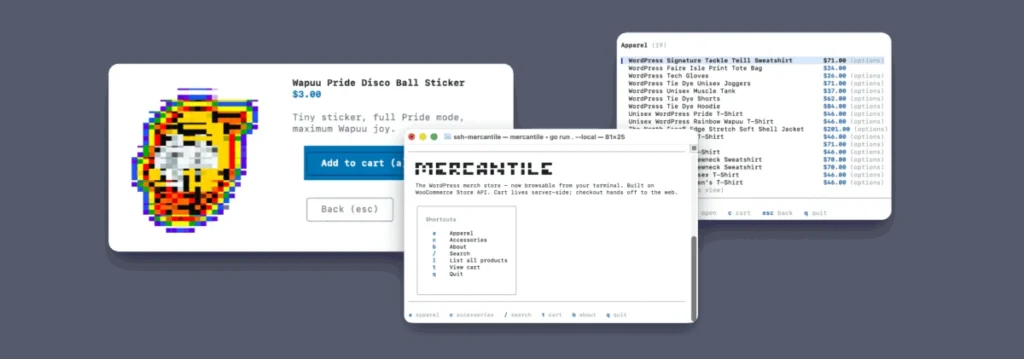
- Phase 4: Future-Proofing: Following the successful launch, the team has shifted focus to experimental features, including a command-line interface (CLI) version of the store for developers, signaling a continued commitment to the project’s roots.
Supporting Data and Technical Architecture
The new Mercantile stands as a technical benchmark for WooCommerce developers. By leveraging modern WordPress capabilities, the site avoids the "plugin bloat" often associated with e-commerce portals.
The Stack
The storefront is built almost entirely with blocks. This includes custom-coded theme blocks that allow for a granular level of control that standard templates simply cannot match.

The Interactivity API
One of the most significant technical advancements is the integration of the Interactivity API. This powers the catalog’s navigation and modal states, providing a snappy, app-like experience that avoids full-page reloads. This creates a perception of speed and fluidity that is essential for modern e-commerce conversion rates.
Accessibility and Inclusivity
The design team prioritized accessibility as a foundational requirement rather than an afterthought. The site honors user system preferences, including support for reduced-motion settings across all animations. Furthermore, the storefront meets stringent color contrast standards, ensuring that all users—regardless of visual ability—can navigate the catalog, read product specifications (such as material, size, and care instructions), and complete their purchases without friction.
Implications for the WordPress Community
The release of the new Mercantile serves as a high-visibility case study for the wider WordPress ecosystem. By demonstrating that a complex e-commerce site can be built entirely using core blocks and the Interactivity API, the project sets a precedent for developers and agencies globally.
Bridging the Gap Between Code and Culture
The design choices reflect a deep understanding of the WordPress user base. By hiding small "Easter eggs"—references to open-source concepts and code—the site fosters a sense of belonging among the developer community. The inclusion of the beloved mascot, Wapuu, in various UI elements serves as a reminder that even the most professional enterprise platforms can benefit from a touch of personality and project pride.
A Blueprint for Open Source Sustainability
The overarching purpose of Mercantile remains unchanged: every purchase directly supports the WordPress Foundation. As a 501(c)(3) nonprofit, the Foundation relies on these funds to continue its mission of democratizing publishing and preserving the open-source software that powers nearly half of the web. The redesign serves to increase the efficiency of this revenue stream, turning the store into a more effective engine for the Foundation’s long-term financial health.
Official Perspectives: The Team’s Vision
The project was the result of a collaborative effort involving designers, developers, and QA testers from across the global community. According to those involved, the goal was never just to create a "store." It was to create a digital space that felt uniquely, authentically WordPress.
"The new Mercantile is a reflection of where we are as a project," says one contributor close to the build. "We are maturing, we are embracing block-based design, and we are doubling down on accessibility and performance. But we aren’t losing the playful, open-source spirit that brought us here."

The focus on the "developer experience" is also intentional. The upcoming command-line version of the store is a nod to the fact that for many WordPress users, the terminal is their natural habitat. By providing a text-based, CLI-friendly interface, the project is showing that "swag" can be accessible even to those who prefer wp-cli over a graphical web browser.
Future Outlook: What Lies Ahead?
The evolution of Mercantile is an ongoing process. With the infrastructure now firmly in place, the team is exploring further optimizations. The "text-based store" is currently in the experimental phase, with subtle clues being prepared to guide curious users toward it once the project matures.
Furthermore, the integration of real-time inventory management and data-rich product pages has set a new standard for how the Foundation communicates product value. As the site continues to scale, it will likely serve as the primary testing ground for new features in the WooCommerce block ecosystem.
Conclusion
The new Mercantile is more than a destination for branded t-shirts and stickers. It is a bold, highly functional piece of software that serves as a testament to the power of the WordPress community. By marrying high-end technical architecture with a deep respect for the project’s history, the team has delivered a platform that is accessible, performant, and, above all, distinctly WordPress.
For the user, the shopping experience is now smoother, faster, and more engaging. For the contributor, it is a source of pride and a window into the future of site building. And for the WordPress Foundation, it is a robust tool that ensures the project’s mission remains sustainable for generations to come.
As the site continues to evolve with experimental features like the command-line storefront, it remains clear that Mercantile is not just selling products—it is curating the culture of the open web.