Seismic Shifts in Performance Marketing: PayPal Honey’s Network Expulsion and Five Vital Lessons for Affiliate Managers

By AM Navigator | Industry Analysis & Insights
It is not every week that a major affiliate publisher—let alone one backed by a tech behemoth like PayPal—is summarily removed from the top U.S. affiliate networks. Yet, that is precisely what unfolded in a historic week that sent shockwaves through the performance marketing industry.
Six years after PayPal completed its blockbuster $4 billion acquisition of the ubiquitous shopping and rewards browser extension Honey, PayPal Honey found itself on the outside looking in. Following a damning public exposé by content creator MegaLag and a rigorous technical investigation by digital marketing expert Ben Edelman, PayPal Honey was swiftly stripped from America’s two premier affiliate marketing environments: Rakuten Advertising and impact.com.
Coinciding precisely with the launch of Affiliate Summit West—the largest U.S. affiliate conference of the year—the news dominated both convention center hallways and social media feeds. For affiliate managers, brand executives, and digital strategists, the incident is more than just a high-profile corporate falling-out; it is a watershed moment that exposes systemic vulnerabilities in attribution modeling, partner compliance, and program management.
Main Facts: The Fall of a Giant
The rapid expulsion of PayPal Honey from top-tier networks centers on allegations of "attribution manipulation," link hijacking, and the intentional circumvention of "stand-down" protocols.
In the modern affiliate landscape, the vast majority of partner programs operate on a "last-touch-wins-all" attribution model. Under this rule, the entire financial commission for a consumer conversion is awarded to the final affiliate link or cookie encountered in the user’s clickstream prior to checkout.
Browser extensions like Honey sit uniquely at the end of the consumer funnel, often injecting themselves into the checkout process to offer coupon codes or cash-back incentives. To maintain a fair ecosystem, networks and merchants enforce strict "stand-down" rules. These protocols dictate that if a consumer arrived via an early-funnel affiliate (such as a content publisher, review site, or influencer), a browser extension must stand down—meaning it must refrain from firing its tracking pixel and overwriting the previous affiliate’s cookie.
According to investigative findings, PayPal Honey repeatedly violated these foundational terms by engaging in concealed stand-down violations. By forcibly overwriting earlier touchpoints, Honey allegedly claimed undeserved credit—and commission payouts—for conversions it did not genuinely generate. This practice not only defrauded merchants but systematically siphoned earnings away from the upstream content creators and niche publishers who initially drove consumer intent.
Chronology of Events: A Week That Shook the Industry
The unraveling of PayPal Honey’s network status occurred in rapid succession over a single business week in January, perfectly timed with the industry’s most critical annual gathering.
- Prior to January: Independent investigations by researcher Ben Edelman and technical YouTuber MegaLag brought mounting evidence of attribution manipulation and cookie-stuffing behaviors to light, putting pressure on network compliance boards.
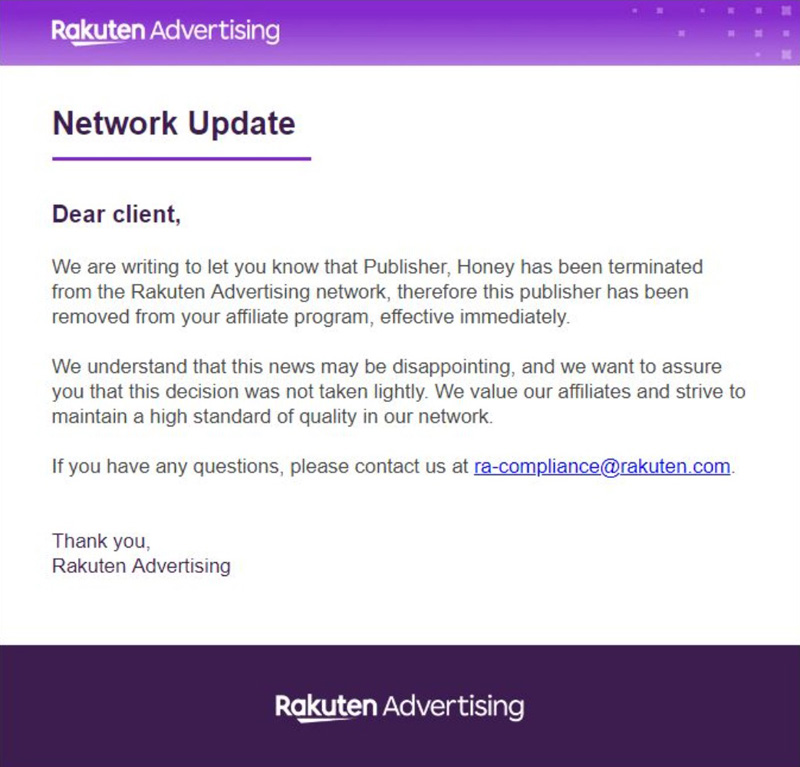
- Monday, January 12 (Day 1 of Affiliate Summit West): Rakuten Advertising dropped the first bombshell. In an official network announcement, Rakuten declared that Honey had been “terminated from the network,” framing the drastic move as a necessary step “to maintain a high standard of quality” across its ecosystem. The timing sent immediate ripples through Affiliate Summit West, instantly making "Rakuten" and "Honey" the most discussed topics of the conference.
- Friday, January 16: The regulatory wave continued as impact.com announced that Honey was found to be “out of compliance” with its platform policies. Consequently, impact.com removed Honey from its prominent “Discovery Marketplace.” Unlike Rakuten’s outright termination, however, impact.com implemented a temporary suspension, signaling that a path to remediation—subject to strict structural compliance—might remain open.
Official Responses and Network Enforcement
The language used by major network executives underscored the severity of PayPal Honey’s transgressions. Both Rakuten and impact.com emphasized that trust is the foundational currency of the partnership economy.

When impact.com announced its enforcement action, leadership explicitly cited "attribution manipulation" and behaviors that "undermine trust in the partnership economy" as the core catalysts for the suspension. The network’s swift action demonstrated a growing industry-wide intolerance for publishers who exploit technological grey areas at the expense of merchant ROI and partner equity.
For its part, Rakuten Advertising’s hardline termination sent a clear message that legacy network giants are increasingly willing to sacrifice short-term transaction volume to protect long-term platform integrity. Nevertheless, industry veterans note that these network-level actions, while impactful, often arrive long after violations have quietly drained marketing budgets.
Supporting Data and Industry Context
The Honey controversy does not exist in a vacuum; it highlights a broader, systemic crisis regarding how the digital marketing industry handles downloadable software publishers (DSPs) and cookie attribution.
To contextualize the technical challenges at play, industry bodies have recently intensified their scrutiny of early-funnel vs. late-funnel attribution. A comprehensive resource for understanding these dynamics is the Performance Marketing Association’s (PMA) benchmark document, Affiliate Network DSP Policies Comparison, which details how various networks police browser extensions.
Furthermore, a landmark independent audit conducted by The Affiliate & Partner Marketing Association (APMA) in the UK shed light on the pervasive nature of attribution discrepancies. The APMA audit evaluated thirty major brands across ten affiliate networks and three distinct affiliate categories, carefully examining the technical dividing line between strict "stand-down" rules and lenient "soft click" mechanics. The findings culminated in a 24-page report—Independent Audit of Attribution Rules in the UK Affiliate & Partner Marketing Industry—which provides seven concrete recommendations for reforming global attribution standards.
The data proves that attribution manipulation is not an isolated glitch, but an ongoing structural vulnerability that requires active, vigilant oversight from every brand operating an affiliate channel.
Implications: Five Vital Lessons for Affiliate Managers
As the dust settles on the PayPal Honey expulsion, affiliate program managers must reevaluate their oversight strategies. Relying on passive management is no longer viable. Based on decades of industry experience, program managers should apply five core lessons to safeguard their affiliate channels:
1. One Bad Apple Spoils the Entire Program
In affiliate marketing, the damage caused by a non-compliant publisher extends far beyond direct financial discrepancies. Modern affiliate programs rely heavily on attracting high-quality content creators, influencers, and product reviewers.
Savvy, rule-abiding affiliates routinely audit merchant programs using professional policing tools to see who else is on the roster. When premium publishers discover that a program actively partners with notorious last-cookie hijackers, they routinely refuse to join—or quietly halt their promotional efforts if they are already enrolled. Tolerating a single rule-violating publisher effectively poisons the well, alienating the exact partners your brand needs for sustainable growth.
2. Do Your Own Policing; Never Rely Solely on Networks
A robust Affiliate Program Agreement and clear Terms & Conditions (T&Cs) are mandatory baseline requirements. However, simply having legal terms in place does not automatically prevent bad behavior.
Once an affiliate applies and is approved, you possess the contractual right—and the ethical obligation—to enforce your rules. Crucially, affiliate managers must understand that network compliance departments monitor for violations of network-wide policies, not necessarily violations tailored to your specific brand guidelines. Over decades of managing high-volume programs, instances of networks looking the other way for too long are far too common. Because your brand reputation and bottom line are at stake, independent program-level policing must become an internal priority.
3. Master the Technical Details
Terms like "stand-down rules," "soft clicks," and "cookie-stuffing" are frequently debated, but how many affiliate managers truly understand the underlying mechanics of Downloadable Software Publishers (DSPs)?
When monitoring affiliate activity, surface-level oversight is insufficient. Managers must deeply comprehend the technical nuances of how browser extensions operate, how clickstreams are logged, and how attribution is triggered. Only by mastering these intricacies can a manager police their program intelligently, differentiating between legitimate utility tools and malicious attribution hijackers.
4. Avoid Extrapolations and Generalizations
A common overreaction during high-profile scandals is a blanket ban on entire classes of publishers. Just as responsible affiliate managers know that not all paid search affiliates engage in malicious trademark bidding, they must recognize that not all browser extensions violate stand-down protocols.
Historically, entire categories of publishers—such as loyalty sites, reward solutions, or closed user group (CUG) platforms—have been incorrectly lumped together with coupon-scraping or cookie-stuffing entities and summarily banned. Building on the previous lesson, managers must evaluate every publisher individually based on behavioral data rather than relying on lazy generalizations that stunt program growth.
5. Diversify Your Affiliate Base
Perhaps the most critical takeaway from the PayPal Honey debacle is a stress-test of basic channel health: If your affiliate program experiences a catastrophic drop in revenue simply because one browser extension was removed, your program was built on a flawed foundation.
A staggering number of affiliate program audits reveal an unhealthy "all-eggs-in-one-basket" syndrome, where 80% or more of all partner-driven revenue is concentrated among a handful of publishers, often belonging to the exact same category.
To build a resilient, future-proof affiliate marketing ecosystem, brands must actively diversify their recruitment pipelines. While traditional models focused on a narrow band of publishers, modern strategies should explore an expanded universe of partner types. Program managers should systematically evaluate and recruit across a broad spectrum of channels:
- Affinity groups
- Card-linked offers
- Charities and fundraisers
- Content producers
- Complementary brands
- Co-registration affiliates
- Coupons and deals
- Connected TV (CTV)
- Consultants and service providers
- Datafeed-driven websites
- Domainers
- Educators
- Email marketers
- Existing customers and brand advocates
- Loyalty affiliates (D2C websites and CUG solutions)
- Mass media opportunities
- Mobile-oriented affiliates
- Online communities and forums
- Paid search affiliates
- Pay-per-call publishers
- Podcasters
- Post-checkout solutions
- Ranking and review sites
- Retargeting and cart abandonment solutions
- Social media influencers
- Sub-affiliate networks
- Software/extensions
- Video marketers
Looking Ahead
The swift expulsion of PayPal Honey from Rakuten and impact.com marks the end of an era where major tech-backed extensions could operate above baseline compliance rules. It serves as a stark reminder that transparency, trust, and structural integrity are non-negotiable pillars of the partnership economy.
For brand leaders and affiliate managers, the path forward requires proactive auditing, rigorous enforcement of program terms, and an unwavering commitment to diversifying partner ecosystems. By treating this seismic event as a learning opportunity, brands can build healthier, fairer, and far more resilient affiliate programs designed to thrive in 2026 and beyond.