Bridging the Compute Gap: AWS Unveils Lambda MicroVMs for Stateful, Isolated Execution
In a significant expansion of its serverless ecosystem, Amazon Web Services (AWS) has announced the launch of AWS Lambda MicroVMs. This new compute primitive represents a fundamental shift in how developers handle multi-tenant applications and untrusted code execution. By leveraging the industry-hardened Firecracker virtualization technology—the same engine powering billions of monthly Lambda function invocations—AWS is providing a specialized environment designed for long-running, stateful, and highly isolated sessions.
This launch addresses a long-standing architectural dilemma: the trade-off between the security of virtual machines (VMs) and the agility of serverless functions. With Lambda MicroVMs, AWS aims to provide a "best of both worlds" solution, enabling developers to run user-generated or AI-produced code with the speed of serverless and the robust security isolation of a dedicated VM.
The Core Innovation: Why Lambda MicroVMs?
For years, software architects building platforms like AI coding assistants, interactive data science sandboxes, and vulnerability scanners have faced a "trilemma" of infrastructure. Traditional Virtual Machines offer ironclad security through hardware-level isolation, but their slow boot times create sluggish user experiences. Conversely, standard container environments offer rapid deployment but rely on shared-kernel architectures, which necessitate complex and brittle hardening measures to protect against malicious user-supplied code. Finally, traditional Functions-as-a-Service (FaaS) are built for fleeting, event-driven request-response cycles, making them ill-suited for the long-running, stateful sessions required by modern interactive applications.
Lambda MicroVMs resolve this by delivering a purpose-built environment. Each user session is encapsulated within its own dedicated MicroVM. Because these environments are managed by the Firecracker VMM (Virtual Machine Monitor), they ensure that no shared kernel or resource can be exploited between users. This creates a "sandbox-by-default" architecture that significantly reduces the engineering burden on developers who previously had to build and maintain custom virtualization infrastructure to achieve this level of security and performance.

Chronology of Development: From Firecracker to Production
The roots of this launch can be traced back to the open-sourcing of Firecracker in 2018. Designed specifically for serverless workloads, Firecracker was built to provide the security benefits of a VM with the low-overhead efficiency of a container. Since its inception, it has served as the backbone for the massive scale of AWS Lambda.
The journey to Lambda MicroVMs involved several critical technical milestones:
- The Snapshotting Breakthrough: The team developed a mechanism to take Firecracker snapshots of both memory and disk state. This allows a VM to be "paused" and "resumed" rather than "booted," effectively eliminating cold-start latency for stateful sessions.
- API Integration: Integrating this technology directly into the AWS Lambda console and CLI required creating a distinct API surface. This ensures that while MicroVMs exist within the Lambda ecosystem, they do not compromise the performance or behavior of standard Lambda functions.
- Developer Experience Optimization: The introduction of a workflow that mirrors modern container development—where a Dockerfile is used to define the image—was essential for adoption. By allowing developers to package their code as a zip artifact and letting AWS handle the snapshotting process, the service lowers the barrier to entry for complex virtualization.
Supporting Data and Technical Specifications
Lambda MicroVMs are not just a concept; they are a production-ready service with impressive technical capabilities. Available now in select regions, including US East (N. Virginia, Ohio), US West (Oregon), Europe (Ireland), and Asia Pacific (Tokyo), the service offers:
- Compute Power: Support for up to 16 vCPUs and 32 GB of memory per MicroVM.
- Storage: 32 GB of disk space, facilitating large datasets or model-heavy AI applications.
- Lifecycle Management: Advanced idle policies allow for automated suspension after a configured duration (e.g., 15 minutes of inactivity), significantly reducing costs while ensuring the environment remains "warm" and ready for the next request.
- Lifecycle Persistence: MicroVMs support up to 8 hours of total runtime, making them ideal for long-running data analytics tasks or complex compilation processes.
The "image-then-launch" model is the technical cornerstone of the system. When a developer creates a MicroVM image, AWS retrieves the code, executes the Dockerfile, and initializes the application. It then captures the precise state of the environment, storing it as a snapshot. When a user requests access, the environment is restored from this snapshot, allowing the application to be "live" from the very first millisecond of the session.

Official Perspectives: The Developer Experience
AWS emphasizes that Lambda MicroVMs are intended to complement, not replace, traditional Lambda functions. During the internal pilot phases, developers reported that the ability to maintain state across interactions changed the fundamental design of their applications.
"We wanted to remove the friction for developers building the next generation of AI-driven applications," says an AWS spokesperson. "By handling the snapshotting, security, and infrastructure management, we are letting developers focus on their core product logic rather than worrying about kernel-level isolation or the nuances of virtualized hardware."
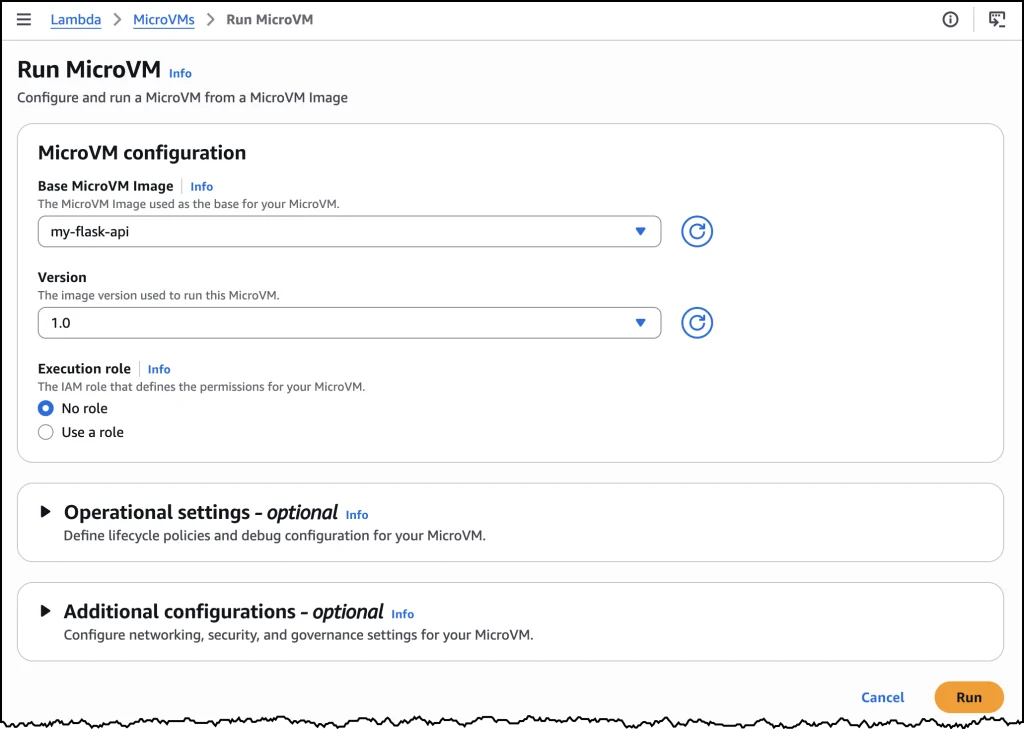
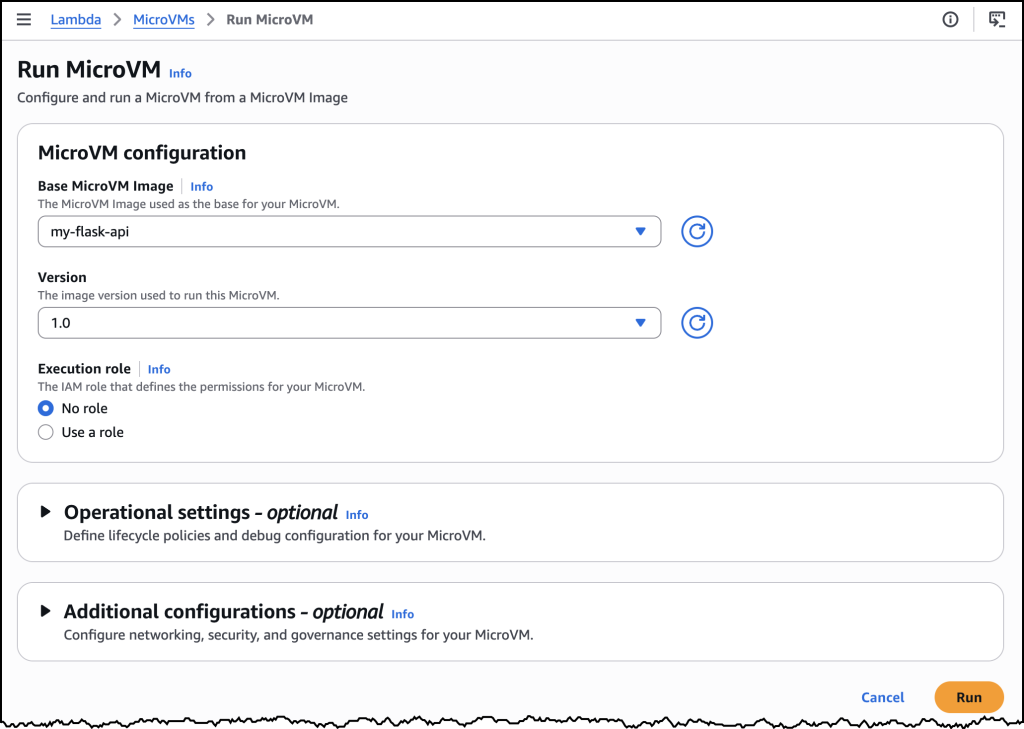
For those transitioning from containers, the process is familiar. The CLI allows for intuitive deployment:
aws lambda-microvms create-microvm-image
--code-artifact uri=<path/to/s3/artifact.zip>
--name <VM_image_name>
--base-image-arn arn:aws:lambda:us-east-1:aws:microvm-image:al2023-1
This command triggers the build process in the cloud, with logs streaming directly to Amazon CloudWatch. Once initialized, the run-microvm command provides an endpoint, effectively abstracting away the underlying networking and virtualization configuration.

Implications for the Future of Serverless
The release of Lambda MicroVMs has profound implications for several fast-growing sectors of the technology industry:
1. The Rise of "AI-Native" Applications
AI coding assistants and LLM-powered agents often need to execute code locally to verify results or test assumptions. Lambda MicroVMs provide a safe, isolated, and fast way to run this generated code. Because the environment is stateful, an agent can "remember" variables or data structures from previous steps, facilitating more complex multi-step reasoning.
2. Democratizing Secure Multi-Tenancy
Small startups and individual developers can now build platforms that provide "dedicated environments" for their end users without needing a team of infrastructure engineers. This levels the playing field, allowing smaller players to offer the same level of security as enterprise-grade platforms.
3. Efficiency and Sustainability
The "suspend-and-resume" capability is a win for both cost-efficiency and sustainability. By allowing environments to enter a low-power, suspended state when not in use, AWS is helping users reduce their cloud footprint. The ability to automatically resume when traffic arrives ensures that users don’t perceive the "pausing" of the underlying infrastructure, maintaining a seamless user experience.
4. A Shift in Architecture
We are likely to see a shift toward hybrid serverless architectures. Developers will continue to use standard Lambda functions for asynchronous, event-driven tasks—such as processing a webhook or resizing an image—while routing compute-intensive, state-dependent, or untrusted code execution to Lambda MicroVMs. This modularity allows for a more granular approach to infrastructure design, where each part of the stack is optimized for its specific workload.
Conclusion
AWS Lambda MicroVMs represent a maturation of the serverless model. By moving beyond the limitations of the traditional request-response cycle and addressing the critical need for isolated, stateful environments, AWS has provided a powerful new tool in the developer’s arsenal. Whether it is powering the next breakthrough in AI coding assistants or enabling secure data analytics for untrusted datasets, Lambda MicroVMs effectively remove the friction that has historically separated the convenience of serverless from the robustness of virtual machines. As the service rolls out globally, it is set to become an essential component for any platform that handles user-generated or dynamic code in the cloud.