Silencing the Signal: How India’s New Telecom Laws and Persistent Internet Shutdowns Collide with Democratic Dissent
Introduction
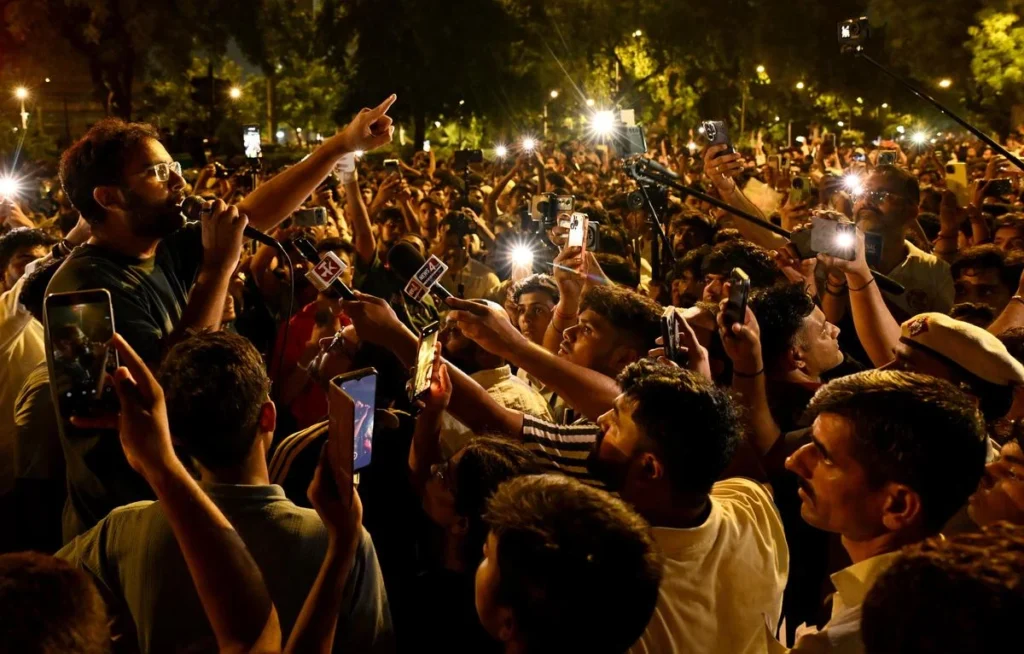
On July 21, 2026, the opening day of the Monsoon Session of Parliament, Central Delhi became the epicenter of both intense political mobilization and a digital communications blackout. Thousands of demonstrators, mobilized under the banner of the Cockroach Janta Party (CJP) and led by spokesperson Ashutosh Ranka, converged on Jantar Mantar for the "Chalo Sansad" protest. Their primary demand was the immediate resignation of Union Education Minister Dharmendra Pradhan, following a series of high-profile examination paper leaks associated with the National Eligibility and Entrance Test (NEET).
However, as the crowds swelled, a familiar administrative countermeasure was deployed: a localized but highly disruptive shutdown of mobile internet services. The blackout, which lasted until late evening, was accompanied by the deployment of signal jammers, severely limiting the ability of protesters, journalists, and bystanders to communicate, coordinate, or access basic digital services.
The incident has reignited a fierce national debate over the legality, proportionality, and systemic transparency of internet shutdowns in India. While the government defends these measures as essential for public safety and the prevention of civil unrest, digital rights advocates—including the Internet Freedom Foundation (IFF) and the Software Freedom Law Centre, India (SFLC)—argue that such actions systematically choke democratic dissent and violate constitutional guarantees.
Main Facts: The Central Delhi Shutdown and the ‘Chalo Sansad’ Protest
The "Chalo Sansad" rally was organized to channel public anger over recurring administrative failures in national competitive examinations. NEET, the gateway for undergraduate medical admissions in India, has been mired in controversy due to systemic paper leaks, prompting widespread student-led protests. As protesters marched toward Parliament, the Ministry of Home Affairs (MHA) executed a targeted digital blockade.
Technical and Administrative Execution
According to industry sources, the suspension order was enforced across approximately 150 cell sites in and around Central Delhi. Protesters and journalists on the ground reported an immediate drop in signal strength, rendering mobile data services entirely unusable.
In addition to cellular data suspension, authorities reportedly deployed tactical signal jammers. This dual approach prevented users from:
- Uploading real-time video documentation of the protests and police action.
- Accessing GPS and navigation applications to navigate the heavily barricaded streets of the capital.
- Accessing encrypted messaging applications to coordinate movement.
The Legal Basis of the MHA Order
The official suspension order, subsequently accessed by media outlets, was issued by the Ministry of Home Affairs. Unlike previous local shutdowns that relied on archaic colonial-era legislation, this order was formally issued under Clause (b) of Sub-section (2) of Section 20 of the Telecommunications Act, 2023, read alongside the newly enacted Telecommunications (Temporary Suspension of Services) Rules, 2024. The MHA justified the shutdown by citing the necessity of "maintaining public safety, preserving public order, averting a public emergency, and preventing the incitement of offences."
Chronology: The Evolution of India’s Internet Shutdown Laws
The legal framework governing state-sponsored communication blackouts in India has undergone a major structural overhaul over the last decade. Understanding the current controversy requires tracing the transition from colonial-era regulations to modern statutory frameworks.
[1885] Indian Telegraph Act (Sec 5(2)) -> [2017] Temporary Suspension Rules -> [2020] Anuradha Bhasin Judgment -> [2023/24] Telecommunications Act & New Rules1. The Era of the Telegraph Act (1885–2023)
For over a century, the Indian government relied on Section 5(2) of the Indian Telegraph Act, 1885, to intercept messages and suspend telecom services. In 2017, the executive formalized this power by notifying the Temporary Suspension of Telecom Services (Public Emergency or Public Safety) Rules, 2017. Under these rules, shutdowns could be ordered by the Union Home Secretary or State Home Secretaries during public emergencies.
2. The Anuradha Bhasin Landmark Ruling (2020)
In the historic case of Anuradha Bhasin v. Union of India, filed in the wake of the indefinite internet blockade in Jammu & Kashmir following the abrogation of Article 370, the Supreme Court of India delivered a landmark ruling. The Court declared that:
- Freedom of speech and expression (Article 19(1)(a)) and the right to carry on any trade or business (Article 19(1)(g)) over the medium of the internet are constitutionally protected.
- Indefinite suspensions of internet services are illegal.
- Any shutdown order must satisfy the principles of necessity and proportionality.
- All suspension orders must be published to allow for judicial review.
- A multi-member Review Committee must assess any suspension order within five working days of its issuance.
3. The Legislative Shift: The Telecommunications Act, 2023
In late 2023, the Parliament enacted the Telecommunications Act, which officially replaced the Indian Telegraph Act of 1885. Section 20(2)(b) of the new Act became the primary statutory tool for suspending telecom services, supported by the updated Telecommunications (Temporary Suspension of Services) Rules, 2024.

Under the 2024 Rules, a suspension order:
- Must be written, reasoned, and published.
- Must be limited in geographic scope and duration.
- Cannot remain in force for more than 15 days.
4. Ongoing Jurisdictional Deviations and Bypasses (2024–2026)
Despite the implementation of the 2024 Rules, a review by the Digital Defenders Network revealed that several state governments have systematically bypassed the new procedural safeguards. By continuing to cite the defunct 1885 Act and the 2017 Rules, states have avoided the stricter accountability standards of the new regime:
- Manipur (June 7, 2025): The State’s Home Department suspended mobile data, VSAT, and VPN services, relying entirely on the outdated 2017 Rules.
- Uttar Pradesh (October 2, 2025): The Home Department issued an internet suspension order for the Bareilly district, invoking Section 7 of the legacy Telegraph Act.
Supporting Data: India’s Position as a Global Leader in Digital Blackouts
Despite boasting one of the world’s largest and cheapest mobile data markets, India consistently leads democratic nations in the frequency and duration of state-mandated internet shutdowns.
SFLC and Access Now Statistical Overview
According to global web rights advocacy group Access Now and the tracker maintained by the Software Freedom Law Centre, India (SFLC), the reliance on digital blackouts remains high:
| Metric / Region | Data Point | Source / Context |
|---|---|---|
| Global Standing | Highest number of shutdowns in a democracy | Access Now annual reports |
| Total Shutdowns (2025) | 65 shutdowns across 12 States & UTs | Access Now 2025 Report |
| Total Shutdowns (2026) | 24 shutdowns (as of July 22, 2026) | SFLC Tracker |
| Jammu & Kashmir | 449 shutdowns (since 2012) | Historical Leader |
| Rajasthan | 115 shutdowns (since 2012) | Often used to prevent exam cheating |
| Manipur | 62 shutdowns (since 2012) | Protracted ethnic and civil unrest |
While the total number of shutdowns in 2025 (65) represents a slight decline from the historic peaks of previous years, civil society groups emphasize that the geographic concentration and duration of these shutdowns continue to raise serious civil liberties concerns.
Official Responses and Legal Perspectives
The deployment of internet shutdowns during peaceful political assemblies has drawn sharp criticism from legal scholars, human rights advocates, and industry groups, contrasted against the government’s stated security objectives.
The Civil Society and Legal Critique
Prominent advocate and founder of the Internet Freedom Foundation (IFF), Apar Gupta, challenged the legal validity of the Central Delhi shutdown.
"A protest, by itself, is not a lawful ground for suspending Internet services. Under Section 20(2) of the Telecommunications Act, 2023, a suspension may be ordered only during a public emergency or in the interest of public safety, and only for specified purposes such as maintaining public order. The order must be reasoned, published, limited in area and duration, and issued by the competent authority under the Telecommunications Suspension Rules, 2024. The government must also consider whether less restrictive measures would be sufficient."
— Apar Gupta, Advocate & Founder, IFF
Gupta also raised concerns regarding the legal ambiguity surrounding the deployment of signal jammers. He noted that the authority to implement network jamming is frequently exercised and claimed by local police departments under broad, non-specific criminal law provisions, bypassing the structured oversight of telecom suspension rules.
Demands for Transparency and Accountability
The Software Freedom Law Centre, India (SFLC), issued a strong public statement emphasizing that the non-publication of shutdown orders constitutes a direct violation of both statutory rules and Supreme Court directives.

"The publication of such Internet suspension orders is necessary and mandatory for ensuring transparency, accountability and proportionality, as required by Rule 3(2) of the Telecommunications (Temporary Suspension of Services) Rules, 2024, read with Section 20(2)(b) of the Telecommunications Act, 2023. The law states that each order is not only required to be published but should also include crucial details such as the date, time, duration, and the specific area where the suspension will be in effect."
— SFLC Press Statement
The Executive Justification
In contrast, officials from the Ministry of Home Affairs and law enforcement agencies argue that localized internet shutdowns are a necessary preventive measure. In highly charged political atmospheres, such as the NEET protest in Central Delhi, authorities assert that the rapid spread of unverified rumors, deepfakes, and coordinate mobilization via social media can quickly turn a peaceful demonstration into a violent riot. From the state’s perspective, temporary digital disruptions are a non-lethal, effective tool to preserve public safety and protect critical infrastructure like the Parliament.
Implications: The High Cost of Digital Blackouts
The recurring use of internet shutdowns as a first-line administrative tool carries profound implications for India’s economy, democratic institutions, and international reputation.
                 ┌──────────────────────────┐
                 │    Internet Shutdown     │
                 └─────────────┬────────────┘
                               │
         ┌─────────────────────┼─────────────────────┐
         ▼                     ▼                     ▼
┌─────────────────┐   ┌─────────────────┐   ┌─────────────────┐
│ Economic Loss   │   │  Legal Deficit  │   │  Human Rights   │
│ • UPI failures  │   │ • Bypassing law │   │ • Free speech   │
│ • Gig-work halts│   │ • No publication│   │ • Information   │
└─────────────────┘   └─────────────────┘   └─────────────────┘
1. Economic Disruptions in a Cashless Society
India has aggressively promoted its Digital Public Infrastructure (DPI), with millions of citizens relying on the Unified Payments Interface (UPI) for daily transactions.
- Gig Economy Impacts: Delivery partners, ride-hailing drivers, and street vendors are completely paralyzed when cellular networks are suspended.
- Business Losses: Even a localized shutdown in Central Delhi halts commercial activity, prevents digital transactions, and disrupts the operations of corporate offices located within the affected cell sites.
2. The Erosion of Constitutional Rights
The Supreme Court’s recognition of internet access as a conduit for Articles 19(1)(a) and 19(1)(g) means that every arbitrary shutdown is a prima facie violation of fundamental rights. When citizens cannot access the internet, they are denied the ability to:
- Report on police actions or state overreach.
- Access emergency medical services or contact family members.
- Exercise their right to assemble peacefully with digital coordination.
3. Systematic Bypassing of the Rule of Law
Perhaps the most concerning trend is the administrative reluctance to adhere to judicial and statutory mandates. Data from the Oxford Human Rights Hub reveals that between 2020 and 2024, a majority of state governments consistently failed to publish their shutdown orders.
By failing to publish these orders and continuing to invoke the repealed 1885 Telegraph Act, state administrations effectively shield their actions from judicial scrutiny. If an order is not public, it cannot be easily challenged under Article 226 in High Courts or Article 32 in the Supreme Court, creating a legal vacuum where executive overreach can thrive unchecked.
As India navigates the implementation of the Telecommunications Act, 2023, the clash during the "Chalo Sansad" protest highlights a critical systemic challenge: balancing the state’s duty to maintain public order with its constitutional obligation to protect the digital rights of its citizens.