Global Open-Source Education: How WordPress Initiatives Are Empowering Students Across Four Continents
By Global Education & Technology Desk
Published: September 2026
Main Facts
In an era where digital literacy dictates economic mobility, global education initiatives spearheaded by the open-source community are bridging the digital divide in unprecedented ways. Throughout July, the WordPress Campus Connect and WordPress Credits programs scaled new heights, engaging thousands of students across Bangladesh, Uganda, Costa Rica, Spain, Japan, and beyond.
Most notably, students at two distinct campuses in Kishoreganj, Bangladesh, constructed 108 fully functional websites within a frantic two-week window. Concurrently, the WordPress Credits program—which places students in mentored internships where they contribute directly to the core software while earning academic credit—surpassed 226 graduates in July alone, up from 199 in June. The initiative now operates across 38 partner institutions in 16 countries.
Operating entirely free of charge for participants, these programs offer an alternative to traditional, cost-prohibitive tech bootcamps. By leveraging a shared global curriculum, localized volunteer networks, and open-source infrastructure like WordPress Playground and AI-assisted tools, students with zero prior coding experience are rapidly transforming into digital creators, open-source contributors, and community leaders.
Chronology: A Month of Global Expansion
The momentum behind July’s educational milestones unfolded through a series of remarkable, localized events spanning multiple time zones and infrastructural challenges:

- Early July (Kishoreganj, Bangladesh): Organizer Muhibul Haque spearheaded the Campus Connect series. In the first session at Kishoreganj University, students built 38 sites. Two weeks later, at the Kishoreganj Polytechnic Institute—where guest speaker Shipon Karmakar traveled over 80 kilometers to attend—students built nearly 70 additional websites, bringing the regional total to over 108 sites.
- Mid-July (Mataró, Spain): Josep Morán conducted two intensive four-hour sessions for 100 vocational students at Escola Pia Sta. Anna. Utilizing WordPress Playground and AI integration, students engineered a functional plugin designed to calculate optimal shore-fishing times for the local municipality.
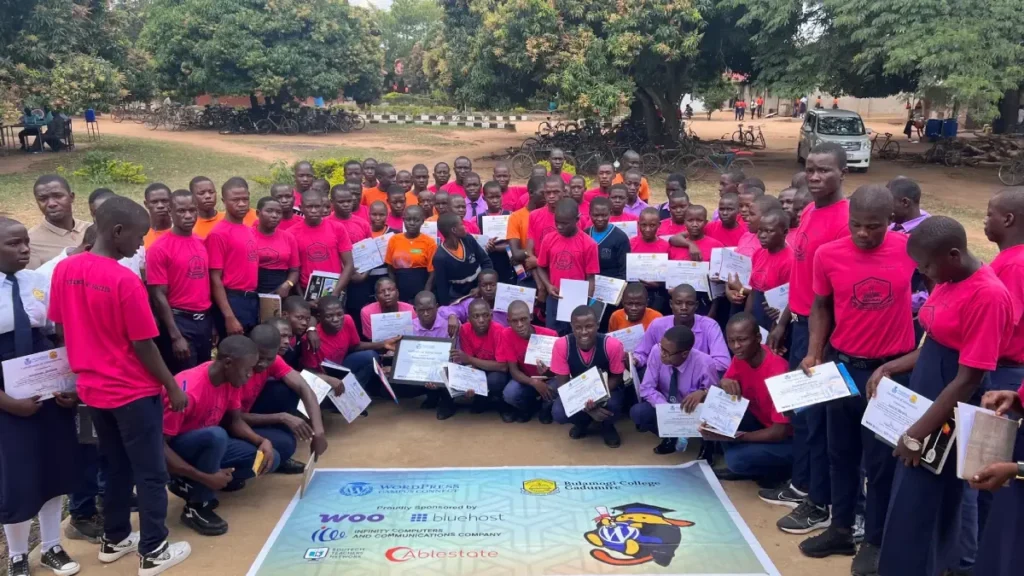
- July 29 (Kaliro, Uganda): At Bulamogi College Gadumire, a highly anticipated workshop faced a sudden infrastructure hurdle: an unexpected total lack of electricity. Thanks to the determination of former student and organizer Mariam Nairuba, the workshop pivoted into an interactive Q&A session, engaging over 100 learners on the fundamentals of web security, free software, and development careers.
- Late July (Costa Rica): Rita Robles Loaiza coordinated two milestone pilots. First, three students from Universidad Fidélitas delivered a WordPress workshop to 40 high school girls at the Patrones Hermosos STEM camp. Second, 13 students at Liceo Experimental Bilingüe José Figueres Ferrer began translating WordPress into the regional Costa Rican Spanish (
es_CR) dialect as part of their community service requirements. - August 2026: The release of the official Monthly Education Buzz Report for July 2026 highlighted additional international achievements, including a student-led Campus Connect event at the Kyoto University of Advanced Science in Japan and a newly formed Student Club in Dhaka, Bangladesh, organizing its own campus events.
Supporting Data and Program Metrics
The quantitative growth of the WordPress Education ecosystem underscores its scalability and institutional appeal:
- Website Production: 108 websites built in two weeks across two Kishoreganj campuses (Bangladesh).
- Graduate Milestone: 226 total graduates in the WordPress Credits internship program as of July, reflecting a month-over-month increase of 27 graduates.
- Global Footprint: 38 active partner educational institutions spread across 16 countries.
- Workshop Reach: Over 100 learners engaged per session in resource-constrained environments like eastern Uganda, and 100 vocational students trained in Spain.
- Demographic Targeting: 40 high school girls reached in Costa Rica to boost female participation in STEM disciplines.
- Market Share Context: Contributions directly feed into software that currently powers over 40 percent of the entire web, giving student resumes unmatched real-world weight.
Official Responses and Participant Perspectives
The success of these initiatives relies heavily on the grassroots dedication of local volunteers, alumni, and institutional leaders who view open-source education as a vehicle for social transformation.
When faced with a blacked-out classroom at Bulamogi College Gadumire in Uganda, the response from organizers and students alike redefined resourcefulness. Rather than canceling the event, volunteers Moses Ssebunya, Mariam Nairuba, and John Wayera turned the blackboard into an interactive dialogue.
"The room exploded," organizers noted in their official day-one recap.
Students eagerly inquired whether WordPress was genuinely free, how cybersecurity protocols functioned, and whether rural African students could realistically aspire to become global software developers. John Wayera diligently transcribed every question onto the blackboard, preserving an energetic exchange that culminated in the Head Teacher accepting a Certificate of Appreciation before the school’s governing body.

In Costa Rica, the philosophy of "students teaching students" yielded equally profound feedback. Rita Robles Loaiza, reflecting on the Universidad Fidélitas pilot, emphasized the multiplier effect of peer-led education:
"The students who have just mastered these tools are uniquely positioned to demystify them for the next cohort. They speak the same language, understand the same hurdles, and prove that success is immediately attainable."
European participants echoed similar sentiments. In Mataró, Spain, faculty and vocational students at Escola Pia Sta. Anna highlighted two primary takeaways from Josep Morán’s sessions: the formal certificates they earned, and the direct alignment between the skills learned and the actual job vacancies in their local economies.
Implications for the Future of Tech Education
The rapid expansion of WordPress Campus Connect, WordPress Credits, and institutional Student Clubs points toward a broader paradigm shift in global technology education. Traditional, top-down educational models often struggle to keep pace with the rapidly evolving digital economy, particularly in developing regions or underfunded rural districts.
1. Democratizing Access Through Open Source
By removing financial barriers, these programs democratize high-level tech skills. Students in Kishoreganj, Kaliro, and Mataró gain access to the same foundational knowledge—content management systems, version control logic, and basic code literacy—as their peers in major tech hubs like San Francisco, London, or Tokyo.

2. Peer-to-Peer Learning Models
The Costa Rican model, where university interns train high school students who subsequently give back through localized translations (es_CR), demonstrates a sustainable, self-replicating educational loop. This framework reduces reliance on external funding and empowers local communities to maintain educational momentum independently.
3. Bridging Theory and Employment
Unlike theoretical computer science curricula that can sometimes feel disconnected from the job market, WordPress training addresses immediate regional economic needs. Whether building local business directories in Bangladesh, developing practical municipal plugins in Spain, or localizing software infrastructure in Central America, students leave with verifiable digital assets—live websites, contributed code patches, and recognized certifications—that enhance their long-term employability.
4. Cultivating Global Open-Source Citizens
Through the WordPress Credits program, learners are not merely consumers of educational content; they are active contributors to global infrastructure. By helping maintain software that powers over 40% of the internet, these students develop a profound sense of global digital citizenship, proving that talent is universally distributed, even if opportunity historically has not been.
As the WordPress Education initiative continues to scale through its tripartite structure—Campus Connect for workshops, WordPress Credits for mentored internships, and Student Clubs for long-term campus engagement—the blueprint for accessible, community-driven technical education is clearer than ever. With upcoming institutions already slated for enrollment and international chapters multiplying month over month, the open-source community is quietly rewriting the rules of global tech literacy.