Beyond the Black Box: Mastering Model Interpretability for Modern AI Deployment
In the rapidly evolving landscape of artificial intelligence, a dangerous disconnect has emerged: we are building models that are increasingly accurate at predicting complex outcomes, yet we are simultaneously losing the ability to explain why those predictions occur. For data science teams, a high-performing model that cannot be explained is no longer just a technical curiosity—it is a liability.
Whether it is a churn prediction algorithm misclassifying a loyal, long-term customer as a flight risk or a credit-scoring model denying a loan without a clear rationale, the "black box" problem is hitting a wall. With the implementation of the EU AI Act’s Article 13, transparency is no longer a "nice-to-have" research topic; it is a regulatory mandate. Organizations must now provide sufficient clarity to deployers, auditors, and customers to justify the outputs of high-risk AI systems.
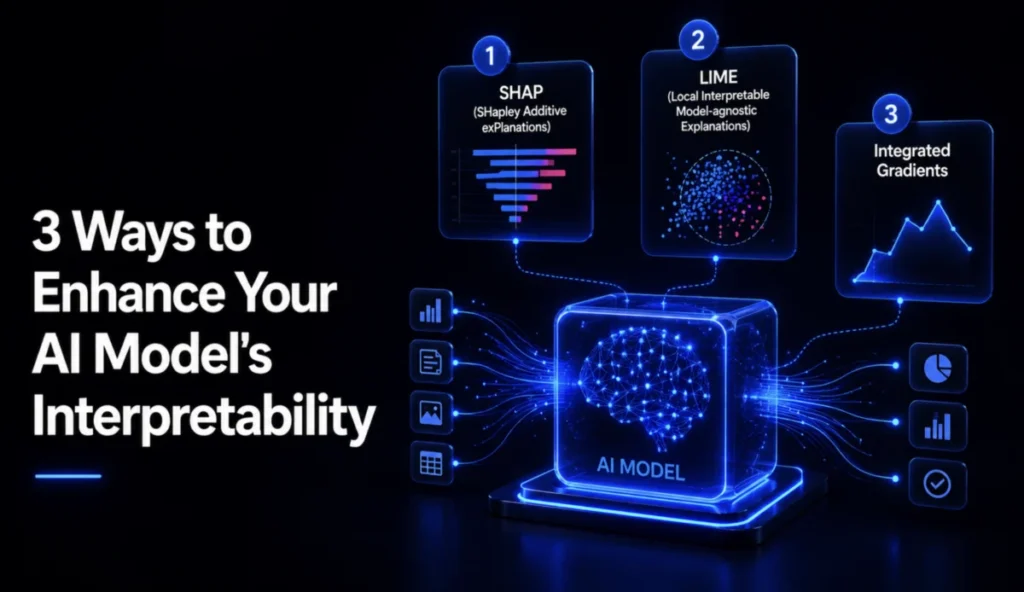
This article explores three concrete, industry-standard techniques—SHAP, LIME, and Integrated Gradients—that allow practitioners to peel back the layers of model logic, moving from opaque predictions to defensible, transparent insights.
The Definition of Interpretability: Untangling the Confusion
Model interpretability is the degree to which a human can understand the reasoning behind a specific machine learning output. It is vital to distinguish between two often-conflated concepts: Global Interpretability and Local Interpretability.
- Global Interpretability: Understanding the overall behavior of the model. This answers the question, "What features does the model consider most important across the entire dataset?"
- Local Interpretability: Understanding individual predictions. This answers, "Why did this specific customer receive this specific risk score?"
The traditional "quick fix"—the feature_importances_ attribute in libraries like scikit-learn—only offers a glimpse of global importance. While useful for high-level feature selection, it fails to explain individual outcomes and is often biased toward high-cardinality features. To meet modern standards, we must look beyond these rudimentary attributes.
Chronology of Methodology: From Heuristics to Formal Theory
Historically, data science relied on linear models where coefficients were directly interpretable. As the industry moved toward ensemble methods (like Gradient Boosting) and deep neural networks, the direct link between input and output was severed.
The evolution of interpretability tools has followed this shift:
- Early Era (2000s–2015): Reliance on simple feature importance rankings.
- The Rise of Model-Agnostic Tools (2016–2018): The introduction of LIME provided a way to explain any model by approximating local behavior.
- The Rigorous Era (2017–Present): The formalization of SHAP (based on cooperative game theory) and Integrated Gradients (leveraging the calculus of neural networks) provided the mathematical rigor required for high-stakes, regulated environments.
Supporting Data: The Churn Case Study
To test these methods, we utilize a synthetic customer churn dataset. Our churn model—a gradient-boosted tree—is trained on features such as tenure_months, monthly_charge, support_tickets, contract_is_monthly, and late_payments.
The Baseline Reality
Our model achieves a test accuracy of 69.8% against a 36.8% churn baseline. By using a controlled dataset where the "true" churn logic is known (short tenure + month-to-month contracts + high support ticket volume), we can verify if our interpretability tools are actually detecting the underlying signal or simply providing noise.
Method 1: SHAP (SHapley Additive exPlanations)
SHAP is grounded in cooperative game theory. It treats each feature as a "player" in a game and computes their "fair share" of the payout (the prediction) by averaging marginal contributions across all possible combinations.
- The Power of SHAP: Unlike traditional methods, it provides a unified approach for both global and local explanations.
- Practical Application: When analyzing a customer with 53 months of tenure but 5 recent support tickets, SHAP reveals that while tenure is generally protective, the
support_ticketsfeature contributes +2.81 to the churn log-odds, effectively overriding the tenure benefit. This provides a defensible, mathematical justification for an 89.5% risk score.
Method 2: LIME (Local Interpretable Model-agnostic Explanations)
LIME operates by generating a "cloud" of perturbed data points around a single input. By observing how the model reacts to these slight variations, LIME fits a simple, interpretable linear model to that specific local neighborhood.
- The Advantage: LIME is "model-agnostic," meaning it works on anything—from a random forest to a complex API output.
- The Trade-off: Because it relies on sampling, LIME lacks the perfect mathematical stability of SHAP. However, it is significantly faster, making it the preferred choice for real-time systems with tight latency constraints.
Method 3: Integrated Gradients (For Neural Networks)
When working with differentiable architectures like neural networks, we can do better than treating the model as a black box. Integrated Gradients calculates the integral of the gradients of the model’s output with respect to the input features along a path from a baseline (e.g., a "zeroed-out" or "average" customer) to the actual input.
- The Precision: It provides a path-based attribution that satisfies the axiom of "completeness"—the sum of the attributions equals the total difference between the model output and the baseline.
- Verification: Using a "convergence delta," practitioners can verify if their attribution calculation is numerically sound. A delta near zero acts as a built-in quality control for the explanation.
Official Responses and Regulatory Implications
Regulatory bodies, including the EU and various financial oversight agencies, are increasingly adopting the stance that "I don’t know why it did that" is an unacceptable answer for high-stakes automated decisions.
Under the EU AI Act, developers of "high-risk" systems must ensure that:
- Transparency is built-in: The system must allow users to understand how the model reaches its decisions.
- Accountability is maintained: There must be a clear audit trail linking input variables to the decision-making logic.
Companies that fail to integrate these interpretability layers into their MLOps pipelines risk being barred from deploying in European markets or facing severe financial penalties. The move toward "Explainable AI" (XAI) is not merely a technical upgrade; it is a fundamental requirement for maintaining the "license to operate" in a digital society.
Strategic Recommendations: Which Method to Choose?
Choosing the right tool depends on your infrastructure and your constraints:
- Choose SHAP if you are working with tree-based models and require rigorous, mathematically consistent explanations that hold up under audit.
- Choose LIME if you are operating under severe latency constraints or need a quick-and-dirty explanation for a legacy system where you have no access to the model’s internals.
- Choose Integrated Gradients when your model is a neural network. It is the only method that respects the internal structure of the model, providing the most accurate attribution for deep learning architectures.
Conclusion
The traditional feature-importance score is a relic of a simpler era. It provides a static snapshot that fails to capture the dynamic, nuance-heavy nature of modern AI predictions. By adopting SHAP, LIME, and Integrated Gradients, data science teams can move away from the "black box" stigma and toward a model of transparency and trust.
In the churn example provided, the agreement across these three disparate techniques serves as a powerful signal: when game theory, local surrogate modeling, and gradient-path integration all point to the same driver of churn, you can be confident that your model is reflecting reality. Building this level of rigor into your deployment pipeline is the most important step you can take toward responsible, scalable, and defensible artificial intelligence.