Decoding the Black Box: A New Framework for Measuring and Maximizing AI Search Performance
The metrics that digital marketers have relied upon for decades to gauge search engine success are undergoing a seismic shift. As generative artificial intelligence (AI) and Large Language Models (LLMs) fundamentally rewrite how users discover information, products, and services, traditional key performance indicators (KPIs) like keyword rankings and organic traffic are no longer sufficient.
However, according to industry experts, the nascent industry of AI search measurement is falling into a dangerous trap: substituting superficial visibility metrics for genuine business performance.
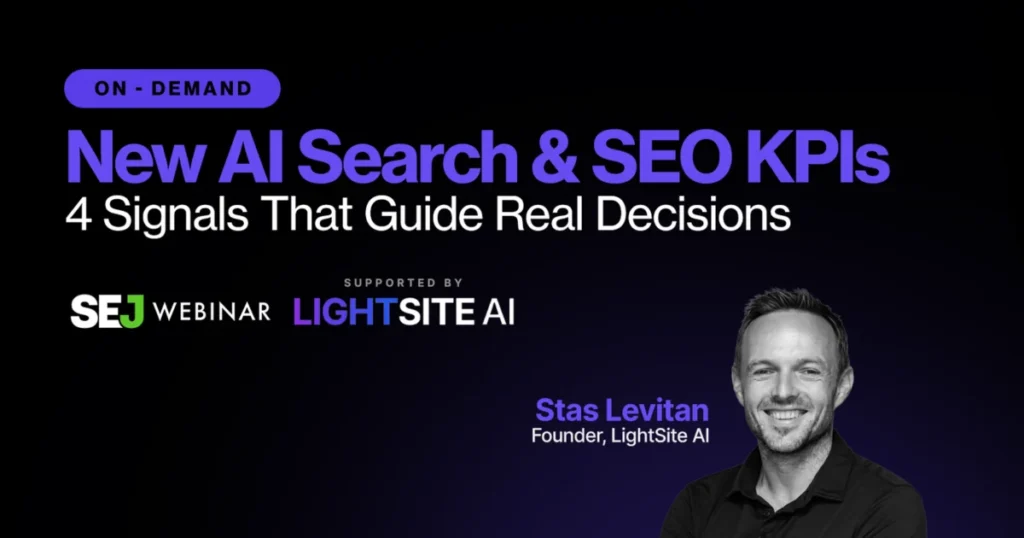
In a comprehensive on-demand webinar hosted by Search Engine Journal (SEJ) founder Loren Baker, alongside Stas Levitan, Founder of LightSite AI, marketing professionals were introduced to a performance-focused approach to AI search measurement. Drawing on extensive data analysis of bot and human referral patterns across hundreds of websites, the session established a critical distinction between benchmark data and performance data.
This article explores the core insights, chronological evolution, supporting data, strategic implications, and expert answers from the session, providing marketers with a blueprint to transition from passive AI visibility tracking to proactive, revenue-driven SEO decision-making.
1. Main Facts: The Illusion of AI Visibility and the Four-Signal Solution
The primary thesis of the recent SEJ webinar is straightforward: AI search visibility is dangerously easy to measure badly.
Metrics such as brand mentions, citations, share of voice, and sentiment scores can illustrate where a brand appears within an LLM-generated response. However, these metrics fail to diagnose underlying technical flaws, inform content strategy, or guide capital allocation. They show what an AI model might do in a simulated environment, but they fail to reveal what is actually happening on a live website.
The Benchmark Trap
Many mainstream AI visibility tools simulate specific prompts to track how often a brand is referenced. While this offers helpful directional trends for competitive benchmarking, Levitan warns that marketing teams are asking these tools to carry more weight than they can structurally support.
AI-generated answers are inherently contextual, dynamic, personalized, and variable. Relying solely on simulated prompts can cultivate false confidence, misallocating budgets toward content creation and optimization strategies that fail to generate actual market demand.
The Four-Signal Framework
To replace guesswork with concrete evidence, Levitan and Baker introduced a four-stage performance framework that bridges the gap between machine behavior and human intent. These signals encompass:
- Machine Discovery: Verifying whether search engines and AI bots can technically access, render, and ingest site pages.
- Machine Interest: Analyzing bot impression concentrations, crawl frequencies, and repeated revisits over multi-week windows.
- Human Demand: Tracking qualified referral traffic, user engagement, and conversion behavior originating from AI-driven platforms.
- The Correlation Layer (AI CTR): Mapping the intersection of machine interest and human demand to dictate exact optimization steps.
2. Chronology: The Evolution of Search Measurement and the Rise of LLM Optimization
To understand why the digital marketing landscape is grappling with AI measurement today, it is helpful to trace the chronological shift in how search engines ingest and serve information over the past decade.
- The Keyword and Link Era (Early 2000s – 2015): Search engine optimization was predominantly deterministic. Success was measured by keyword density, exact-match URLs, and backlink volume. Algorithms matched user queries directly to static web pages through explicit string matching.
- The Semantic and Intent Era (2015 – 2022): The introduction of natural language processing updates (such as Google’s BERT and MUM) shifted the focus toward user intent and contextual understanding. Marketers began optimizing for topic clusters, comprehensive guides, and structured data, tracking performance via impressions, clicks, and average position.
- The Generative AI and Zero-Click Era (2023 – Present): The rapid deployment of conversational search interfaces, AI-powered summaries, and autonomous retrieval-augmented generation (RAG) systems fundamentally altered the user journey. Search engines increasingly answer questions directly on the results page, diminishing traditional click-through rates. Consequently, brands are forced to optimize not just for human users, but for the intermediate AI crawlers and synthesizing models that curate the web’s knowledge base.
As this evolution accelerated, early-stage AI visibility tools emerged to mimic traditional rank-tracking software. However, the disconnect between simulated prompts and actual bot behavior quickly became apparent, prompting industry leaders to demand empirical, first-party data solutions—culminating in the insights shared during the SEJ and LightSite AI collaboration.
3. Supporting Data: What Bot Logs and Referral Patterns Actually Reveal
The most compelling portions of the webinar moved away from theoretical frameworks and grounded themselves in empirical data drawn from LightSite AI’s extensive dataset.
Extreme Concentration of AI Attention
One of the most striking findings presented by Levitan is that AI attention is not evenly distributed across web properties. According to the dataset:
- The 12% Rule: Roughly 12% of pages on an average website absorb nearly 50% of all AI bot impressions.
- The High-Value Re-Reader Cohort: A microscopic fraction of pages that were repeatedly crawled and "reread" by AI bots across a consistent four- to six-week window accounted for a disproportionate share of total crawl volume. This persistent bot behavior serves as a strong proxy for content value and machine trust.
Generic Blogs vs. High-Utility Assets
The data comparison between traditional, generic blog content and high-utility assets yielded clear directives for content budgets. Pages designed to solve specific, granular problems—such as interactive calculators, templates, technical support documentation, and single-question resource hubs—consistently earned higher human visit rates and sustained bot engagement compared to broad, thousand-word thought-leadership articles.
Technical Roadblocks: The Accidental Bot Blockade
Before any content or visibility strategy can succeed, a technical audit must occur. LightSite AI’s data revealed a staggering operational disconnect: approximately one-third of all websites in their dataset were accidentally blocking at least one major AI bot.
These blockades rarely stemmed from an intentional executive decision. Instead, they were the unintended side effect of fragmented operations where security settings, content delivery network (CDN) configurations, web application firewalls (WAFs), and marketing strategies operated in silos.
4. Official Responses and Industry Insights from the Q&A Session
The live webinar concluded with an extensive question-and-answer session addressing the practical hurdles marketers face when auditing their AI search performance.
Can AI Search Visibility Be Connected to Revenue?
Addressing attribution, Levitan broke down the funnel with candid realism. While attributing multi-touch enterprise sales cycles entirely to an AI citation remains complex, conversion behaviors among visitors referred directly by AI systems exhibit distinct high-intent characteristics. Marketers can measure top-of-funnel discovery and bottom-of-funnel conversion with confidence, even if the middle attribution layers require sophisticated multi-touch modeling.
Are Some CMS Platforms Easier for AI Bots to Crawl?
When asked whether platforms like WordPress, Shopify, Webflow, or Squarespace hold an inherent advantage, Levitan emphasized that Content Management System (CMS) native features matter far less than external infrastructure. CDN configurations, strict rate-limiting rules, and overly aggressive bot-management software routinely override an otherwise accessible website setup, locking out valuable machine crawlers regardless of the underlying platform.
Does Crawl Behavior Predict Citations?
Clarifying the relationship between two distinct datasets, Levitan explained why deterministic crawl observations should never be confused with probabilistic citation monitoring. Crawl logs tell marketers how a machine interacts with their infrastructure, while citation monitors track what the model outputs to users. Both datasets are necessary, but they answer completely different strategic questions.
Do Lists, Tables, or Blog Templates Improve AI Performance?
Addressing formatting queries, the discussion underscored that formatting alone cannot rescue poor content. While structured data, clean HTML tables, and bulleted lists help LLMs parse information more efficiently, page intent and topical authority remain paramount. Site hierarchy and clarity of purpose dictate whether an AI model selects a URL as a definitive source.
5. Implications and Strategic Action Plan for Digital Marketers
The shift toward AI-driven discovery requires a fundamental modernization of digital marketing operations. Relying on vanity metrics like estimated share of voice or speculative prompt tracking exposes organizations to wasted budgets and strategic blind spots.
To capitalize on the insights provided in the SEJ and LightSite AI webinar, marketing, technical, and executive teams should immediately adopt the following actionable roadmap:
- Audit Technical Infrastructure and Bot Access: Verify that marketing, IT, and security teams are aligned. Check robots.txt files, WAF settings, and CDN rules to ensure that valuable AI crawlers are not being inadvertently blocked from accessing core content assets.
- Shift Focus from Simulation to First-Party Data: Prioritize log file analysis and first-party bot consumption metrics over simulated prompt trackers. Measure what AI models are actually crawling and valuing on your domain today.
- Prioritize High-Utility Assets Over Generic Content: Review content inventories using bot impression concentration data. Double down on optimizing the small percentage of pages that attract organic machine interest and human demand, upgrading support documentation, templates, and granular problem-solving resources.
- Implement the AI CTR and Performance Decision Matrix: Utilize a comprehensive multi-signal framework to evaluate pages based on machine discovery, machine interest, and human referral traffic, ensuring that every dollar spent on SEO and content production aligns with measurable demand.
Looking Ahead
As the search ecosystem continues to evolve, the brands that win will be those that abandon outdated keyword mindsets in favor of robust, data-backed performance measurement.
To dive deeper into the complete framework, explore detailed customer case studies, and access the full decision matrix, watch the on-demand webinar, New AI Search & SEO KPIs: 4 Signals That Guide Real Decisions, hosted by Search Engine Journal.
Join the Conversation
Building upon these insights, the continuous evolution of generative search demands ongoing education. Digital marketers are encouraged to look forward to upcoming educational events, such as the upcoming SEJ webinar featuring Constance Tan of Ahrefs, titled: "AI Cites Your Brand. Now What? Turn AI Visibility Data Into Actions," designed to help practitioners master the tactics that win sustainable citations in the age of conversational AI.