The Last Stand in Quick Food: How Swish Outlasted Giants to Become India’s Lone 10-Minute Delivery Pioneer
By Nikhil Subramaniam
Creatives by Abhyam Gusai
When startup chroniclers at Inc42 first posed the question in August 2024—asking whether a fledgling, hyper-fast food delivery startup named Swish could pull off what multi-billion-dollar behemoths like Zomato couldn’t—the skepticism was palpable. The 10-minute food delivery category was widely viewed as a high-burn, low-margin fever dream bound to crash against the harsh realities of Indian logistics.
Two years on, the industry landscape has undergone a seismic reversal.
The giants have retreated. Zomato pulled the plug on its rapid-delivery vertical. Swiggy, Rebel Foods, and regional challengers like Zing have quietly folded their tents, conceding defeat to unworkable unit economics, supply-chain friction, and shifting consumer habits.
Yet, Swish remains standing.
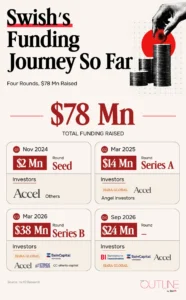
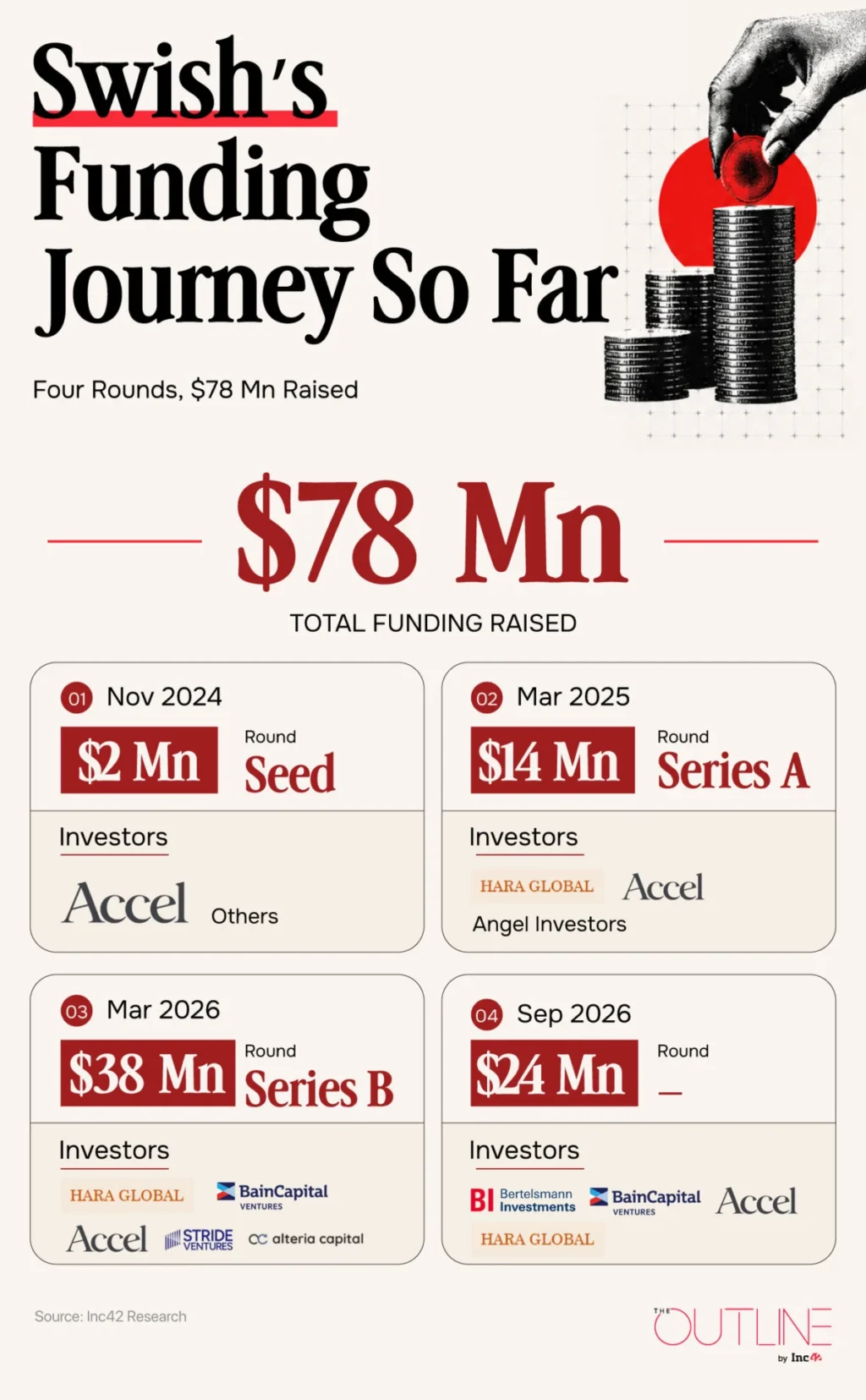
In a testament to its improbable resilience, the Bengaluru-based startup secured a $24 million funding injection—arriving less than six months after a previous $38 million raise. Having banked a total of $78 million across four rounds in less than two years of operations, Swish finds itself in an enviable, albeit lonely, position: it is the last pure-play survivor in India’s 10-minute food delivery arena.
As the dust settles on the great quick-commerce food experiment, the spotlight is no longer on whether the model is eccentric, but whether Swish has quietly engineered a blueprint that can defy gravity where its deep-pocketed predecessors failed.
1. Main Facts: The Anatomy of Swish’s Survival
To understand how Swish has survived a bloodbath that claimed the quick-food initiatives of India’s top tech unicorns, one must examine its core operating mechanics.
Unlike traditional food delivery giants like Swiggy, Zomato, or transit-tech players like Rapido—which operate strictly as aggregator marketplaces connecting third-party restaurants with independent gig-economy riders—Swish controls the entire vertical stack.

- Full-Stack Control: Swish owns its kitchens, develops the proprietary technology, prepares the food, and manages the delivery fleet.
- Hyper-Dense Micro-Kitchens: Its dark kitchens are strategically positioned in ultra-dense clusters, typically within a strict 1-kilometer radius of its target consumers. This proximity is the secret sauce enabling the company to bypass urban traffic bottlenecks.
- Blazing Speed and Scale: The startup crosses over 1 million orders a month, with monthly order volumes tripling since March 2026. More than 80% of these orders are fulfilled within 15 minutes, anchored by an average kitchen food-preparation time of under four minutes.
- Geographic Footprint: Operating across nearly 55 cloud kitchens in 50 strategic pin codes spanning Bengaluru and the Delhi National Capital Region (NCR), Swish handles an average of roughly 800 orders per kitchen daily.
2. Chronology: The Rise, The Rush, and The Great Retreat
The trajectory of India’s quick-food delivery sector reads like a masterclass in market exuberance followed by rapid, sober correction.
Late 2024: The Genesis
Founded by Aniket Shah, Ujjwal Sukheja, and Saran S, Swish enters the market with a modest menu of roughly 75 Stock Keeping Units (SKUs), largely skewed toward snacks, quick bites, and impulse cravings. Co-founder Aniket Shah lays out an aggressive roadmap, projecting a network of 150 kitchens across Bengaluru by March 2025.
2025: The Corporate Gold Rush and Sudden Stumbles
Capital floods the space as quick-commerce fever grips investors. However, operational friction quickly manifests.
- Zepto Cafe: As the pioneer of the rapid-cafe concept, Zepto scaling hits a wall. Amid severe supply-chain bottlenecks and a critical shortage of trained kitchen staff, Zepto Cafe is forced to shutter over 50 kitchens in 2025, watching its peak daily orders plummet from 100,000 to nearly half that figure.
- Zomato Pulls the Plug: In May 2025, Eternal-backed Zomato officially shuts down its rapid-delivery iterations, Quick and Everyday, citing weak consumer demand and unsustainable profitability structures.
- Zing Bows Out: Gurugram-based Zing exits the market, admitting that it vastly overestimated consumer demand for rapid delivery, finding that patrons preferred waiting longer for food from their favorite, established restaurant brands.
Early 2026: Trimming the Fat
- Swiggy Slams the Brakes: In February 2026, Swiggy officially pulls the plug on Snacc, its 15-minute food delivery experiment. Leadership notes that while product-market fit was evident, the fundamental unit economics simply refused to balance out.
- Rebel Foods Retreats: Cloud kitchen titan Rebel Foods quietly halts QuickiES, its proprietary 15-minute delivery vertical.
- Swish Pivots and Expands: Bucking the industry-wide retreat, Swish officially expands into Delhi NCR. Co-founder Shah reveals encouraging early metrics: over 40% of Delhi consumers exhibit repeat-ordering behavior. By mid-2026, monthly orders cross the 1-million milestone, buoyed by successive funding rounds totaling $38 million and, subsequently, $24 million.
3. Supporting Data: Inside the Unit Economics
The ultimate acid test for any food-tech venture lies in its financial architecture. According to industry intelligence reports from The Arc, Swish’s business model possesses distinct structural traits that differentiate it from traditional aggregators.
+---------------------------------------------------------------+
|                   SWISH UNIT ECONOMICS SNAPSHOT               |
+---------------------------------------------------------------+
| Average Order Value (AOV)         | INR 250                   |
| Estimated Gross Food Margin       | 60% – 70%                 |
| Estimated Gross Profit per Order  | ~INR 160 (Pre-overhead)   |
| Daily Order Volume                | ~30,000 orders/day        |
| Average Daily Orders per Kitchen  | ~800 orders               |
| Customer Repeat Rate              | ~10% order twice a day    |
| Average Monthly Orders per User   | Just over 3 orders        |
+---------------------------------------------------------------+
The Power of High Kitchen Density
A mature Swish kitchen processing 800 orders daily enjoys vastly superior unit economics compared to a fledgling unit handling just 100. High throughput allows the company to:
- Station delivery riders directly adjacent to the kitchen, minimizing transit idle time.
- Amortize fixed staffing and rental overhead across a larger volume of transactions.
- Keep raw-ingredient food wastage under strict mathematical surveillance.
Unlike aggregators who wage constant political warfare with restaurant partners over commissions, Swish owns its inventory margins. This grants the startup direct control over pricing tiers, enabling it to focus entirely on optimizing internal costs and net margins per order. Furthermore, the startup has strategically expanded its menu by 3X, moving away from snack-heavy impulse items to capture high-frequency lunch and dinner slots—a pivot that positions everyday meals as its primary growth engine.
4. Official Responses and Industry Perspectives
The structural divergence in how platforms approach rapid food delivery has sparked intense industry debate.
While full-stack players like Swish and Blinkit-owned Bistro own the entire physical supply chain—absorbing higher operational risks and capital expenditures—other players have favored asset-light maneuvers.
For instance, Swiggy’s Bolt and competing rapid services bypass the need to construct dedicated cloud kitchens entirely. Instead, they partner with established third-party restaurants capable of rapid packing, restricting delivery radii to under 2 kilometers. By mid-2025, Swiggy Bolt accounted for more than one in ten of Swiggy’s total food orders across 500+ cities.

Critics note that while asset-light models protect parent platforms from heavy real estate overheads, they sacrifice absolute quality control over preparation times. Conversely, full-stack operators like Swish must continually justify their heavy capital expenditures.
Addressing the company’s aggressive expansion goals, co-founder Aniket Shah has maintained that disciplined execution in core micro-markets will yield sustainable dividends. The startup’s roadmap includes scaling its kitchen network toward an ambitious target of over 1,000 kitchens across India over the next five years—a physical footprint that mirrors legacy cloud-kitchen titans like Rebel Foods, which took 15 years and over $785 million to scale 450 kitchens across 75 cities.
5. Implications: Can Swish Turn Time at the Table into Lasting Profits?
Swish’s recent capital injections have bought the company a precious commodity that its fallen competitors ran out of: time.
Yet, profound strategic challenges loom on the horizon. Scaling a full-stack cloud kitchen network requires sustained, multi-million-dollar capital outlays. As Swish expands beyond its core, highly optimized neighborhoods in Bengaluru and Delhi NCR, it will inevitably face the friction of customer acquisition costs and the necessity of introductory promotional discounting in unfamiliar territories.
To bridge the gap to long-term profitability, Swish plans to introduce high-margin app-based advertising layers in the near future, mirroring the monetization strategies of mature quick-commerce giants.
Ultimately, the broader implication for India’s digital economy rests on a knife-edge. Swish must prove that its hyper-dense cloud kitchen model is not merely a localized phenomenon that thrives exclusively in high-density urban enclaves, but a scalable, fundamentally profitable food business capable of permanently changing how urban India consumes its daily meals.
For now, the pioneer of rapid-food delivery has secured its place at the head table. Whether it can feast or merely fast remains the defining question of India’s next startup cycle.