Bridging the Divide: Integrating LLM Embeddings with Tabular Data in Scikit-Learn Pipelines
In the modern data science landscape, the most potent predictive signals rarely exist in isolation. While traditional machine learning has long excelled at processing structured, tabular datasets—the bread and butter of banking, retail, and logistics—the advent of Large Language Models (LLMs) has opened the door to extracting intelligence from vast, unstructured troves of text. The challenge, however, has always been the "silo effect."
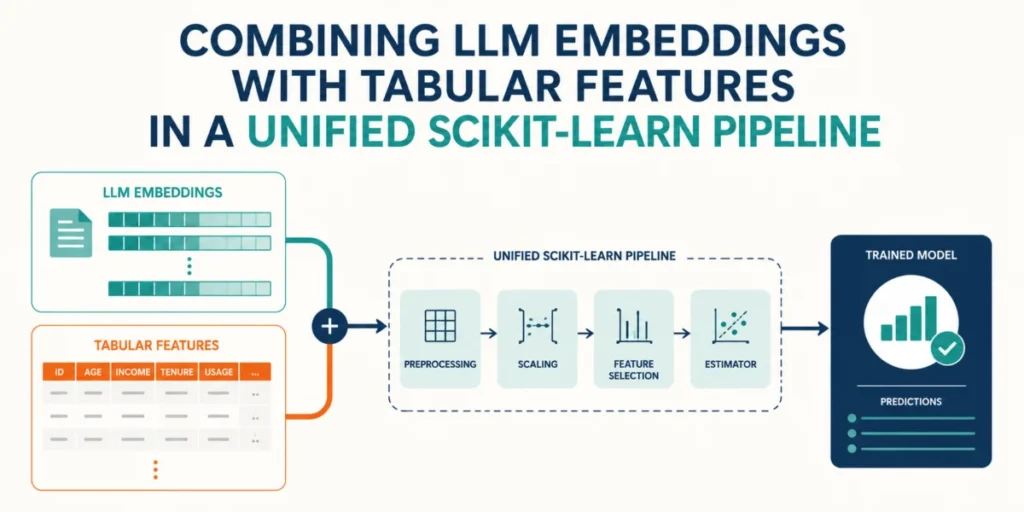
Data scientists are frequently tasked with building classification models that must reconcile these two distinct worlds: the deterministic nature of numeric and categorical tabular data and the high-dimensional, semantic richness of unstructured text. This article explores how to bridge that divide by constructing a unified, production-ready Scikit-learn pipeline that seamlessly integrates lightweight, open-source LLM embeddings with structured features.
The Core Challenge: Data Heterogeneity
Real-world applications, such as automated customer ticket triage, spam detection, and churn prediction, are inherently multi-modal. A customer churn model, for instance, might rely on account tenure and payment history (tabular) while simultaneously analyzing the sentiment and specific keywords found in customer support transcripts (unstructured).
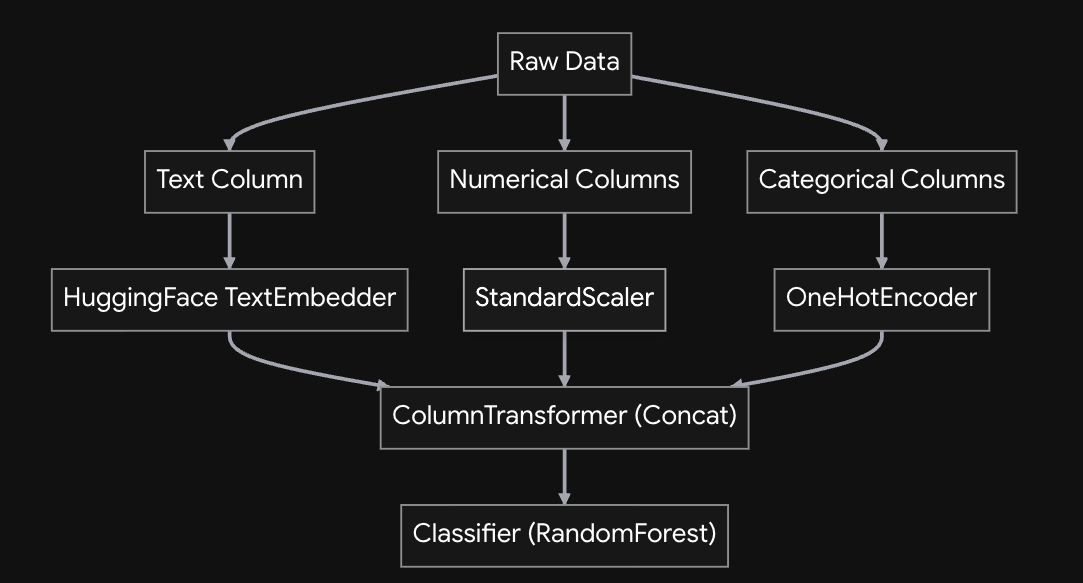
Historically, engineers would process these data streams in separate, disconnected scripts, leading to "pipeline debt"—a state where preprocessing steps are fragile, difficult to version control, and prone to training-serving skew. The solution lies in building a singular, encapsulated pipeline that treats the LLM as just another transformer within the Scikit-learn ecosystem. By leveraging the ColumnTransformer, we can force the model to handle diverse data types in parallel, ensuring that the feature engineering process is atomic and reproducible.
Chronology of the Development Lifecycle
To build a robust system, we must follow a logical, step-by-step engineering sequence:
- Environment Setup: Establishing the library dependencies, specifically focusing on CPU-friendly implementations of
sentence-transformers. - Synthetic Data Engineering: Constructing a hybrid dataset that simulates the complexity of real-world business data, complete with realistic feature overlap to avoid trivial classification outcomes.
- Custom Transformer Development: Creating a bridge between the Scikit-learn API and modern deep learning models.
- Orchestration: Using the
ColumnTransformerto route different data columns to their respective preprocessing branches. - Model Integration and Evaluation: Wrapping the logic in a final
Pipelineobject and benchmarking performance.
Supporting Data: Why "Lightweight" Matters
While massive models like LLaMA 3 or GPT-4 offer unparalleled reasoning capabilities, they are often overkill for simple classification tasks and can be prohibitively expensive to run in real-time inference environments.
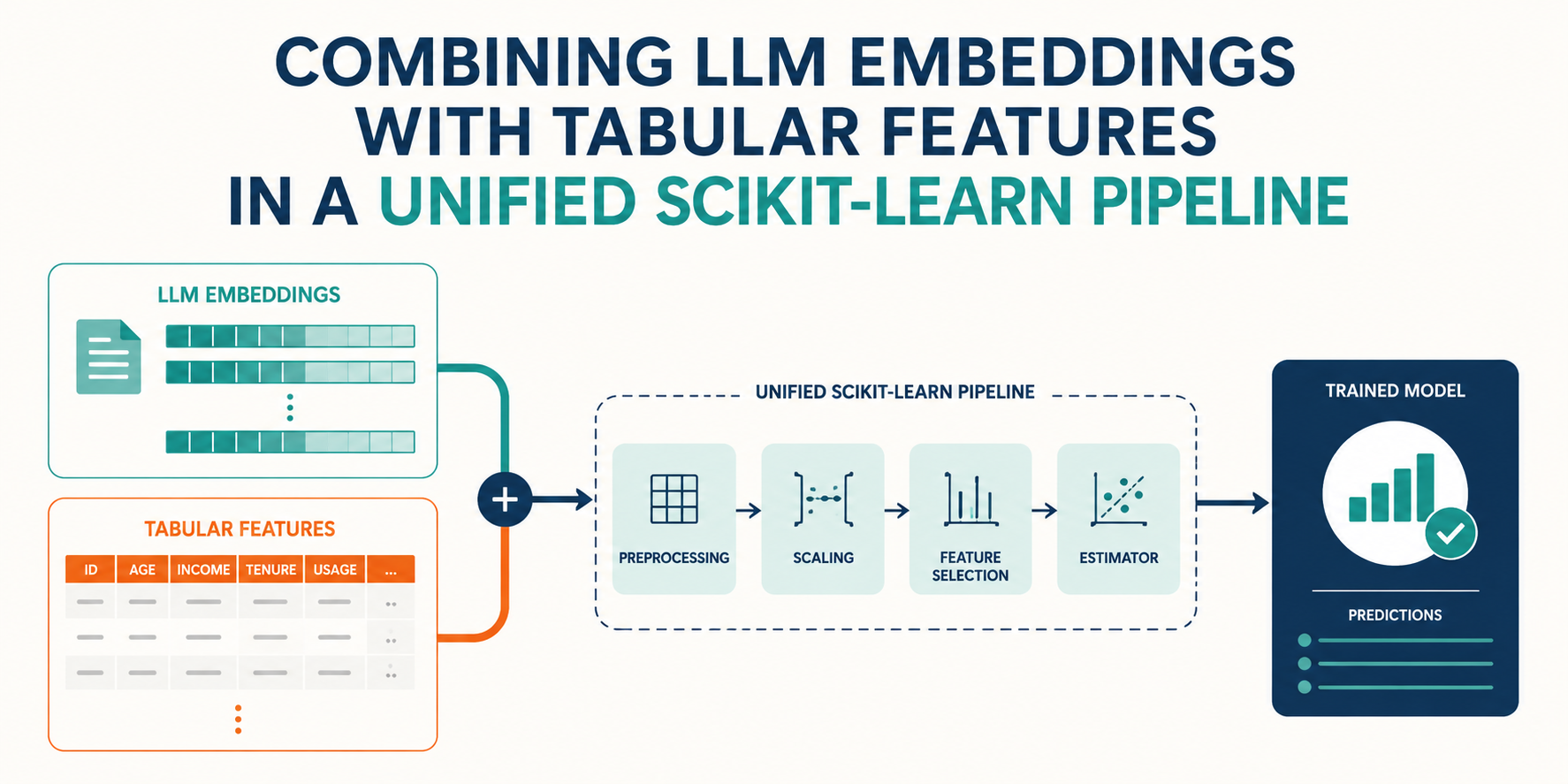
For this implementation, we utilize all-MiniLM-L6-v2. This model is a powerhouse of efficiency, mapping sentences to a 384-dimensional dense vector space. By choosing a lightweight, Hugging Face-hosted model, we ensure that our pipeline remains portable, low-latency, and capable of running on standard hardware without the need for high-end GPU clusters. The performance trade-off is negligible for most classification tasks, as the primary goal is semantic representation rather than generative creative writing.
The Custom Transformer Logic
The bridge between text and numbers is the TextEmbedder class. By inheriting from BaseEstimator and TransformerMixin, we adhere to the strict interface requirements of Scikit-learn.
from sklearn.base import BaseEstimator, TransformerMixin
from sentence_transformers import SentenceTransformer

class TextEmbedder(TransformerMixin, BaseEstimator):
    def __init__(self, model_name='all-MiniLM-L6-v2'):
        self.model_name = model_name
        self.model = None

    def fit(self, X, y=None):
        if self.model is None:
            self.model = SentenceTransformer(self.model_name)
        return self

    def transform(self, X):
        texts = X.iloc[:, 0].astype(str).tolist()
        return self.model.encode(texts, show_progress_bar=False)
This class encapsulates the instantiation of the neural network within the fit method, ensuring that when the pipeline is saved (via pickle or joblib), the transformer remains self-contained and ready for deployment.
Official Perspective: The Role of Unified Pipelines
Leading industry practitioners emphasize that the "pipeline approach" is the gold standard for MLOps. By using a single object to manage the flow from raw data to prediction, you eliminate the risk of "data leakage." For example, if you perform scaling on your numeric features before splitting your training and test data, your model is effectively "peeking" at the test set. A unified Pipeline ensures that every transformation is learned only on the training subset and then applied to the test subset, preserving the integrity of the evaluation process.
Implications for Industry Deployment
1. Simplified Maintenance
In a standard enterprise workflow, updating a feature involves changing code in multiple places. With a unified pipeline, updating the text-processing strategy—such as switching from MiniLM to a newer, more efficient model—is as simple as modifying a single line in the ColumnTransformer definition.
2. Improved Model Observability
Because the entire transformation logic is captured within the Scikit-learn structure, the pipeline can be serialized into a single file. This artifact can then be deployed to cloud services like AWS SageMaker, Google Vertex AI, or Azure ML, ensuring that the exact same transformations used during development are executed in production.
3. Handling "Dirty" Data
Real-world data is rarely clean. The use of ColumnTransformer allows us to define specific remainder policies—either dropping, passing through, or transforming columns we didn’t explicitly account for. This level of control is vital for robust production systems that must gracefully handle unexpected input formats.
Case Study: The Spammer Detection Scenario
In our experiment, we utilized the SMS Spam Collection dataset, augmented with synthetic features like account_age_days, is_premium, and priority_score.
- The Text Component: Captured the semantic nuance of phishing attempts.
- The Tabular Component: Added context—spammers, for instance, were modeled to have shorter account histories and lower premium subscription rates.
By forcing the model to integrate these disparate sources, the Random Forest classifier achieved an F1-score of 0.95 for the spam class. This result highlights that while text embeddings provide the "what" (the message content), tabular features provide the "who" and "when" (the user context). Combining both leads to a holistic model that is significantly more resilient than a model trained on text alone.
Conclusion: The Future of Hybrid AI
The ability to build unified, hybrid pipelines is no longer just a "nice-to-have" skill for data scientists; it is a fundamental requirement. As Large Language Models continue to permeate traditional tabular workflows, the distinction between "NLP engineers" and "traditional ML engineers" will continue to blur.
By mastering the use of Scikit-learn’s ColumnTransformer and embedding custom model logic into standard pipelines, you empower yourself to build systems that are not only sophisticated in their use of state-of-the-art AI but also robust, scalable, and maintainable. The path forward for enterprise-grade AI is not in building bigger, more complex black boxes, but in crafting cleaner, more integrated bridges between the structured and unstructured information that powers our modern digital economy.