Unlocking the Future of Serverless Intelligence: Amazon DynamoDB Introduces Native Vector Search

In a major development for cloud architects, database administrators, and artificial intelligence developers alike, Amazon Web Services (AWS) has officially announced the general availability of native vector search in Amazon DynamoDB. This landmark release bridges the long-standing gap between operational databases and high-performance vector stores, allowing organizations to store vector embeddings directly alongside their core operational data.
By eliminating the need to provision, manage, and synchronize separate vector databases, this release dramatically simplifies the architecture of modern AI-powered applications. Developers can now perform lightning-fast similarity searches at scale, maintaining single-digit millisecond latencies with a recall rate of 99% or higher, all within the familiar, serverless environment of DynamoDB.
Main Facts: What is DynamoDB Vector Search?
The integration of vector search into Amazon DynamoDB fundamentally changes how applications handle semantic retrieval. Traditionally, enterprises building Retrieval-Augmented Generation (RAG) pipelines, recommendation systems, semantic search engines, and agentic memory architectures were forced to adopt a dual-database pattern. They would store transactional data in DynamoDB while copying vector embeddings into a dedicated vector store.
This multi-database approach introduced significant technical debt, including:

- Data Synchronization Pipelines: Requiring complex event-driven architectures (such as DynamoDB Streams coupled with AWS Lambda) to keep operational records and vector embeddings in sync.
- Elevated Operational Overhead: Managing patching, scaling, and operational monitoring across two distinct database systems.
- Increased Financial Costs: Paying for idle capacity or complex licensing fees associated with dedicated vector solutions, alongside data transfer expenses.
- Latency Bottlenecks: Struggling to maintain predictable, low-latency performance at enterprise scale while joining data across disparate systems.
With native vector search, DynamoDB solves these challenges entirely. Vectors are stored natively as lists of floats inside standard table items. Developers can create specialized vector indexes that scale horizontally with no storage limits, leveraging the exact same serverless infrastructure and pay-per-request pricing model they already rely on for their operational workloads.
Chronology: The Journey to Native Vector Integration
The path toward native vector search in DynamoDB reflects the broader industry transformation driven by generative AI. As large language models (LLMs) and vector embeddings transitioned from experimental technologies to core enterprise infrastructure, AWS steadily expanded its database portfolio to support AI workloads.
- Early Multi-Service Architectures: Initially, developers building AI applications on AWS relied on specialized external vector databases or integrated vector capabilities into other AWS services, while using DynamoDB strictly for relational or key-value metadata. This required cumbersome synchronization code.
- The Rise of RAG and Agentic Workflows: As enterprise demand surged for contextual AI applications—such as personalized recommendations, semantic search, and autonomous AI agents with long-term memory—the friction of managing separate data silos became an acute pain point for engineering teams.
- General Availability Release: AWS addressed this architectural bottleneck by introducing native vector search directly into DynamoDB. Available immediately in all commercial AWS Regions and AWS GovCloud (US) Regions, the feature requires no new data types, leveraging DynamoDB’s existing
ListandNumberstructures to ingest, index, and query vector embeddings seamlessly.
Supporting Data and Technical Architecture
Under the hood, vector search in DynamoDB is engineered to handle massive scale—ranging from gigabytes to trillions of vectors—without sacrificing performance.
Technical Specifications
- Scale and Latency: Delivers single-digit millisecond latency at 99%+ recall across datasets of virtually any size.
- Dimensions: Fully supports high-dimensional vectors up to 4,096 dimensions, accommodating advanced embedding models from various providers.
- Distance Functions: Provides flexibility with three primary distance metrics:
- Cosine Distance: Measures the angle between vectors, highly effective for semantic text comparison.
- Euclidean Distance: Measures straight-line distance in vector space.
- Dot Product: Measures directional alignment and magnitude, often used in recommendation systems.
- Filtering Capabilities: Integrates inline filtering, allowing developers to narrow search results at query time using non-vector attributes (e.g., filtering a product catalog by category or region using exact-match criteria).
Step-by-Step Implementation Workflow
Implementing vector search within an existing application—such as an online sporting goods store—involves a straightforward, three-step process:

-
Preparing the DynamoDB Table:
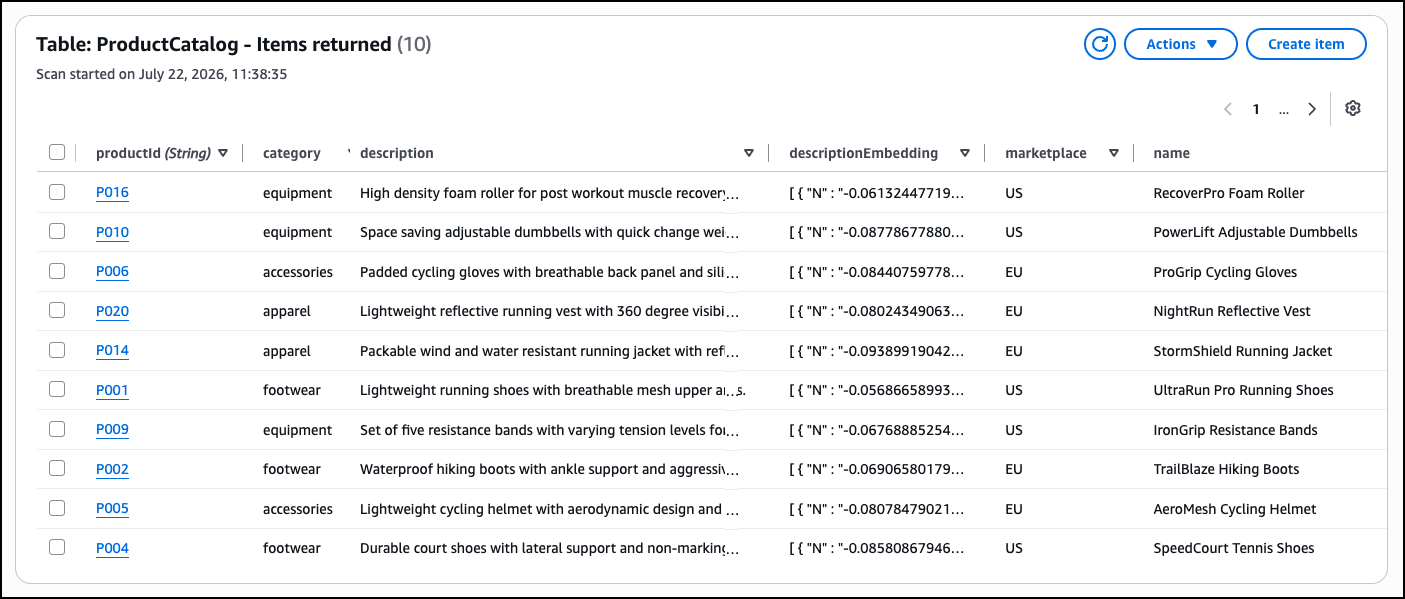
Developers generate vector embeddings from textual attributes (such as product descriptions) using models like Amazon Bedrock Titan Text Embeddings, Cohere Embed, or OpenAI text embedding models. These embeddings are then written to the table items as a standard list of floats under a dedicated attribute (e.g.,descriptionEmbedding) using standardPutItemorUpdateItemAPI calls. No schema migrations or new data types are required. -
Creating the Vector Index:
Through the AWS Management Console, AWS CLI, SDKs, or Infrastructure as Code (IaC) tools like AWS CloudFormation, administrators create a vector index on the embedding attribute. Configuration parameters include the index name, vector attribute, dimension count, and chosen distance function. Additionally, developers can specify a partition key (such asmarketplace) to distribute vectors efficiently across partitions, ensuring high query throughput and localized searches, as well as defining inline filter attributes. -
Executing the Vector Search:
Using the newSearchVectorsAPI, applications submit a query vector generated from natural language terms (e.g., "lightweight running shoes for summer"), specify the Top-K results required (up to 100), apply optional inline filters (such ascategory = 'footwear'), and scope the search via partition keys. DynamoDB instantly returns the most semantically similar items, complete with their operational attributes (like name, price, and ID) in a single unified response.
Official Responses and Industry Implications
The release has drawn significant attention from enterprise developers and cloud architects seeking to streamline their infrastructure.
Industry analysts note that the elimination of data synchronization pipelines represents a massive win for engineering productivity. By unifying operational databases and vector search into a single serverless engine, companies can drastically reduce their total cost of ownership (TCO). Furthermore, because DynamoDB handles automatic scaling, infrastructure provisioning and maintenance windows are entirely a thing of the past. Zero-downtime maintenance ensures that mission-critical production environments remain online and responsive even as indexes expand to accommodate trillions of vectors.
Integration with modern developer tooling has also been prioritized. Developers can interact with vector search APIs and documentation programmatically using the AWS MCP Server and associated plugins within their preferred AI coding environments, accelerating the development lifecycle for next-generation intelligent applications.
Implications for the Future of Enterprise AI
The availability of vector search in Amazon DynamoDB signals a broader architectural shift in enterprise software development: the convergence of operational and analytical/AI workloads onto unified data platforms.
For organizations, this means that building sophisticated, AI-driven features is no longer restricted by the complexities of managing disparate data silos. Whether powering real-time fraud and anomaly detection, driving highly personalized e-commerce experiences, or maintaining context for autonomous agentic AI memory, developers can now deploy scalable semantic search with the same operational simplicity they have come to expect from serverless technologies.

As businesses continue to embed artificial intelligence into every layer of their software stack, native database capabilities like DynamoDB’s vector search remove the friction of scale, cost, and complexity—paving the way for the next wave of intelligent, responsive cloud applications.