Decoding the LinkedIn Algorithm: The Masterclass on Writing Winning Content Without AI
In the modern digital ecosystem, professional networking platforms have evolved from digital resume repositories into high-stakes arenas for brand authority, lead generation, and business scaling. Yet, despite the platform’s explosive growth, a glaring paradox remains: millions of professionals post consistently, yet only a tiny fraction manage to break through the digital noise.
According to platform data, a mere 1% of LinkedIn’s massive user base actively creates content. This dramatic supply-and-demand gap means the platform aggressively rewards those who show up with substantive, high-value insights. However, simply showing up is no longer enough. To capture attention, hold a reader’s focus, and drive meaningful shares, creators must master the mechanics of human-centric copywriting.
In a comprehensive masterclass co-created by digital strategist Kasey Brown and industry authority Michael Stelzner, experts break down a three-part framework designed to revolutionize how professionals approach LinkedIn content—entirely without the crutch of artificial intelligence.
Laying the Groundwork: The Content Gap and the Ideal Client Profile
To understand how to win on LinkedIn, one must first understand the structural dynamics of the platform. The fact that 99% of users are passive consumers creates an immense opportunity for the 1% who publish. But unlocking this potential requires meticulous groundwork before a single word is written.
Defining a Laser-Focused ICP
Kasey Brown emphasizes that foundational success begins with an ultra-specific Ideal Client Profile (ICP). A vague demographic sketch—such as "people who want to build a brand online"—is entirely useless for content creation.
Instead, Brown argues that an ICP must be precise enough that a virtual assistant could plug its keywords directly into LinkedIn’s search bar and instantly generate a list of qualified prospects. For example, rather than targeting generic business owners, an effective ICP targets "speakers, coaches, and consultants earning at least $20K per month who need systems for organic content so they can scale their impact and their business."
The 30-Day Transformation and Audience-First Psychology
Paired with a precise ICP is the concept of transformation. Creators must ask themselves: What tangible shift will a reader experience after following my content for 30 days? This question frames every piece of content before drafting begins.
Furthermore, creators must shift their psychological motivation. Most creators publish while asking inward-facing questions: Did I sound smart? Did I share enough client wins? Will this drive sales?
When the question shifts outward—What does the ideal reader get from consuming this content?—posts begin to generate the kind of resonance that compounds business growth. With these foundational principles locked in, creators can deploy the tactical "Triple S Framework."
The Triple S Framework: Stop, Stay, and Share
The Triple S Framework covers the three critical dimensions of LinkedIn user engagement: Stop, Stay, and Share. Each dimension governs a specific phase of the reader’s journey from passive scroller to active advocate.
1: Stop—Pausing the Scroll With Images and Hooks
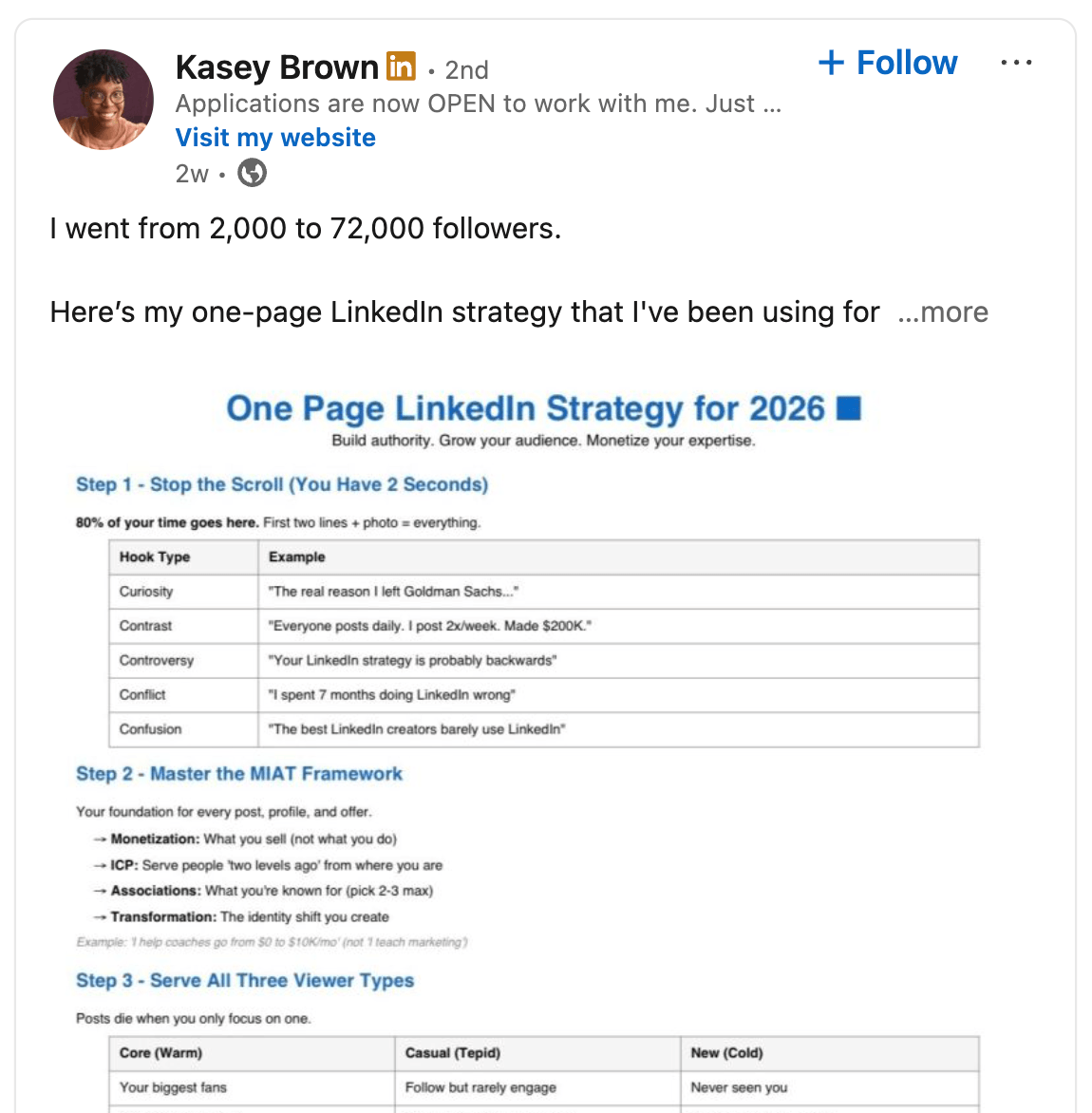
The immediate objective of any LinkedIn post is simple: halt the user’s thumb mid-scroll. Brown identifies two primary levers for this—the attached image and the first two lines of text—which together account for roughly 80% of a post’s impressions.
The Power of Unpolished, Vertical Visuals
Most creators default to professional headshots or polished speaking photos. Because this polished look has become ubiquitous, it creates a massive opportunity for disruption. The goal is not to post a better version of what everyone else is sharing, but to be fundamentally different.
In a direct A/B test conducted by Brown, a wide-angle selfie taken from a stage using a phone’s back camera at 0.5x zoom—showing an unpolished, authentic view of the audience—generated an astounding 3,000 leads when paired with a slide deck offer. Conversely, reposting the exact same offer with a high-resolution, professionally lit photo of her presenting generated only 200 leads.
"We don’t have to be better. We have to be different," Brown notes.
Tactically, vertical images consume more real estate in the LinkedIn feed and resist awkward cropping. Furthermore, wide-angle 0.5x smartphone shots reveal surrounding environments, sparking natural curiosity. For infographics, Brown recommends packing the image with dense, valuable information styled like a working document rather than an empty title card, instantly triggering a pattern interrupt.
Crafting Hooks That Trigger the "Five Cs"
The text hook must work in tandem with the visual. Brown evaluates hooks through the lens of the "Five Cs"—curiosity, contrast, contradiction, controversy, and confusion—borrowed from short-form video psychology. A strong hook reliably triggers at least two or three of these psychological triggers.

For example, a generic vacation photo captioned "On vacation in Bali, having a great summer" offers none of the Five Cs. However, repositioning the exact same photo with a potent hook—"I was at a job I hated. 2021." followed by "2026. I just spent $30K to come here…"—instantly captivates the reader through confusion, contrast, and curiosity.
2: Stay—Keeping Readers Hooked From Hook to Finish
Once a user clicks "see more," the challenge shifts from capturing attention to sustaining it. This phase requires earning the right to keep the reader’s focus all the way to the conclusion.
The Art of the Re-Hook
When a reader expands a post, the third line must validate their click without immediately resolving the narrative arc. A weak approach gives away the punchline instantly, deflating reader interest.
A strong re-hook continues building tension. Using the Bali example, instead of stating immediately that the business runs fine without them, a masterclass re-hook builds suspense: "It was a wild dream I had last February. I never thought I could actually leave my business and spend this kind of money… especially with so many fires burning in the company and everything feeling like it was about to fall apart." This sustains engagement because the reader demands a resolution.
Structuring for Readability and Mobile Optimization
Content structure dictates whether a reader stays until the end. Brown advocates for intentional rhythm: alternating between three or four short, one-sentence lines to land key points, followed by a two-to-three-sentence block to develop the ideas.
To maximize accessibility, content should be written at a fourth-to-seventh-grade reading level, verifiable via tools like the Hemingway App. Because roughly 70% of LinkedIn users browse via mobile devices, creators should preview drafts using specialized tools like Authored Up or native mobile apps to ensure dense paragraphs do not overwhelm small screens.
3: Share—Triggering Network Distribution
The final pillar of the framework is the share, which Brown tracks as the definitive health metric of content performance. While views and comments are relatively easy to generate, a share or repost indicates that a user found the content valuable enough to attach their personal reputation to it and distribute it to their broader network.
The Metrics of Success
- A shares-per-impression ratio of 0.3 is solid.
- A ratio of 0.5 or higher is exceptional.
- Posts achieving a 0.5 ratio are prime candidates for recycling, entering a rotation to be reposted every 60 to 90 days with identical text and visuals.
The Mechanics of Shareable Content
Shares are driven by concrete, actionable transformations delivered at the end of a post. Returning to the narrative example, concluding a personal story with a clear, step-by-step framework transforms a self-serving anecdote into a valuable resource that professionals will eagerly forward to colleagues, save for later reference, or comment on to secure a lead magnet.
When this tangible value—the metaphorical "goodie bag at the end of a party"—is present, explicit calls to action (such as tagging a peer) feel organic and highly effective.
Implications for Modern Content Creators and Marketers
The insights shared by Kasey Brown and Michael Stelzner carry profound implications for the digital marketing landscape. As artificial intelligence tools flood content channels with homogenized, automated prose, audiences are developing an acute fatigue for synthetic writing.
The market is experiencing a massive pendulum swing back toward radical authenticity, raw visual perspectives, and deeply human storytelling. Platforms like LinkedIn are systematically adapting their algorithms to penalize low-effort, mass-produced content while elevating substantive, community-driven insights.
For founders, executives, and consultants, mastering the Triple S Framework offers a clear roadmap: success on social media is no longer about out-posting competitors through sheer volume or algorithmic hacks. Instead, it is about understanding the psychological triggers of the human reader, respecting their time, and delivering uncompromising, practical value that compels them to stop scrolling, stay engaged, and share the message with the world.