India’s Startup Ecosystem in FY26: The Great Pivot Toward Sustainable Scale Amid Funding Realities
The Indian startup ecosystem experienced a defining maturation phase in Fiscal Year 2026 (FY26). Moving past the hyper-growth-at-all-costs philosophy of previous cycles, the landscape witnessed 22 new-age tech companies making their public market debuts—a sharp increase from the 13 initial public offerings (IPOs) recorded in FY25.
Concurrently, a growing contingent of startups successfully crossed the threshold into profitability, or significantly narrowed their losses, following years of aggressive cost rationalization designed to survive shifting macroeconomic and venture capital realities.
Despite a challenging fourth quarter marked by geopolitical uncertainties and supply chain bottlenecks, India’s tech-driven enterprises demonstrated strong top-line resilience. Financial disclosures from a tracked cohort of 90 prominent startups reveal a massive expansion in aggregate operating revenue, alongside stark reminders that sustainable profitability remains an ongoing challenge for capital-intensive sectors.
The Macro Picture: Record Revenue Meets Persistent Cash Burns
Aggregate Financial Health
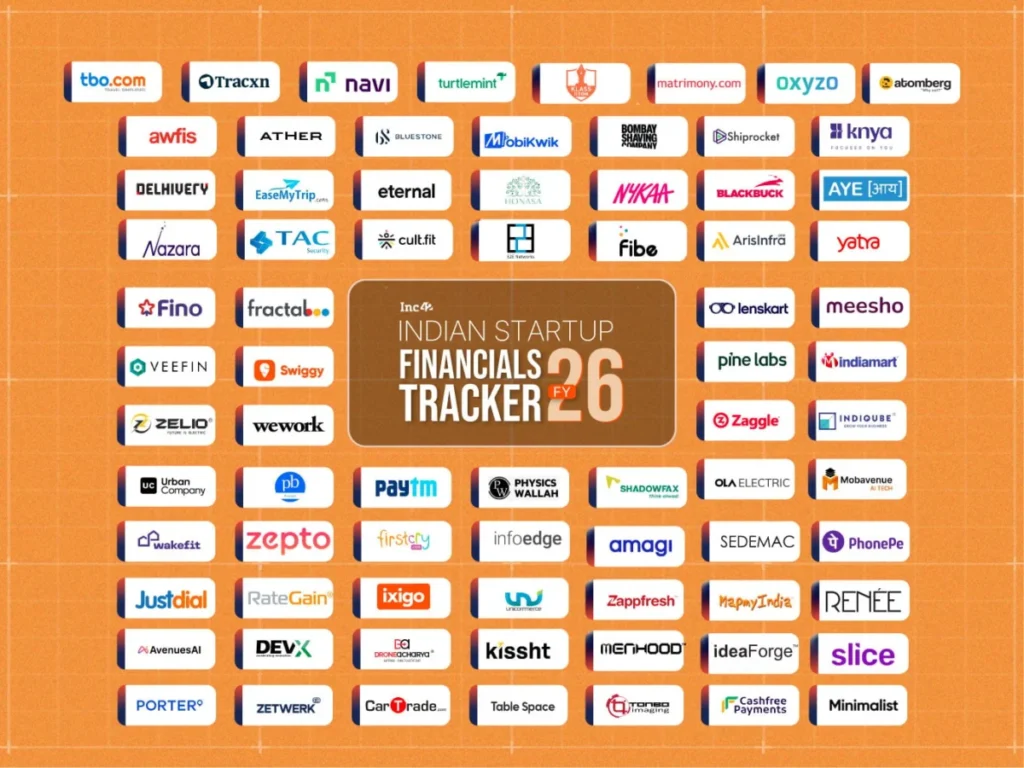
According to data compiled in the newly launched Inc42 FY26 Financial Tracker, the aggregate operating revenue of the 90 tracked new-age tech companies surged by 44.4% to reach ₹3.12 Lakh Cr in FY26, up from ₹2.15 Lakh Cr in FY25.
The profitability narrative, however, remains polarized:
- The Profitable Cohort: Out of the 90 startups, 63 companies (roughly 70%) reported profits for FY26. Together, this profitable segment generated a cumulative net profit of ₹14,249.5 Cr.
- The Loss-Making Cohort: Conversely, the remaining 27 companies posted a cumulative net loss of ₹20,358.8 Cr, driven primarily by heavy capital expenditure, aggressive scaling in quick commerce, and investments in emerging technologies such as artificial intelligence.
Chronology of Ecosystem Shifts Through FY26
H1 FY26: Cost Discipline and Public Market Optimism
The fiscal year began on a cautious yet optimistic note. Having spent FY24 and FY25 trimming fat, optimizing unit economics, and rationalizing marketing budgets, startups entered FY26 with leaner cost structures. This discipline paved the way for a flurry of public listings. Mid-sized SaaS firms, B2B marketplaces, and select fintech players capitalized on buoyant public market sentiment, resulting in 22 successful tech IPOs over the course of the fiscal year.
H2 FY26: Geopolitical Pressures and the Quick Commerce Surge
As the year progressed into its final quarters, the macroeconomic environment grew complex. Geopolitical uncertainties weighed heavily on supply chains—notably impacting hardware-dependent sectors like electric vehicles (EVs) due to international restrictions on rare earth materials.
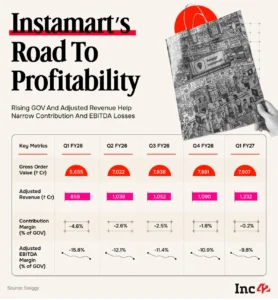
Simultaneously, the quick commerce sector—anchored by giants like Blinkit (Eternal), Zepto, and Instamart (Swiggy)—witnessed an unprecedented race for geographical expansion and dark store penetration. This intense battle drove aggregate revenues to historic highs, but also triggered substantial cash burns, widening losses for logistics and quick-commerce heavyweights in the second half of the year.
Supporting Financial Data: Selected Startup Performances
To understand the micro-dynamics behind the aggregate numbers, a cross-section of company performances highlights the divergence in the FY26 landscape:
| Company Name | Operating Revenue (FY26) | YoY Revenue Change (%) | Profit / Loss (FY26) | Profit / Loss (FY25) |
|---|---|---|---|---|
| Eternal (Zomato/Blinkit) | ₹54,364 Cr | +168.56% | ₹366 Cr | ₹527 Cr |
| Zepto | ₹22,623.6 Cr | +103.63% | -₹5,905.2 Cr | -₹4,699.7 Cr |
| Swiggy | ₹23,053 Cr | +51.40% | -₹4,154 Cr | -₹3,117 Cr |
| Paytm | ₹8,437 Cr | +22.28% | ₹552 Cr | -₹663 Cr |
| Groww | ₹4,645 Cr | +19.04% | ₹2,083 Cr | ₹1,824.4 Cr |
| Lenskart | ₹8,814 Cr | +32.49% | ₹500.9 Cr | ₹297.3 Cr |
| Ather Energy | ₹3,671.8 Cr | +62.83% | -₹517.2 Cr | -₹812.3 Cr |
| Amagi Media Labs | ₹1,505.6 Cr | +29.50% | ₹71.7 Cr | -₹68.7 Cr |
Key Sectoral Highlights:
- Fintech & Digital Payments: Paytm marked a historic milestone by reporting its first full year of profitability, posting a net profit of ₹552 Cr compared to a net loss of ₹663 Cr in FY25. Meanwhile, discount broker Groww crossed the ₹2,000 Cr profit mark, cementing its position as a dominant cash-generative player. Conversely, PhonePe saw its net loss widen 62% to ₹2,792 Cr, weighed down by elevated ESOP expenses, marketing spends, and aggressive expansion into new financial services.
- Quick Commerce & Food Delivery: Eternal reported robust revenue growth of 168.6% to ₹54,364 Cr, aided by Blinkit’s transition to an inventory-led model, though net profit dipped 31% to ₹366 Cr due to continuous reinvestment. Zepto and Swiggy scaled top-line revenues exponentially—reaching ₹22,623.6 Cr and ₹23,053 Cr respectively—while recording steep net losses of ₹5,905.2 Cr and ₹4,154 Cr as dark store wars intensified.
- EVs and Hardware: Ather Energy managed to trim its net loss by 36% to ₹517.2 Cr despite supply chain disruptions stemming from international export restrictions on critical components. Ola Electric similarly narrowed its loss by 19.5% to ₹1,833 Cr, even as operating revenue dropped 50% to ₹2,253 Cr amid shifting consumer demand and after-sales service challenges.
- SaaS and Enterprise Tech: Companies like Amagi Media Labs and Capillary Technologies crossed significant profitability milestones. Amagi posted a net profit of ₹71.7 Cr, turning around from a loss of ₹68.7 Cr in FY25, while Capillary saw its net profit soar 271% to ₹52.4 Cr.
Official Responses and Executive Commentary
Industry leaders and company executives have emphasized strategic pivoting as the cornerstone of their FY26 performance.
Founders and CFOs across the fintech and commerce sectors highlighted that capital efficiency is no longer optional. Executives navigating public market preparations—such as those at IPO-bound Atomberg, Fibe, and NoPaperForms—notated that institutional investors are heavily prioritizing sustainable EBITDA margins over unconstrained top-line growth.
In the quick commerce and logistics segments, leadership teams defended elevated burn rates as necessary land-grab investments. Representatives from firms like Shadowfax and Porter—both of which reported strong net profits of ₹115.2 Cr and ₹229 Cr respectively—pointed out that localized density and tech-driven route optimization were critical to decoupling revenue growth from operational expenditure.
Implications for the Broader Ecosystem
The financial disclosures of FY26 carry profound implications for the future trajectory of Indian entrepreneurship:
- The Raising of Institutional Barometers: With 22 companies successfully testing public waters in FY26, the public markets have become a primary exit and capitalization route. However, public shareholders have shown little tolerance for prolonged cash burns, forcing late-stage private companies to accelerate their paths to profitability before ringing the opening bell.
- AI and Technology Integration as Cost Drivers: Investments in artificial intelligence infrastructure, automated warehousing, and machine-learning-driven customer acquisition tools have driven up total expenses across the board—explaining why several high-revenue companies continue to post widening net losses. Going forward, the ability of these algorithms to translate into tangible margin expansion will determine market survival.
- Consolidation and Survival of the Fittest: As well-funded incumbents clash in hyper-competitive verticals like quick commerce, travel, and logistics, smaller players with weaker balance sheets face increasing pressure to consolidate or pivot toward niche profitability.
Conclusion
FY26 will be remembered as a transitional epoch for Indian tech startups—a period where record-breaking operating revenues coexisted with deep, strategic investments in the future of commerce and logistics. As the FY26 Financial Tracker continues to monitor these disclosures, the ecosystem stands at a critical juncture: one foot firmly planted in aggressive market expansion, and the other stepping cautiously toward enduring financial maturity.