By Financial News Desk | Edited by Nikhil Subramaniam
Introduction: The Evolution of a Pioneer
When Swiggy burst onto India’s urban landscape in 2014, it fundamentally altered the convenience economy, pioneering the concept of bridging the gap between local eateries and customer doorsteps. A year later, Zomato entered the fray, setting off a fierce, prolonged duopoly that has defined India’s consumer internet story.
However, over the past decade, Swiggy has evolved far beyond its origins as a food delivery marketplace. Today, it operates as a sprawling conglomerate encompassing quick commerce, B2B supply chains, dine-out discovery, and an experimental incubator for emerging consumer trends.
An analysis of Swiggy’s financial performance for the first quarter of fiscal year 2027 (Q1 FY27) reveals a fascinating paradox: while its core food delivery engine and mature operational segments continue to pump out profits, the sheer scale of its aggressive growth bets—most notably the quick commerce titan Instamart—keeps the broader enterprise in the red.
Chronology of Expansion: From Single-Vertical to Multiverse
Swiggy’s journey from a niche food courier to a diversified commerce engine reflects deliberate structural evolution:
2014: Swiggy is founded, launching India’s maiden tech-enabled restaurant-to-doorstep food delivery service.
2015: Competitor Zomato enters the food delivery race, sparking industry-wide scaling and aggressive capital deployment.
Post-2015 Era: Swiggy gradually broadens its mandate, introducing subscription programs, dining out discovery, and supply chain logistics to capture a wider share of consumer wallet spend.
The Quick Commerce Pivot: Recognizing a structural shift in consumer behavior toward instant gratification, the company launches Instamart, pivoting heavily into the 10-minute grocery and daily essentials delivery race.
Q1 FY27 Performance Window: Swiggy reports a consolidated net loss of INR 791 Cr, driven primarily by intensive capital outlays in quick commerce and early-stage platform innovations, even as its core food delivery segment prints solid operational profits.
The Financial Breakdown: Core Profits vs. Growth Drains
To understand Swiggy’s financial health, one must separate the mature revenue-generating pillars from the heavy-investment growth engines. In Q1 FY27, Swiggy posted total operational revenue of INR 6,812 Cr against total expenses of INR 7,813 Cr, culminating in an overall quarterly net loss of INR 791 Cr.
1. Food Delivery & Supply Chain: The Profit Anchors
Swiggy’s food delivery business remains the crown jewel of its financial structure, generating an operating revenue of INR 2,208 Cr in Q1 FY27 with an operating profit (segment profit) of INR 299 Cr.
Operationally, the food delivery Gross Order Value (GOV) climbed 17.4% year-on-year (YoY) to INR 9,490 Cr, while Monthly Transacting Users (MTUs) expanded by 17.8% YoY to reach 19.2 million. Swiggy calculates its food delivery Contribution Margin (CM) after deducting delivery charges, platform-funded discounts, and variable costs—landing at 7.6% of GOV for the quarter. Adjusted EBITDA margins for the segment stood at 3.1% of GOV.
However, sequential dips in food delivery margins were observed during the quarter. Management attributed this compression to seasonality, alongside deliberate investments in delivery-partner availability and annual wage hikes.
Parallel to food delivery, Swiggy’s Supply Chain & Distribution (SC&D) business emerged as the largest top-line contributor for the quarter, bringing in INR 3,195 Cr in revenue. Unlike the asset-light commission model of food delivery, SC&D operates as an inventory-led B2B business where Swiggy purchases wholesale products and distributes them to merchant partners. While this segment drives massive revenue, it operates on much thinner margins, running roughly at breakeven at the operating level.
2. Instamart: The Heavyweight Growth Engine Burning Cash
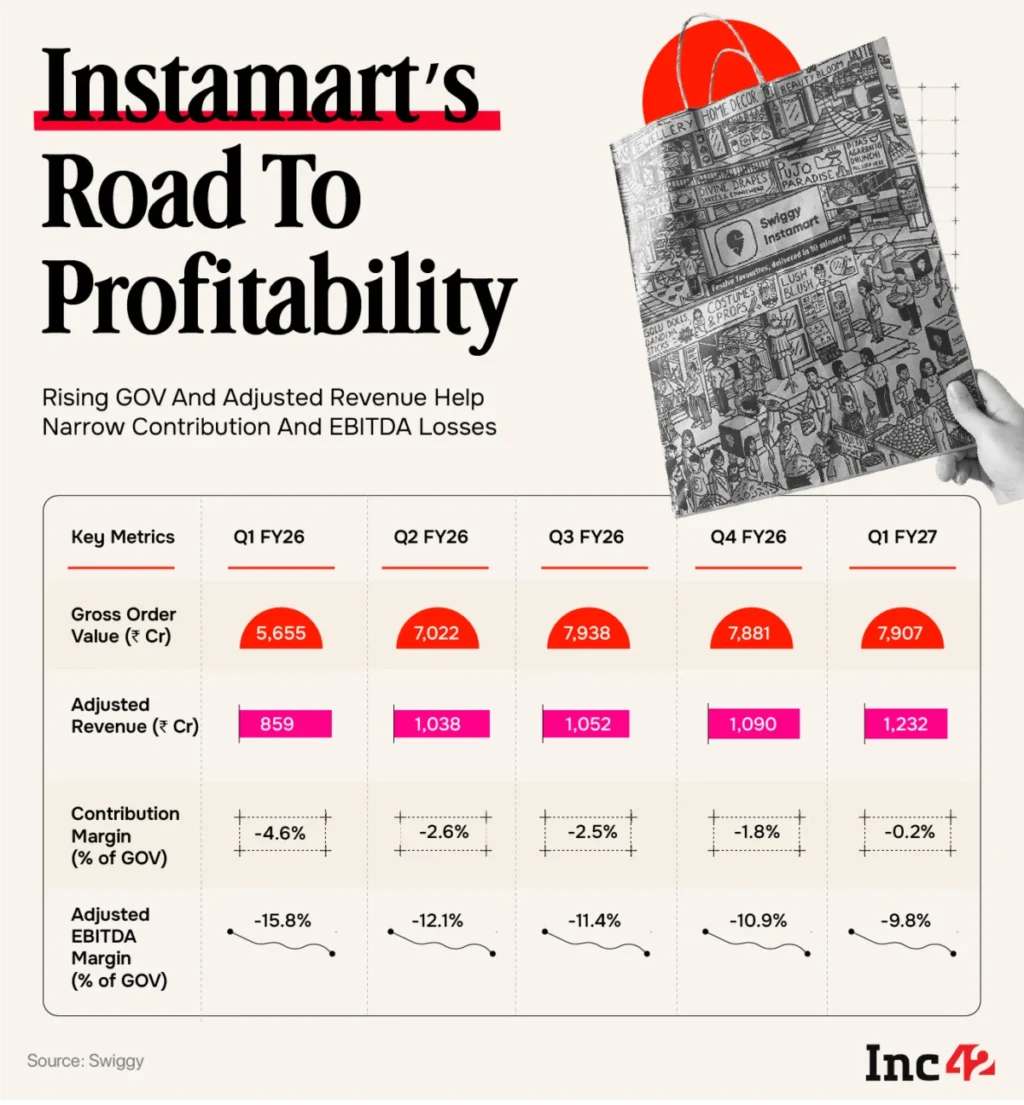
If food delivery provides the profits, quick commerce is where the capital goes. Instamart reported a massive GOV of INR 7,907 Cr in Q1 FY27—a 40% YoY jump—and pulled in operational revenues of INR 1,232 Cr.
Yet, Instamart remained the single largest drag on the company’s consolidated bottom line, posting an adjusted EBITDA loss of INR 778 Cr (an adjusted EBITDA margin of -9.8% of GOV). Despite these losses, there are silver linings: Instamart’s contribution margin improved significantly to -0.2% of GOV, up from -1.8% in the preceding quarter. Management noted that the contribution margin turned positive on a monthly basis in May, signaling that individual dark stores are nearing order-level break-even.
During the quarter, Instamart operated 1,171 active dark stores with an average of 1,089 orders per store per day. With network utilization hovering around 40%, Swiggy plans to add approximately 75 new stores in Q2 to capture surging demand in high-growth micro-markets.
Strategic Architecture: The Platform Innovations Sandbox
Beyond its established pillars, Swiggy maintains a dedicated "platform innovations" segment. Functioning essentially as an internal venture incubator, this division tests nascent consumer propositions, pricing models, and alternative delivery formats without risking core platform economics.
The portfolio under this head is fluid. Experiments are launched, scaled, or swiftly abandoned based on product-market fit (PMF) and business-market fit (BMF). Notable initiatives include:
Toing: A distinct marketplace model designed for price-conscious demographics like students and early-career professionals, offering low Average Order Value (AOV) meals paired with reduced restaurant commissions.
Crew: Initially launched as a broad concierge pilot handling everything from golf caddy bookings to luxury travel and cab sourcing, Crew recently pivoted into a dedicated personal travel concierge service.
Specialized Extensions: The company also manages operations like Swiggy Sports, Bolt, 99 Store, Late Night Eats, Food On Train, Eatright, and DeskEats. Conversely, unprofitable experiments like the standalone food delivery test Snacc were shuttered.
During Q1 FY27, the platform innovations segment generated INR 51 Cr in operating revenue against a segment loss of INR 131 Cr, with the majority of capital directed toward marketing-led customer acquisition for Toing.
Supporting Data: Expense Architecture and Scale Economics
Running a massive multi-vertical consumer internet ecosystem requires immense capital. Swiggy’s Q1 FY27 financials highlight the cost pressures associated with hyper-scaling:
Stock-in-Trade Purchases: Standing at INR 2,978 Cr, this represents the single largest expense item, directly tied to the inventory-heavy SC&D business.
Delivery & Fulfillment Charges: Accounting for INR 1,750 Cr, this reflects the massive logistical outlays required to maintain active delivery fleets across food delivery and quick commerce.
Advertising & Sales Promotion: Totaling INR 1,160 Cr, this expenditure underpins user acquisition strategies for new categories and platform experiments.
Employee Benefits: Absorbed INR 662 Cr, while depreciation, amortization, and finance costs stood at INR 298 Cr and INR 53 Cr, respectively.
Official Responses and Management Perspective
Addressing analysts and shareholders during the Q1 FY27 earnings call, Swiggy’s leadership emphasized a disciplined approach to capital allocation while defending the ongoing investments in quick commerce and experimental sandboxes.
Chief Financial Officer Rahul Bothra highlighted the strategic interplay between mature and growth segments:
"Platform innovation by its nature is something that we are not committing ourselves fully to. As we have said, once the product hits both product market fit as well as what we call business market fit, that is when it will get its growth capital, and it will have its own economics from there on."
Discussing Instamart’s trajectory, Bothra noted that growth will increasingly rely on expanding the transacting user base and driving higher order frequencies and larger basket sizes per user.
Meanwhile, CEO Sriharsha Majety underscored that experimental offerings like Toing are structurally distinct from conventional food delivery—spanning last-mile economics, delivery fees, and cuisine propositions—to safely target underserved consumer segments without diluting the core brand equity.
Industry Implications and Future Outlook
Swiggy’s financial posture presents a compelling study in contrasts when compared to its primary rival, Zomato. While Zomato has reorganized its corporate structure under Eternal, with food delivery accounting for a smaller sliver of its overall top-line matrix, Swiggy’s core food delivery business continues to anchor its P&L, bringing in the bulk of operational profits.
However, the divergence in business models raises critical strategic questions for the Indian quick-commerce and food-tech landscape:
Cross-Subsidization Sustainability: Can the mature profits generated by food delivery sustainably finance the multi-billion-dollar battleground of quick commerce indefinitely?
Dark Store Unit Economics: As Instamart edges closer to absolute contribution break-even across more tier-1 cities, the path to consolidated EBITDA profitability depends heavily on optimizing dark store density and supply chain efficiency.
Risk-Mitigated Innovation: Swiggy’s sandbox model allows it to fail fast and cheap on experimental apps, preserving core capital while keeping a finger on the pulse of evolving consumer habits.
As Swiggy navigates the remainder of FY27, the primary challenge will not be driving top-line gross order values—which continue to surge—but successfully converting high-frequency consumer engagement into sustainable, consolidated bottom-line profitability.