Judicial Integrity in the Age of Scrutiny: CJI Surya Kant Defends the Necessity of Critique
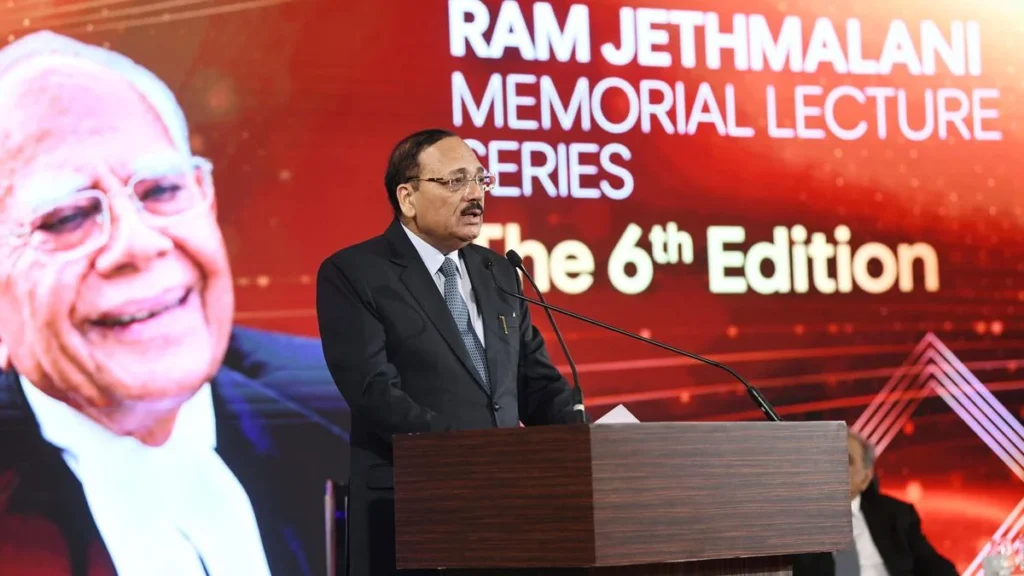
New Delhi, September 14, 2026 — In a profound address that bridged the gap between historical jurisprudence and modern institutional accountability, Chief Justice of India (CJI) Surya Kant delivered the sixth edition of the ‘Ram Jethmalani Memorial Lecture’ on Monday. Speaking on the theme, “Justice seen to be done: Transparency and public trust as pillars of the legal system,” the CJI offered a candid reflection on the judiciary’s role in a democratic society, specifically addressing the recent, high-profile controversy surrounding NCERT Class 8 textbooks.
His remarks signal a potential paradigm shift in how the Indian judiciary perceives its relationship with public discourse, moving away from the defensive posturing often associated with contempt proceedings toward a philosophy of transparency and iterative institutional growth.
The NCERT Textbook Row: A Case Study in Institutional Tension
The CJI’s address served as a reflective post-script to one of the most contentious judicial interventions of the year. In early 2026, the Supreme Court took suo motu cognizance of content within an NCERT Class 8 social science textbook that made explicit references to “judicial corruption.”
The Bench, led by CJI Kant, initially responded with significant severity. The court characterized the textbook’s depiction of the judiciary as “reckless, irresponsible, motivated, and contemptuous.” The bench argued that such narratives were designed to instill deep-seated bias in the “impressionable minds” of young students. In the heat of the initial proceedings, the court went as far as to demand that “heads must roll,” threatening stringent action against the academicians and bureaucrats responsible for the curriculum’s content. The court ordered an immediate withdrawal of the textbooks, citing the potential for irreparable harm to the image of the judiciary.
However, as the legal process unfolded, the tone shifted. By mid-September 2026, the Supreme Court officially closed the suo motu proceedings. This followed the NCERT’s decision to replace the controversial chapter with a revised curriculum and the court’s subsequent decision to recall its earlier, harsher remarks directed at individual researchers and writers.
Chronology of the Controversy
- Early 2026: NCERT publishes a revised Class 8 textbook containing references to corruption within the judiciary.
- Mid-2026: The Supreme Court takes suo motu cognizance of the matter, labeling the text "contemptuous" and "motivated."
- June–August 2026: Legal and academic circles engage in intense debate regarding the balance between academic freedom and the protection of constitutional institutions.
- Early September 2026: The NCERT submits a proposal to revise the curriculum. The Supreme Court reviews the changes.
- September 10, 2026: The Court formally closes the suo motu case, noting that while the initial text was problematic, the judiciary remains open to "informed and constructive critique."
- September 14, 2026: CJI Surya Kant addresses the Ram Jethmalani Memorial Lecture, contextualizing the episode as a "learning moment" for the institution.
Institutional Philosophy: "Institutions Do Not Stay Clean by Being Shielded"
In his keynote address, CJI Kant emphasized that the NCERT episode provided an essential opportunity to evaluate the relationship between legitimate criticism and public confidence. He underscored a critical realization for the modern judiciary: "Institutions do not stay clean by being shielded from scrutiny."
He argued that the judiciary’s strength is not derived from its ability to silence dissent, but from its capacity to survive the scrutiny of a vibrant democracy. "The judiciary, as an institution, is not, and cannot be, averse to criticism," the CJI remarked. He further clarified that while the court had taken exception to the specific, arguably "reckless" nature of the NCERT content, it fully acknowledges that "fair, informed, and constructive critique" is a vital feature of constitutional life.

The Myth of Absolute Immunity
The CJI rejected the notion that the judiciary could secure public trust by placing itself on a pedestal above questioning. "A court cannot seek the confidence of the public by placing itself beyond scrutiny," he stated. "It must remain willing to be examined, questioned, and, where necessary, criticized."
This stance marks a departure from the traditional, sometimes rigid, enforcement of the contempt of court doctrine. The CJI suggested that the true metric of a court’s integrity is not the absence of criticism, but the ability to withstand and engage with it transparently.
Defining "Justice Seen to be Done"
A central pillar of the CJI’s lecture was the classic legal adage that "justice must be seen to be done." He expanded on this, noting that a judicial verdict is insufficient if it is merely technically correct; it must also be perceived as equitable by those directly affected by it.
Beyond Approval: The Currency of Trust
"A court does not earn trust by being liked, or by handing out the outcomes people wanted," the Chief Justice explained. "It earns trust when the people who lost, who wanted an entirely different result, still walk away believing that the process which decided against them was a fair one. That is a far harder thing to earn than approval, and far more valuable."
This distinction—between public approval and public trust—is crucial. Approval is fleeting and often tied to case outcomes, whereas trust is structural. It is built on the consistency, logic, and transparency of the process itself.
Transparency as Reasoning, Not Just Procedure
CJI Kant offered a compelling definition of transparency, arguing that it extends far beyond the physical act of holding public hearings or keeping court doors open.
"It means that the reasoning behind a decision, and not merely its result, can be examined by anyone who cares to look," he noted. "A court that announces its verdicts but keeps its reasoning to itself has not really been transparent, whatever else it may have done." This reinforces the mandate for judicial orders to be articulate, accessible, and grounded in clear, defensible logic that can stand up to public and academic review.

Implications for the Future of the Judiciary
The CJI’s speech suggests that the Indian judiciary is moving toward a strategy of "radical transparency" as a survival mechanism in an age of misinformation and heightened public awareness.
1. Re-evaluating Contempt
By backing away from the initial, aggressive stance on the NCERT textbook, the Court has signaled that it prefers to rely on institutional prestige and the quality of its reasoning rather than the punitive weight of contempt laws. This is likely to lead to a more restrained judicial approach when dealing with public or media criticism in the coming years.
2. The Responsibility of the Judiciary
The CJI acknowledged that public trust is the "only coin the judiciary has ever truly held." He stressed that this trust is not a static asset that can be deposited once; it must be "renewed continuously." This renewal, he explained, is shaped more by the "accumulated, ordinary experience people have of a system" than by any single landmark judgment.
3. A Call for Self-Correction
By framing the NCERT controversy as an "occasion to consider" the judiciary’s relationship with society, the CJI effectively signaled that the institution is in a state of self-correction. The willingness to recall earlier, harsher findings suggests an institutional maturity that prioritizes the long-term health of the justice system over the short-term ego of the court.
Conclusion: The Never-Ending Task
As he concluded his address, Chief Justice Surya Kant returned to the reality of the judicial mandate. The work of earning and maintaining public trust, he asserted, is “never really finished.”
In the wake of the NCERT textbook row, the judiciary appears to be charting a path that acknowledges its fallibility while reaffirming its commitment to the constitutional principles that define it. By inviting scrutiny, the CJI is betting that the institution’s core integrity is robust enough to survive, and ultimately be strengthened by, the very critique it once sought to suppress.
For a nation as complex and diverse as India, the Chief Justice’s vision of a judiciary that is "willing to be examined" serves as a powerful reminder that in a democracy, the ultimate authority is not the court itself, but the public trust that sustains it.