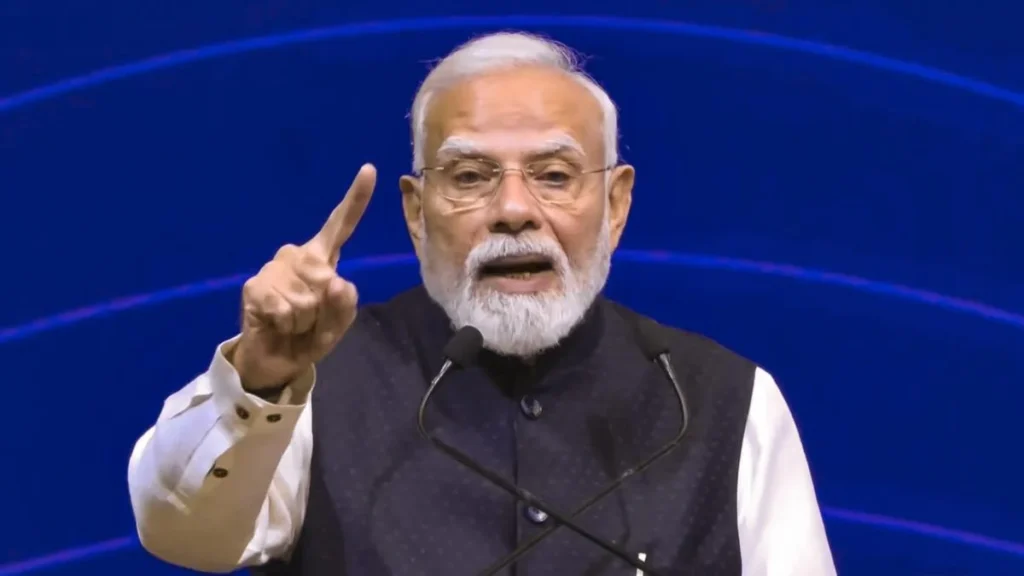
NEW DELHI — In a major push to establish the country as an indispensable pillar of the global technology architecture, Prime Minister Narendra Modi on September 17, 2026, pitched India as a "new and trustworthy location" for electronics and semiconductor manufacturing. Addressing the high-profile inauguration of SEMICON India 2026 at Yashobhoomi in New Delhi, the Prime Minister urged global chipmakers to leverage India’s growing manufacturing and design capabilities to safeguard critical technology supply chains from increasing geopolitical vulnerabilities and the threat of "weaponisation."
The four-day summit, which has drawn premier executives, policymakers, and innovators from across the globe, comes at a transformative juncture for India’s technological ambitions. It follows closely on the heels of the formal notification of the second phase of the India Semiconductor Mission (ISM 2.0), backed by a substantial outlay of ₹1.27 lakh crore.
Main Facts
SEMICON India 2026 has emerged as a watershed moment for the nation’s high-tech manufacturing sector, spotlighting major financial commitments, strategic policy rollouts, and strong validation from global semiconductor giants.
The Visionary Pitch: Prime Minister Modi emphasized that India’s holistic approach—simultaneously scaling chip design, fabrication (foundries), equipment manufacturing, the materials ecosystem, and advanced testing—sets it apart from historical models where ecosystems took decades to build in a fragmented manner.
Massive Financial Inflows: Major global firms have announced landmark investments. Notably, Applied Materials committed $5 billion over the next five years to expand its R&D and supply chain footprints in India, while Lam Research announced a ₹10,000 crore investment to build its first silicon component manufacturing facility in the country.
Policy Foundation: The notification of ISM 2.0 (with a ₹1.27 lakh crore financial backing) has provided the predictable, long-term policy foundation required to attract high-risk, capital-intensive semiconductor projects.
Talent Development: The Ministry of Electronics and Information Technology (MeitY), led by Minister Ashwini Vaishnaw, announced an aggressive plan to train 100,000 skilled professionals to build a "global pool of talent" ready for immediate deployment in upcoming domestic chip facilities.
Chronology of India’s Semiconductor Journey
The realization of SEMICON India 2026 is the culmination of a meticulously planned national strategy that accelerated over the past half-decade.
December 2021: The Union Cabinet approved the comprehensive ₹76,000 crore ($10 billion) India Semiconductor Mission (ISM) to incentivize semiconductor and display manufacturing ecosystems in the country.
2022–2023: India successfully positioned itself as a premier global hub for chip design, hosting thousands of design engineers for major multinational corporations and domestic startups alike. However, domestic fabrication (fab) plants remained absent.
Late 2023 – 2024: Groundbreakings and approvals for initial Outsourced Semiconductor Assembly and Test (OSAT) and fab facilities began taking shape. Micron Technology broke ground on its massive assembly, test, marking, and packaging (ATMP) plant in Sanand, Gujarat.
Early 2026: Micron’s Sanand facility officially commenced commercial production, marking a historic milestone as the first large-scale memory packaging plant in the country to go live.
September 2026: The Indian government officially notified the second phase of the India Semiconductor Mission (ISM 2.0) with an outlay of ₹1.27 lakh crore, expanding incentives to cover raw materials, specialized chemicals, equipment manufacturing, and advanced packaging.
September 17, 2026: Prime Minister Modi inaugurated SEMICON India 2026 at Yashobhoomi, New Delhi, where global industry leaders unveiled multi-billion-dollar expansion plans.
Supporting Data and Market Projections
The backdrop of SEMICON India 2026 is defined by staggering global market projections and concrete corporate commitments.
According to Ajit Manocha, CEO of the global industry body SEMI, the worldwide semiconductor industry is poised to cross $1.3 trillion in total value by the end of 2026, on a clear trajectory toward $2 trillion by 2030. As artificial intelligence, automotive electronics, Internet of Things (IoT), and high-performance computing (HPC) drive insatiable demand for silicon, diversifying supply chains has become an existential priority for the global economy.
Corporate commitments made public at the summit underscore this momentum:
Applied Materials: Committed $5 billion over the next five years to dramatically expand its R&D centers and localize its supply chain network.
Lam Research: Pledged ₹10,000 crore to establish its maiden silicon component manufacturing facility in India, while scaling up domestic sourcing partnerships for specialized gases, chemicals, precision components, and metrology services.
Micron Technology: CEO Sanjay Mehrotra reported that the company’s Sanand facility is already producing at a scale that "exceeds the memory required for India’s entire laptop market."
Infineon Technologies: Announced a 28% increase in hiring in India, citing the unmatched pace of progress within the country’s engineering ecosystem.
Merck Electronics and ASML: Executives highlighted India’s swift transition from a pure consumer and design market into a "full-stack global semiconductor powerhouse," with ASML emphasizing the long-term importance of the Indian market as its lithography ecosystem matures.
Official Responses and Perspectives
The summit served as a platform for alignment between the Indian government and international semiconductor titans, emphasizing mutual trust, democratic values, and economic security.
"This is not a sector where you set up a factory and the job is done. Wherever semiconductor ecosystems have been built in the world, the entire ecosystem has come together only after decades of hard work. But India, with your cooperation, has worked simultaneously on chip design, manufacturing, equipment manufacturing, the materials ecosystem, testing capability, and has demonstrated success."
— Prime Minister Narendra Modi
Addressing the geopolitical realities shaping contemporary trade, Mr. Modi added:
"India is the mother of democracy. When such a country succeeds in a critical industry, it strengthens the supply chain of the entire world. And today, when supply chains are being weaponised, its importance becomes much greater. We should also look at this development taking place in India from this larger perspective."
IT Minister Ashwini Vaishnaw elaborated on the human capital strategy, confirming the administration’s focus on workforce readiness:
"We plan to train one lakh people who will constitute a global pool of talent, capable of being straightaway employed in the advanced factories that are rapidly coming up across India."
Global industry leaders echoed these sentiments of optimism. Jochen Hanebeck, CEO of Infineon, described India as a "market of tremendous importance" with an exceptional pace of ecosystem development. Benjamin Hein, Electronics CEO at Merck, noted:
"India is evolving from a major chip consumer and chip design hub into a full-stack global semiconductor powerhouse."
Wayne Allan of ASML reinforced that Dutch manufacturing technology providers view India as an increasingly crucial anchor in the future global landscape.
Implications for India and the Global Economy
The unfolding developments at SEMICON India 2026 carry profound structural implications, both domestically and internationally.
1. Re-engineering Global Supply Chains
For decades, semiconductor manufacturing has been dangerously concentrated in a handful of East Asian geographies, leaving the global economy vulnerable to geopolitical flashpoints, natural disasters, and logistical bottlenecks. By positioning itself as a democratic, reliable, and transparent alternative, India is offering the world a viable "China Plus One" (and increasingly, a primary diversification) strategy. The weaponization of supply chains has made trusted partnerships paramount; India’s stable regulatory environment and democratic governance model provide a reassuring anchor for Western and allied tech firms.
2. Economic Transformation and High-Value Job Creation
The transition from a service-oriented IT exporter to a hardware and advanced manufacturing powerhouse will fundamentally alter India’s economic fabric. The influx of billions of dollars in foreign direct investment (FDI), coupled with domestic capital outlays under ISM 2.0, will catalyze downstream industries—including automotive, consumer electronics, telecommunications, and defense. Furthermore, the targeted training of 100,000 engineers and technicians ensures that the demographic dividend translates into high-paying, high-value technical employment.
3. Technological Sovereignty and National Security
In the modern era, semiconductors are the new oil—powering everything from everyday smartphones to advanced defense systems, artificial intelligence models, and critical infrastructure. Developing indigenous capabilities in chip design, packaging, and eventually advanced fabrication ensures that India safeguards its national security interests and reduces strategic dependency on external suppliers.
As SEMICON India 2026 progresses, it is abundantly clear that the nation’s semiconductor dream is no longer a distant aspiration, but a rapidly accelerating reality backed by hard capital, visionary policy, and global industrial alignment.