Beyond the ‘Site:’ Command: How to Check if Your Web Pages Are Appearing in AI Search Retrieval Systems
By [Author Name]
Published in Search & Discovery Insights
Main Facts
In the modern landscape of Search Engine Optimization (SEO), traditional methods for verifying whether a web page has been indexed are undergoing a massive transformation. For decades, SEO professionals relied on the trusty "site:" search operator in Google and Bing to quickly check if a specific URL resided in a search engine’s index without needing direct access to Google Search Console (GSC) or Bing Webmaster Tools (BWT). Alternatively, practitioners would copy a distinct snippet of meaningful text from a page, enclose it in quotation marks, and paste it into a traditional search engine to check for indexing or accidental duplication.
However, as the paradigm shifts from traditional keyword-based search engines to Answer Engine Optimization (AEO) and AI-driven chatbots with real-time web browsing capabilities, these classic troubleshooting methods are no longer sufficient on their own. Without direct diagnostic tools or server log file access, webmasters face a frustrating blind spot regarding how AI models discover, retrieve, and reference their content.
To bridge this gap, SEO expert Chris Green has introduced an innovative workaround: using targeted prompting to verify if AI search models (such as ChatGPT with active search tooling) can retrieve and cite exact text snippets from a web page. To streamline this process for marketing professionals, Green has also developed an open-source Chrome extension called "Exactly Matchy." While this method is not a silver bullet and requires careful interpretation, it offers a vital new diagnostic pathway for auditing content visibility in the age of generative AI.
Chronology: The Evolution of Index Verification and AI Retrieval
To understand the significance of this new AI-focused verification method, it helps to look at how SEO auditing practices have evolved alongside search technology:
- The Traditional Era (Late 2000s–Early 2020s): SEOs relied heavily on the
"site:yourdomain.com/page-url"command. This straightforward Boolean operator allowed instant confirmation of whether a URL was part of a search engine’s database. Exact-match phrase matching via quotation marks became the standard for checking content uniqueness and syndicate tracking. - The Rise of Webmaster Dashboards: Google Search Console and Bing Webmaster Tools became the gold standards for diagnosing technical health, providing direct metrics on crawling, indexing statuses, and query performance.
- The Generative AI Disruption (2023–Present): With the explosive growth of conversational AI platforms like ChatGPT, Perplexity, and Claude—many equipped with live web-retrieval features—traditional search engines are no longer the sole gatekeepers of web traffic. Webmasters noticed a gap: content might be visible to traditional search crawlers, but its presence and retrievability within large language model (LLM) search indexes remained opaque.
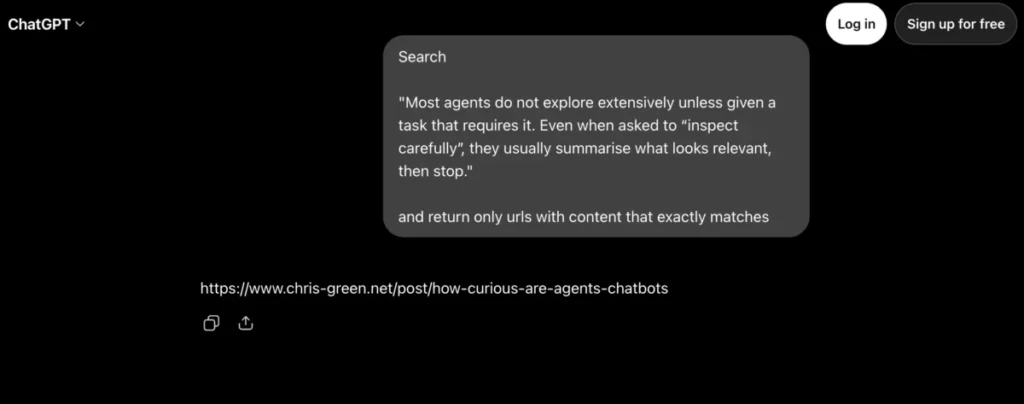
- The AI Prompting Workaround: Recognizing the lack of dedicated GSC-style reporting for AI search engines, industry practitioners began testing custom exact-match prompts. By commanding an LLM to search for a specific verbatim text string and return only matching sources, users discovered a reliable way to test whether an AI retrieval system acknowledges a page.
- Automation and Tooling: To eliminate the clunkiness of manual copy-pasting, developer-minded SEOs began building browser utilities—such as Green’s GitHub-hosted extension, Exactly Matchy—to automate the process of testing web page retrievability directly within AI chat interfaces.
Supporting Data and Technical Mechanics
To successfully execute this AI retrieval check, SEOs must understand the technical boundaries and mechanics of how conversational agents interact with live web data.
The Core Prompting Formula
When querying an AI model that features browsing capabilities (such as ChatGPT signed out or in a neutral session), standard natural language queries will not suffice. Instead, a strict formatting constraint must be applied to force the model to behave like a retrieval-augmented generation (RAG) verification tool.
The baseline prompt structure looks like this:
“Search for ‘[paste your exact text snippet here]’ and return any results which contain that exact text only.”
Interpreting the Results
When an AI chatbot successfully processes this command and returns your specific URL, several technical inferences can be made:
- Successful Discovery and Indexing: The AI’s underlying search provider has successfully crawled, parsed, and indexed the specific URL containing that text string.
- Retrieval Viability: The content snippet possesses enough semantic uniqueness and structural clarity to be surfaced during a live retrieval phase.
Troubleshooting Failed Retrievals
If the AI model fails to return your page, it does not automatically mean your site is permanently banned or ignored. However, it signals a high-priority troubleshooting checklist:

- Crawl and Rendering Blocks: Check your
robots.txtfile or meta robots tags to ensure AI user-agents (such asGPTBot,OAI-SearchBot, or third-party web scrapers) are not blocked from accessing your content. - Discovery Delays: The page may simply be too new; discovery and indexing in AI-driven retrieval systems can follow non-traditional cadences compared to standard search engines.
- Insufficient Distinctiveness: The text snippet chosen might be too generic, generic boilerplate text, or masked behind heavy client-side JavaScript that the retrieval crawler failed to execute properly.
Accounting for Variability
Because large language models often draw from diverse, distributed data sources and varying cache layers, a single test is rarely definitive. Experts recommend executing the test four to five times across different sessions or varying the text snippet slightly. If inconsistent results occur, it often indicates that the AI model is pulling from multiple underlying database replicas where synchronization is still catching up.
Official Responses and Industry Perspectives
While major AI developers and search engines—including OpenAI, Microsoft, and Google—have not released official APIs specifically designed to audit LLM retrieval indexes in the granular way webmasters desire, industry experts are actively vocal about the implications of this shift.
Chris Green, creator of the Exactly Matchy extension, emphasizes that while these workarounds provide immense value, they must be handled with professional skepticism:
"Without GSC, BWT, or access logs, you can’t answer those questions for sure, but you have a list of potential issues to work through. This ‘workaround’ is not a straight-out replacement, and AI chatbot responses are not ‘truth’—so you need to interpret the output."
Furthermore, search and content analysts point out a critical distinction that many marketers misunderstand: retrieval is not the same as ranking.
A common frustration among site owners is discovering that while their page passes the AI retrieval test (meaning the chatbot can find it when forced), the page still fails to drive conversational traffic or appear organically in broader AI-generated summaries. Industry veterans stress that passing the retrieval hurdle is merely step one. Beyond technical access, AI search visibility relies heavily on contextual authority, brand entity strength, and how uniquely valuable a piece of content is relative to the fierce competition within the LLM’s training and retrieval ecosystem.
Implications for the Future of SEO and AEO
The transition from traditional blue links to conversational AI answers fundamentally alters how websites measure digital visibility. As search marketing shifts toward Answer Engine Optimization (AEO), the implications for digital strategists are profound:
1. The Death of the Monopolistic Index Check
As search fragments across dozens of proprietary AI interfaces, relying solely on Google Search Console will no longer paint a complete picture of a brand’s digital footprint. Marketers will need to adopt multi-platform auditing habits, testing how their content appears across OpenAI, Microsoft Copilot, Perplexity, and emerging localized LLMs.
2. The Rise of Developer-Driven SEO Tooling
Because major tech platforms are slow to provide transparent, native debugging tools for AI retrieval behavior, the SEO community is increasingly leaning toward open-source, community-built utilities. Tools like Exactly Matchy—which requires users to fork GitHub repositories and run Chrome extensions in developer mode—foreshadow a future where technical SEOs act more like software engineers, building custom scripts to audit machine-readable web ecosystems.
3. Redefining Content Quality for Machines
To survive in an AI-dominated search environment, content cannot merely be well-written for human readers; it must be uniquely structured for machine retrieval. If a page’s content is too homogenous or lacks distinct textual identifiers, it risks being swallowed by the noise of LLM training data and real-time RAG fetching. Crafting content with clear semantic boundaries, definitive data points, and robust entity signals will become the cornerstone of future optimization strategies.
Conclusion
Verifying whether your web pages exist within the hidden machinery of AI search engines is no longer a luxury—it is a technical necessity. While manual prompts and open-source browser extensions like Exactly Matchy are not flawless diagnostic panaceas, they offer webmasters an actionable, forward-thinking toolkit to navigate the opaque waters of generative search. By mastering these retrieval checks, SEO professionals can proactively resolve crawling blocks, ensure technical readiness, and position their content to win visibility in the rapidly expanding era of conversational AI.