AWS Unveils Enhanced Custom Event Bus for Amazon EventBridge: A Paradigm Shift for Multi-Account Serverless Architectures
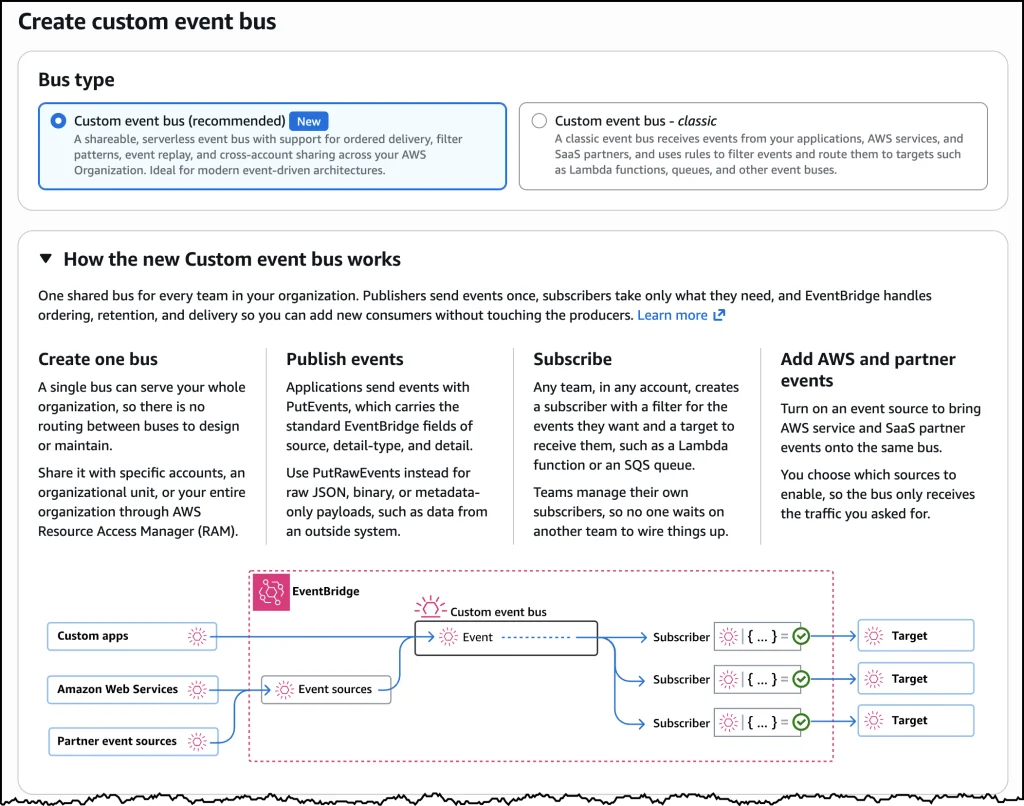
SEATTLE — In a major development for cloud architects and serverless developers, Amazon Web Services (AWS) has announced the official launch of the enhanced custom event bus for Amazon EventBridge. Designed from the ground up to address the friction points of scaling event-driven applications across complex, multi-account organizational topologies, this new capability promises to eliminate the operational overhead of cross-account routing while introducing native event ordering, simplified subscriber management, and a modernized ingress-egress pricing model.
The release marks one of the most substantial architectural evolutions for Amazon EventBridge since its inception. By allowing organizations to deploy a single, centralized, organization-wide event bus, AWS is tackling head-on the sprawling complexity that typically accompanies enterprise-grade serverless adoption.
Main Facts: What is the Enhanced Custom Event Bus?
The newly released enhanced custom event bus is a purpose-built AWS resource designed to streamline asynchronous communication across large enterprises. Previously, organizations scaling event-driven architectures faced a structural dilemma: while AWS best practices mandated isolated multi-account environments for security and governance, routing events across those accounts required intricate webs of cross-account permissions, resource policies, and bus-to-bus configurations.
Key attributes of the enhanced custom event bus include:
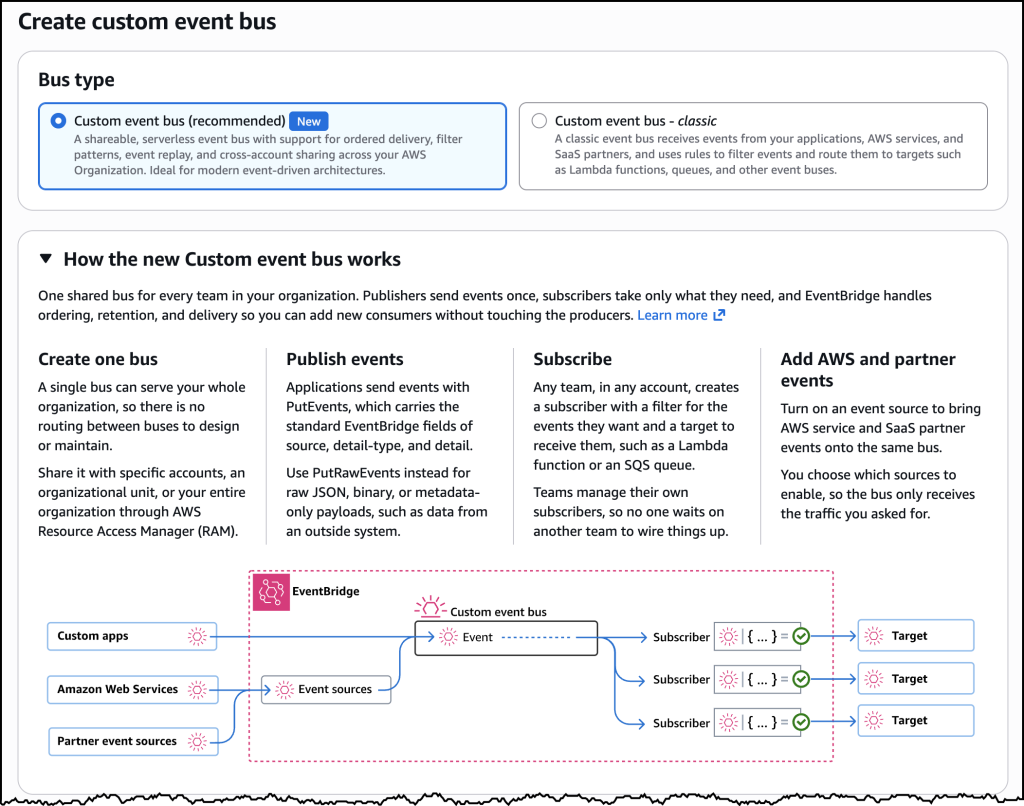
- Organization-Wide Centralization: A single event bus can now be shared across all AWS accounts within an enterprise organization using native AWS Resource Access Manager (AWS RAM) integration.
- Native Event Ordering: Publishers can specify an
EventGroupIdto enforce strict sequential processing for targeted workloads—such as logistics or financial ledgers—without sacrificing asynchronous performance for other consumers. - The Subscriber Resource: A consolidated resource model that merges event filtering, target configuration, retry policies, and dead-letter queues (DLQs) into a single manageable entity.
- Advanced Event Evaluation: Support for content-based deduplication, JSONata-based payload transformation, and deserialization of Apache Avro or Protocol Buffers.
- Scale and Throughput: A default quota of 10,000 subscribers per bus, drastically reducing the need to fragment workloads across multiple disparate buses.
- A New Economic Model: A split ingress and egress pricing structure that charges publishers for events ingested and subscribers for events delivered, eliminating compound cross-account routing fees.
Chronology: The Evolution of Event-Driven Routing on AWS
To understand the significance of this release, it is helpful to examine the historical trajectory of event-driven architectures on the AWS platform:
Phase 1: The Single-Account Paradigm
In the early days of serverless application development, organizations built applications within a single AWS account. A single custom event bus sufficed for all internal routing. Teams enjoyed rapid iteration, clear visibility, and low operational friction. However, as enterprise adoption accelerated, security and compliance requirements necessitated the division of workloads into dedicated accounts per team or business unit.

Phase 2: The Multi-Account Workaround
To bridge the architectural gap between isolated accounts, developers turned to cross-account rules and bus-to-bus configurations. While functional, this approach introduced severe operational complexities:
- Platform teams lost central visibility into event subscriptions.
- Routing costs compounded rapidly as events hopped across multiple buses.
- Teams requiring strict event ordering or complex transformations were forced to deploy auxiliary infrastructure—such as Amazon Simple Queue Service (Amazon SQS) or custom middleware—strictly to maintain message sequence and reliability.
Phase 3: The Unified Enterprise Vision
Recognizing that workaround architectures violated the core tenets of serverless simplicity, AWS engineering teams spent months designing a native solution. The result is the enhanced custom event bus. Announced and rolled out globally across major AWS regions, this feature transitions enterprises away from patchwork multi-bus systems back to a streamlined, governed, and scalable central backbone model.
Supporting Data and Technical Capabilities
The technical architecture of the enhanced custom event bus introduces several powerful mechanisms designed to handle high-throughput enterprise workloads securely and efficiently.
1. Frictionless Resource Sharing via AWS RAM
Setting up the new bus requires minimal administrative overhead. Administrators navigate to the AWS Management Console, select the new custom event bus option, and toggle on event bus sharing. By integrating with AWS RAM, platform engineers can scope sharing parameters to an entire organization, specific organizational units (OUs), or individual AWS accounts. Publishers and subscribers can immediately interact with the shared bus without manually authoring complex IAM cross-account trust policies.
2. Resolving the Event Ordering Dilemma
Event-driven patterns inherently thrive on asynchronous execution where message order is irrelevant. Yet, real-world domains—such as tracking physical shipments, executing financial transactions, or managing IoT device states—frequently demand chronological integrity.
The enhanced custom event bus solves this by allowing publishers to attach an EventGroupId to payloads. EventBridge guarantees that events sharing the same identifier are delivered in strict sequence to subscribers configured for ordered delivery. Crucially, other subscribers on the same bus can continue consuming events asynchronously without being bottlenecked by the ordered streams. Furthermore, the introduction of synchronous invocation modes for targets like AWS Lambda eliminates the traditional dependency on intermediary SQS queues for ordering guarantees.

3. Streamlined Subscriber Management and Transformation
Managing disparate rules, targets, and retry policies has historically created administrative friction. The new "Subscriber" resource unifies these configurations. Each consumer defines an independent subscription detailing filter patterns, retry mechanics, and dead-letter handling.
To assist downstream systems with disparate schema requirements, the bus integrates JSONata expressions. Subscribers can dynamically reshape payloads on the fly—extracting, renaming, or computing fields before the event reaches its target. Additionally, native deserialization for Apache Avro and Protocol Buffers allows consumers to filter and route complex binary data payloads without writing custom parsing code.
4. Smart Deduplication
Network timeouts and transient failures frequently trigger retries that result in duplicate message processing. The enhanced custom event bus features content-based deduplication. By hashing meaningful payload attributes and identifying identical events arriving within a five-minute window, EventBridge automatically drops duplicates, effectively offering exactly-once processing semantics for unreliable sources.
Official Responses and Strategic Implications
While AWS has positioned the feature as a natural evolution of serverless infrastructure, early industry response highlights profound strategic implications for enterprise cloud governance.
Cloud platform architects have long struggled with the "tragedy of the commons" in shared serverless environments: while centralization fosters collaboration, it frequently breaks down security boundaries and cost attribution models. By separating the financial responsibility between ingress (paid by publishers) and egress (paid by subscribers) through the new pricing structure, AWS has resolved a major political hurdle within enterprise finance departments. Platform teams can now accurately allocate cloud expenditures down to the consuming business unit.
Furthermore, industry analysts note that the inclusion of native event ordering and format deserialization directly targets niche messaging systems and enterprise service buses (ESBs) that organizations previously retained out of necessity. By absorbing these capabilities into a fully managed, serverless event bus, AWS continues to consolidate the modern application integration stack.
Organizational Implications: Adopting the Enhanced Bus
For organizations evaluating the migration to the enhanced custom event bus, AWS has ensured a smooth transition path. Existing architectures will remain entirely unaffected: legacy configurations will continue to operate seamlessly under the designation Custom event bus – classic.
Adoption of the enhanced model is entirely voluntary and can be executed at an organization’s own pace. Platform engineering teams are advised to follow a structured roadmap:
- Audit Existing Topologies: Review current multi-account bus-to-bus routing structures to identify candidates for consolidation into a single centralized organizational bus.
- Define Governance Policies: Establish AWS RAM sharing parameters, identifying which organizational units or accounts require publishing and subscribing permissions.
- Refactor Critical Paths: Migrate workloads requiring strict sequential processing to utilize
EventGroupIdand evaluate the removal of intermediary SQS queues where synchronous Lambda invocation is preferred. - Optimize Cost Allocation: Review the new ingress/egress pricing metrics to align internal chargeback models with consuming teams.
Global Availability
The enhanced custom event bus is available immediately across a broad footprint of global AWS Regions, including US East (N. Virginia, Ohio), US West (Oregon), Europe (Ireland, Frankfurt, Stockholm, Spain), and Asia Pacific (Hong Kong, Malaysia, Mumbai, Singapore, Sydney, Thailand, Tokyo). Engineering teams can provision the new resource today via the AWS Management Console, AWS Command Line Interface (CLI), or programmatic EventBridge APIs.