AWS and Open Source Communities Converge at Open Source Summit Korea 2026 and MCP DevSummit Seoul
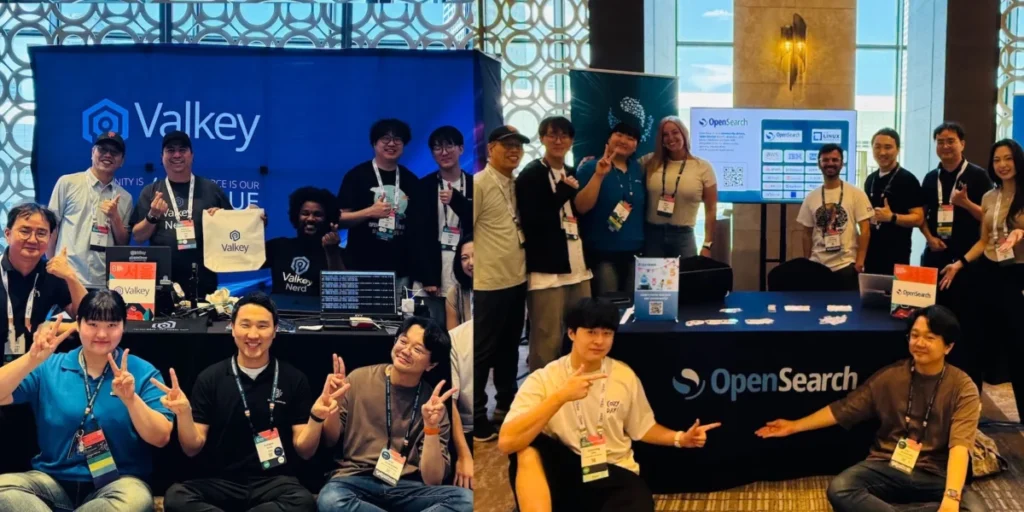
SEOUL, SOUTH KOREA — In a vibrant showcase of international collaboration and open-source momentum, Amazon Web Services (AWS) contributors converged with the global developer ecosystem last week at the Open Source Summit Korea 2026 and the MCP DevSummit Seoul 2026. The high-profile, four-day gathering brought together a diverse cohort of software engineers, community leaders, and enterprise architects from the Linux Foundation’s marquee open-source initiatives.
The event served as an epicenter for technical knowledge sharing, collaborative problem-solving, and hands-on networking. Central to the AWS presence at the conference were two foundational pillars of modern cloud architecture: OpenSearch, the enterprise-grade search and observability suite, and Valkey, the high-performance key/value datastore.
Throughout the four-day schedule, Korean OpenSearch community leaders took center stage, volunteering at dedicated project booths and facilitating direct engagement with developers. These interactions culminated in a lively local user group meetup in Seoul, where contributors discussed roadmap priorities, shared implementation strategies, and celebrated the burgeoning adoption of open-source technologies across the Asia-Pacific region.
Main Facts: Deep Dive into the Core Technologies
The convergence in Seoul highlighted significant recent milestones for both OpenSearch and Valkey, particularly regarding how upstream innovations translate directly into enterprise-ready managed services on AWS.
OpenSearch 3.7 and Amazon OpenSearch Service
OpenSearch remains a critical engine for organizations seeking to make sense of unstructured data at massive scale, powering search, logging, and application monitoring workloads worldwide.
- The Upstream Release: On June 9, 2026, the OpenSearch project officially rolled out OpenSearch 3.7. This major release introduced advanced tools enabling developers to query, alert, and track Service Level Objectives (SLOs) across logs, traces, and metrics through a unified, centralized interface. Crucially, OpenSearch 3.7 delivered dramatic performance optimizations, achieving vector retrieval speeds up to 5.5x faster than previous iterations to support modern generative AI and semantic search workloads.
- The AWS Integration: Building upon these open-source advancements, AWS announced that as of July 30, 2026, customers can run OpenSearch version 3.7 natively on Amazon OpenSearch Service. This integration brings immediate enhancements to vector search performance, search relevance, and Query Insights, allowing enterprises to scale their machine learning and observability infrastructure with enterprise-grade reliability and reduced operational overhead.
Valkey 9.1 and Amazon ElastiCache
For workloads demanding microsecond latencies—such as caching layers, real-time message queues, and high-frequency primary data stores—Valkey has firmly established itself as a premier open-source key/value datastore.
- The Upstream Release: Released on May 19, 2026, Valkey 9.1 introduced a completely redesigned I/O threading model. This architectural overhaul boosted overall data throughput by up to 17% while simultaneously driving down memory consumption for strings under 128 bytes by up to 20%.
- The AWS Integration: Demonstrating a rapid time-to-market for upstream innovations, AWS made Valkey 9.1 available on Amazon ElastiCache starting June 23, 2026. Tailored specifically for node-based clusters, this managed implementation delivers accelerated throughput, superior memory efficiency, and fortified access controls designed explicitly for complex, multi-tenant cloud environments.
Chronology: A Season of Open-Source Innovation
The momentum witnessed in Seoul is part of a broader, carefully synchronized timeline of open-source evolution and cloud integration throughout the first half of 2026.
[May 19, 2026]         ➡️  Valkey 9.1 released upstream (New I/O threading, +17% throughput).
[June 9, 2026]         ➡️  OpenSearch 3.7 released upstream (Unified observability, 5.5x faster vectors).
[June 23, 2026]        ➡️  AWS launches Valkey 9.1 support in Amazon ElastiCache.
[July 30, 2026]        ➡️  AWS launches OpenSearch 3.7 support on Amazon OpenSearch Service.
[Mid-August 2026]      ➡️  AWS contributors join Open Source Summit Korea & MCP DevSummit Seoul.
This sequence underscores a deliberate operational philosophy within the modern cloud ecosystem: upstream open-source communities drive rapid, community-vetted innovation, while hyperscale cloud providers like AWS rapidly operationalize these breakthroughs into secure, scalable, fully managed services.
Supporting Data & Metrics
The technical enhancements showcased at Open Source Summit Korea 2026 are underpinned by rigorous benchmarking and measurable performance gains. The transition to OpenSearch 3.7 and Valkey 9.1 addresses two of the most critical pressures facing modern engineering teams: skyrocketing data volumes and the demand for real-time AI capabilities.
| Technology Component | Version | Key Performance Metric | Enterprise Impact |
|---|---|---|---|
| OpenSearch | v3.7 | Up to 5.5x faster vector retrieval | Accelerates generative AI, semantic search, and Retrieval-Augmented Generation (RAG) pipelines. |
| OpenSearch Service | v3.7 | Unified observability interface | Combines logs, metrics, and traces with streamlined SLO tracking and advanced Query Insights. |
| Valkey | v9.1 | Up to 17% higher throughput | Handles heavier request loads with lower latency for cache-heavy applications. |
| Valkey (Memory) | v9.1 | Up to 20% reduction in memory usage (strings < 128 bytes) | Significantly lowers infrastructure costs for high-density, key-value workloads. |
| Amazon ElastiCache | v9.1 | Enhanced multi-tenant access controls | Secures shared environments while maintaining high-performance data delivery. |
Official Perspectives and Community Response
The presence of AWS contributors alongside grassroots community leaders in Seoul highlights a vital shift in how major technology corporations interact with open-source projects. Rather than merely consuming open-source code, hyperscalers are actively embedding engineering resources directly into upstream governance, maintenance, and event sponsorships.
Local Korean OpenSearch community leaders, who volunteered extensively at the event booths, emphasized the importance of face-to-face collaboration. In an era dominated by remote work and digital communication, summits like those in Seoul provide an irreplaceable venue for junior developers to interface with core maintainers.
The Seoul user group meetup served as a microcosm of this dynamic. Developers shared candid feedback regarding multi-region deployments, migration paths from legacy systems, and optimization strategies for vector databases. Feedback gathered during these sessions directly informs the feature backlogs of both project maintainers and AWS service teams, ensuring that cloud-managed implementations remain closely aligned with developer realities.
Implications for Enterprise Architecture
For enterprise CTOs, cloud architects, and software engineering managers, the developments showcased at Open Source Summit Korea 2026 carry several strategic implications:
1. The Maturation of Vector Search Infrastructure
As generative AI transitions from experimental prototypes to mission-critical enterprise applications, the underlying data layer must keep pace. The 5.5x vector retrieval speedup found in OpenSearch 3.7—and operationalized via Amazon OpenSearch Service—lowers the latency barrier for real-time semantic search and large language model (LLM) context retrieval. Organizations no longer need to maintain fragmented, specialized vector databases alongside their traditional search infrastructure; they can unify keyword search, log analytics, and vector workloads within a single, scalable ecosystem.

2. Cost Optimization Through Architectural Efficiency
With Valkey 9.1’s redesigned I/O threading model and 20% memory reduction for smaller strings, cloud financial management (FinOps) teams gain immediate leverage. High-throughput caching layers and message queues can process significantly more transactions per second (TPS) on fewer compute nodes, directly translating to reduced cloud compute and memory expenditure.
3. Deepening Trust in Open-Source Foundations
The active participation of global tech giants in community-governed projects like Valkey and OpenSearch offers long-term architectural stability. Enterprises hesitant to adopt proprietary vendor lock-in can invest heavily in these ecosystems with the confidence that their technology stacks are backed by broad community consensus, transparent roadmaps, and robust enterprise support from providers like AWS.
Looking Ahead
As the 2026 conference season progresses, AWS has signaled its intent to maintain a heavy physical and virtual presence across upcoming global developer gatherings. Contributors from AWS are scheduled to participate in a series of upcoming community events hosted by both the OpenSearch Project and the Valkey Foundation.
Developers eager to stay on the bleeding edge of cloud architecture and open-source software are encouraged to monitor several primary channels:
- Keep a close eye on the official What’s New with AWS page for instantaneous updates regarding service launches and version rollouts.
- Explore upcoming AWS Summits, Community Days, and developer-focused events to engage in-person with technical experts.
- Connect with peers, share architectural blueprints, and access specialized learning paths by joining the AWS Builder Center.
That concludes this week’s comprehensive roundup of open-source developments and AWS ecosystem news. Be sure to check back next Monday for the next weekly dispatch.
Reported by Channy Yun / AWS News Blog.