The Fall of PayPal Honey: A Watershed Moment for Affiliate Marketing Ethics and Program Management

The digital marketing landscape was sent into a profound state of shock following an unprecedented enforcement action against one of the industry’s most recognizable names. PayPal Honey—the ubiquitous browser extension acquired by fintech giant PayPal for $4 billion six years ago—found itself unceremoniously stripped from America’s premier affiliate marketing networks.
For an industry built on the fragile architecture of trust, performance-based tracking, and last-click attribution, the removal of a dominant affiliate publisher serves as a stark wake-up call. Driven by relentless investigative work from digital rights and tracking experts, major affiliate hubs have finally drawn a hard line against conversion manipulation. As brands, affiliate managers, and network executives reassess their risk profiles, this seismic event offers five critical lessons for maintaining the integrity of modern partnership ecosystems.
Main Facts: The Anatomy of PayPal Honey’s Network Expulsion
The core controversy surrounding PayPal Honey centers on deliberate violations of "stand-down" protocols—rules specifically designed to prevent browser extensions and downloadable software publishers (DSPs) from hijacking customer journeys.
In traditional affiliate marketing, the vast majority of programs operate on a "last-touch-wins-all" attribution model. Under this paradigm, the final affiliate publisher to interact with a consumer prior to purchase claims 100% of the commission for that transaction. However, ethical boundaries are tested when browser extensions utilize intrusive code to overwrite existing referral cookies at the eleventh hour, unjustly taking credit for sales driven by top-of-funnel content creators, reviewers, or email marketers.
PayPal Honey was specifically found to be out of compliance regarding intentional stand-down rule violations and the active concealment of these practices. When a consumer arrives at an e-commerce checkout page having already clicked through an affiliate link, standard rules dictate that extension-based tools must "stand down" and refuse to inject a new tracking cookie. By circumventing these safeguards, Honey allegedly manipulated attribution metrics, forcing networks and brands to reckon with systematic overpayments and unfair compensation imbalances.
Chronology of the Crackdown: A Week That Shook the Industry
The unraveling of PayPal Honey’s network status did not happen in a vacuum; it was the culmination of mounting scrutiny, whistleblowing, and public exposure.
- Preceding Investigations: Months of tension preceded the official network actions. Independent digital investigations—most notably led by transparency advocate Ben Edelman alongside deep-dive technical breakdowns by digital creator MegaLag—exposed how certain browser extensions covertly bypassed attribution rules to steal commissions.
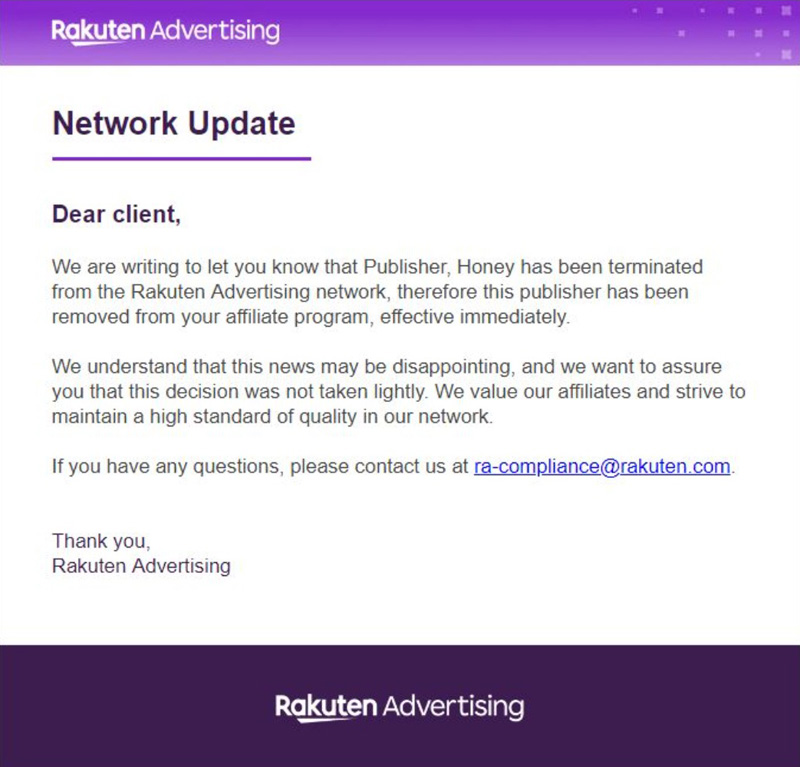
- Monday, January 12: The hammer dropped on the opening day of Affiliate Summit West, the largest U.S. affiliate marketing conference. Rakuten Advertising made waves across the industry by officially announcing that Honey had been "terminated from the network." Rakuten framed the drastic measure as a necessary step to maintain a "high standard of quality" across its ecosystem. The timing sent shockwaves through the conference floor, making "Rakuten" and "Honey" the undisputed buzzwords of the week, both live in Las Vegas and across social media platforms.
- Friday, January 16: Additional enforcement followed when impact.com confirmed that Honey was found "out of compliance" with its platform policies. Consequently, impact.com removed the publisher from its Discovery Marketplace, though industry watchers noted this action was implemented as a temporary suspension rather than a permanent, irrevocable ban.
Supporting Data, Audits, and Industry Standards
The fallout surrounding PayPal Honey has brought structural flaws in attribution management into sharp focus, prompting independent organizations to publish comprehensive data audits.
The APMA UK Independent Audit
Across the Atlantic, The Affiliate & Partner Marketing Association (APMA) in the United Kingdom conducted an independent audit examining thirty brands spread across ten affiliate networks and three distinct affiliate categories. The resulting 24-page report, titled Independent Audit of Attribution Rules in the UK Affiliate & Partner Marketing Industry, highlighted the acute complexities of modern tracking.

The audit established clear technical distinctions between varied software technologies—specifically contrasting strict "stand-down" rules against "soft click" mechanisms. By providing concrete data and actionable recommendations, the APMA audit underscored that attribution manipulation is a systemic, cross-border challenge requiring rigorous industry-wide standardization.
The PMA DSP Policies Comparison
To help brand managers navigate the murky waters of downloadable software, organizations like the Performance Marketing Association (PMA) have maintained vital resources, such as the Affiliate Network DSP Policies Comparison. These tools allow program managers to compare how different networks police software publishers, providing a baseline for evaluating whether a browser extension operates transparently or utilizes predatory cookie-dropping tactics.
Official Responses and Network Posturing
The public statements issued by major networks illuminate the delicate balancing act platforms face between maximizing transaction volume and protecting the integrity of the partnership economy.
Rakuten Advertising’s abrupt termination of Honey signaled a zero-tolerance stance toward quality degradation. By stating that the expulsion was required to uphold strict platform standards, Rakuten positioned itself as a defender of merchant trust.
Meanwhile, impact.com’s leadership addressed the suspension by explicitly calling out "attribution manipulation" as the primary driver behind the disciplinary action. Impact.com’s CEO emphasized that behaviors undermining trust within the partnership economy—specifically those that subvert the intended clickstream and penalize honest content publishers—will face swift regulatory and platform-level intervention.
Despite these decisive moves, industry veterans point out that network-level policing often lags behind actual violations, leaving individual brands vulnerable during the interim periods between detection and official network bans.
Implications and Five Lessons for Affiliate Program Management
For corporate affiliate managers, the PayPal Honey case is a masterclass in risk management. Navigating this new era requires a strategic shift away from passive oversight and toward proactive governance. Industry experts outline five vital lessons derived from the crisis:
1. One Bad Apple Spoils the Entire Program
In the affiliate ecosystem, toxic partnerships do not merely exist in a silo; they actively poison the well. Program operators running on last-touch attribution models often find that reputable, high-value affiliates—such as top-tier content creators, product reviewers, and niche bloggers—audit a brand’s partner ecosystem before joining.
If these top-tier publishers spot notorious cookie-snatchers allowed to operate unchecked, they will refuse to join or promote the program. Allowing a single non-compliant publisher to harvest unearned commissions inevitably alienates the productive majority of your affiliate base.
2. Do Your Own Policing. Don’t Rely on Networks
While networks like Rakuten and impact.com eventually took action against Honey, relying entirely on network compliance departments is a dangerous gamble. Affiliate networks monitor for violations of network-wide policies, which may not always align with your brand’s specific strategic goals. Furthermore, networks have historically moved slowly when dealing with high-volume, enterprise-scale publishers. Because your brand reputation and bottom line are at stake, establishing independent, internal policing protocols is paramount.
3. Take Time to Understand the Technical Details
Terms like "stand-down rules," "soft clicks," and "cookie stuffing" are frequently tossed around in boardrooms, but brand managers must deeply comprehend the underlying mechanics. Not all browser extensions behave maliciously; however, distinguishing between value-additive shopping assistants and predatory DSPs requires technical literacy. Utilizing benchmarking resources like the PMA’s DSP policies comparison and reviewing independent audits ensures that your compliance team acts intelligently rather than arbitrarily.
4. Don’t Extrapolate and Don’t Generalize
A common pitfall in crisis management is the tendency to overcorrect. Following high-profile enforcement actions, some affiliate managers make the mistake of banning entire classes of publishers—such as summarily rejecting all browser extensions, loyalty platforms, or cashback sites. Just as not all paid search affiliates engage in malicious trademark bidding, not all software extensions violate stand-down rules. Every publisher must be evaluated individually on their merits, traffic quality, and behavioral compliance.
5. Diversify Your Affiliate Base
The ultimate safeguard against publisher volatility is robust diversification. If your affiliate program suffers a catastrophic revenue drop simply because one major browser extension is removed, your program structure is critically flawed. Many audits reveal an unhealthy "all-eggs-in-one-basket" syndrome, where 80% of sales are driven by a handful of publishers belonging to a single category.
To build a resilient program, brands must expand their recruitment horizons across a wide array of publisher models. Modern programs should actively cultivate relationships across a diverse spectrum of 28 distinct affiliate types:
- Affinity groups
- Card-linked offers
- Charities and fundraisers
- Content producers
- Complementary brands
- Co-registration affiliates
- Coupons and deals
- Connected TV (CTV)
- Consultants and service providers
- Datafeed-driven websites
- Domainers
- Educators
- Email marketers
- Existing customers and brand advocates
- Loyalty affiliates (D2C and closed user groups)
- Mass media opportunities
- Mobile-oriented affiliates
- Online communities and forums
- Paid search affiliates
- Pay-per-call publishers
- Podcasters
- Post-checkout solutions
- Ranking and review sites
- Retargeting and cart abandonment solutions
- Social media influencers
- Sub-affiliate networks
- Software/extensions
- Video marketers
Conclusion
The swift dethroning of PayPal Honey from top U.S. affiliate networks marks a definitive turning point for digital partnerships. It demonstrates that the era of looking the other way on attribution manipulation is rapidly coming to a close. For brands willing to embrace rigorous policing, deepen their technical understanding, and ruthlessly diversify their publisher bases, this crisis presents an invaluable opportunity. By cleaning house and prioritizing genuine consumer value over artificially inflated conversion metrics, affiliate marketers can build stronger, more sustainable, and profoundly more trustworthy programs for 2026 and beyond.