Automating Knowledge Graph Population: From Unstructured Text to Deterministic AI Reasoning
In the rapidly evolving landscape of Large Language Models (LLMs), one of the most persistent hurdles remains the phenomenon of "hallucinations"—instances where AI models generate plausible-sounding but factually incorrect information. While Retrieval-Augmented Generation (RAG) has emerged as a standard solution, traditional vector-based retrieval often lacks the semantic precision required for high-stakes, deterministic applications.
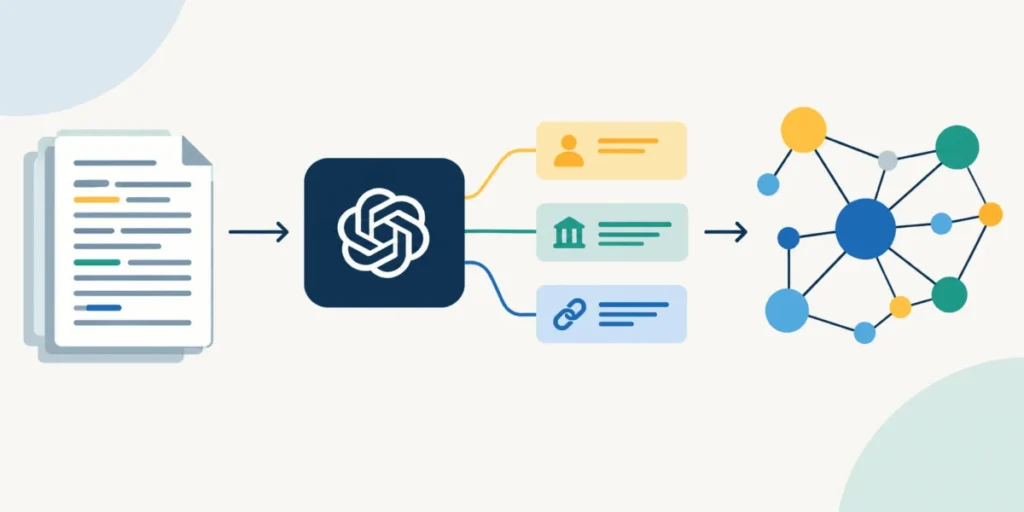
A sophisticated solution to this challenge lies in the integration of Knowledge Graphs. By moving beyond vector embeddings and toward structured, graph-based architectures, developers can create systems that prioritize ground-truth facts. However, a significant bottleneck has persisted: the manual labor of populating these graphs. In this guide, we explore how to bridge this gap by using local LLMs via Ollama to automatically extract structured knowledge from raw, unstructured text, transforming narrative content into actionable SPOC (Subject-Predicate-Object-Context) quads.
The Paradigm Shift: Why Graph-RAG Matters
The architecture of a deterministic 3-tiered Graph-RAG system represents a departure from standard, probabilistic retrieval. In a traditional vector search, the system retrieves "similar" chunks of text, which may contain conflicting or ambiguous information. By contrast, a graph-based system anchors the LLM’s output to a structured database—such as the lightweight Quadstore—where relationships between entities are clearly defined.
The introduction of the "Context" dimension in the SPOC quad model is transformative. By adding a fourth pillar to the classic RDF triple, we can track the lineage of information. A fact is no longer just a static statement; it is a statement with a verifiable source. This metadata allows developers to filter for truth, resolve contradictions, and provide citations for AI-generated answers, effectively creating an audit trail for every piece of information processed by the model.
Prerequisites and Technical Foundation
Before diving into the extraction engine, we must establish a robust environment. This workflow is designed for flexibility, operating seamlessly within Google Colab or a local Python development environment.
Setting Up the Environment
To begin, you will need the Ollama runtime to host your local LLM. For those working in a cloud-based notebook environment like Google Colab, the setup involves a two-step process: installing system-level dependencies and initializing the server.
- System Infrastructure: Install
zstdand the Ollama binary. - Model Selection: We utilize Llama 3.2, a high-performance, lightweight model ideal for structured data extraction.
- Core Libraries: The Python ecosystem requires
wikipediafor data ingestion andrequestsfor interfacing with the local LLM server.
Once the environment is active, the subprocess module is used to initiate the Ollama server in the background. This architecture ensures that the LLM operates as a local API, keeping data private and ensuring that the extraction process is not subject to third-party rate limits or latency issues.
Chronology of the Extraction Process
The transformation of raw text into a knowledge graph follows a structured, multi-phase pipeline.
Phase 1: Data Ingestion
We begin by sourcing raw information. In our example, we utilize the Wikipedia API to retrieve the summary of an encyclopedic entry—in this case, the life and work of Alan Turing. By disabling auto_suggest, we ensure the integrity of the data fetch, preventing the API from defaulting to incorrect or tangential topics.
Phase 2: The Logic of Extraction
The "brains" of this operation is the extraction function. This function does not merely "read" the text; it enforces a rigid schema. We instruct the LLM to output exclusively in JSON format, containing a facts key. This is critical for downstream integration; without a structured output, the pipeline would break during parsing.
We set the model’s temperature to 0.0. In the context of data extraction, creativity is a liability. A zero-temperature setting forces the model to act as a deterministic extractor, consistently mapping the same input to the same structural representation.
Phase 3: Parsing and Normalization
Raw JSON output from an LLM can be unpredictable. The script includes robust error handling to normalize keys (e.g., converting "Subject" to "subject") and filter out non-compliant data. By the time the function finishes, we have a clean list of dictionary objects, each ready to be converted into a formal quad.
Supporting Data: Structuring the SPOC Quad
The QuadStore acts as our repository. Unlike a standard database, it is specifically designed to store and query the 4-tuple format. The Python class implementation includes:
addmethod: Ensures that duplicates are filtered out, maintaining the cleanliness of the graph.querymethod: Allows for surgical retrieval. By setting specific parameters (e.g.,subject="Alan Turing"), the system can pull all associated facts instantly, providing the "ground truth" context for the RAG pipeline.
Sample Extraction Output
Consider the following data points extracted from the Wikipedia summary of Alan Turing:
- (Subject: Alan Mathison Turing, Predicate: was born, Object: in London, Context: Wikipedia_Alan_Turing)
- (Subject: Alan Mathison Turing, Predicate: led, Object: Hut 8, Context: Wikipedia_Alan_Turing)
These are not just strings; they are nodes and edges in a living network. By aggregating these, we turn a flat text file into a searchable, navigable database of historical facts.
Implications for AI Reliability
The shift toward automated knowledge graph population has profound implications for enterprise AI.
1. Eliminating Hallucinations
When an LLM is forced to verify its response against a populated QuadStore before delivering an answer, the likelihood of hallucination drops significantly. If the graph does not contain the information, the system is instructed to report that the fact is unavailable, rather than guessing.
2. Explainability
In regulated industries—such as healthcare, law, or finance—black-box AI is unacceptable. A system that can trace its answer back to a specific quad (and thus, a specific source document in the context field) provides the transparency required for institutional adoption.
3. Scalability
Manual graph construction is prohibitively expensive and slow. By leveraging local LLMs to do the "heavy lifting" of entity and relationship extraction, organizations can scale their knowledge bases to include thousands of documents in hours, not months.
Moving Toward Autonomous Knowledge Maintenance
The current implementation is an initial step toward fully autonomous knowledge maintenance. As we move forward, the next logical evolution is the implementation of incremental graph updates. Instead of rebuilding the graph from scratch, future iterations of this pipeline will monitor source documents for changes and use the LLM to perform "diffs"—updating, adding, or deleting only the affected quads.
Furthermore, the integration of entity resolution—where the system recognizes that "Alan Turing" and "Turing" refer to the same node—will be the next frontier. By combining the natural language understanding of Llama 3.2 with graph-native logic, we are witnessing the birth of a new category of AI: one that is not just a language generator, but a verifiable knowledge manager.
Conclusion
We have successfully closed the loop on the deterministic 3-tiered Graph-RAG architecture. We have demonstrated that the transition from raw, messy, human-readable text to a structured, machine-navigable knowledge graph is not only possible but accessible using free, local tools.
By automating the population of SPOC quads, developers can reclaim control over the factual accuracy of their AI systems. Whether you are building an educational assistant, a legal research tool, or a corporate knowledge management system, the techniques outlined here provide the foundation for a more reliable, trustworthy, and intelligent future for generative AI. The era of guessing is ending; the era of structured, verifiable knowledge retrieval has begun.