Google Introduces Multimodal Search Filter to Search Console Performance Report: A New Era for Visual Discovery Analytics
Global Rollout Begins Today, Providing Website Owners with Vital Insights into Image-Based and Visual Search Traffic Across Google Ecosystems.
Main Facts
Google has officially announced a major expansion to Google Search Console, introducing a dedicated multimodal filter to the Performance report. This new reporting capability is designed to capture, isolate, and analyze website traffic originating from searches where users incorporate visual elements—such as images, photos, and screenshots—alongside or instead of traditional text strings.
According to the official announcement published on the Google Search Central blog, the new filter encompasses a broad range of modern visual discovery tools. These include Google Lens, Circle to Search on Android devices, direct image uploads to the Google Search homepage, and the popular Chrome right-click context menu feature "Search this image."
The rollout is global, starting immediately, though webmasters should note that the feature is deploying progressively and may not yet be visible across all Search Console properties.
Key takeaways of the new Search Console update include:
- Categorization under "Web": The Performance report now splits the "Web" search type into traditional text-based traffic and multimodal traffic.
- Absence of Query Data: Due to the visual nature of these searches, traditional text-based query reports are unavailable when the multimodal filter is applied. Analysis is primarily page-centric.
- Integration with Generative AI Reports: Multimodal tracking is also expanding to Google’s generative AI performance reports, which measure visual and AI-driven impressions.
- Strategic Value for E-commerce: The update provides unprecedented visibility for online retailers, brand managers, and publishers whose assets are frequently discovered via smartphone cameras and visual queries.
Chronology of Visual Search Integration in Google Search Console
The journey toward recognizing multimodal and visual search traffic in web analytics has been evolutionary, reflecting how user behavior has shifted away from purely text-based keyboard queries toward camera-first and AI-assisted discovery.
1. The Rise of Camera-First Search (2017–2022)
For years, Google expanded its visual capabilities through the introduction and refinement of Google Lens, mobile image searches, and reverse-image technologies. While consumers rapidly adopted features allowing them to snap a photo of a plant, a pair of shoes, or a landmark to find information, digital marketers and SEO professionals faced a significant blind spot. Traffic driven by these visual interactions was lumped into standard organic web traffic, making it impossible to measure the concrete ROI of visual optimization.
2. The Expansion of Multimodal Touchpoints (2023–2025)
Google systematically integrated visual search deeper into its core ecosystem. The launch of Circle to Search on Android devices allowed users to highlight images on their screens seamlessly, while desktop users gained quick-access tools like "Search this image" natively within Google Chrome. Simultaneously, generative AI search experiences began blending text and images fluidly, creating a fragmented landscape where standard SEO metrics no longer told the whole story.
3. The Generative AI Report Precedent (August 2025)
As a precursor to the current update, Google rolled out its generative AI performance reporting features to all sites globally on August 31, 2025. This laid the technological groundwork for tracking non-traditional search interactions that rely on impressions rather than direct text clicks.
4. The September 2026 Multimodal Update
Announced and rolled out globally in September 2026, the new Search Console multimodal filter officially bridges the gap between modern visual discovery tools and webmaster analytics. By separating text-based traffic from image-influenced web traffic, Google has provided the industry with its first official window into camera- and screenshot-driven discovery.
Supporting Data and Technical Architecture
To understand how the multimodal filter functions, webmasters must examine how Google has re-architected the Web search type within Search Console’s reporting framework.
How the Filter Operates
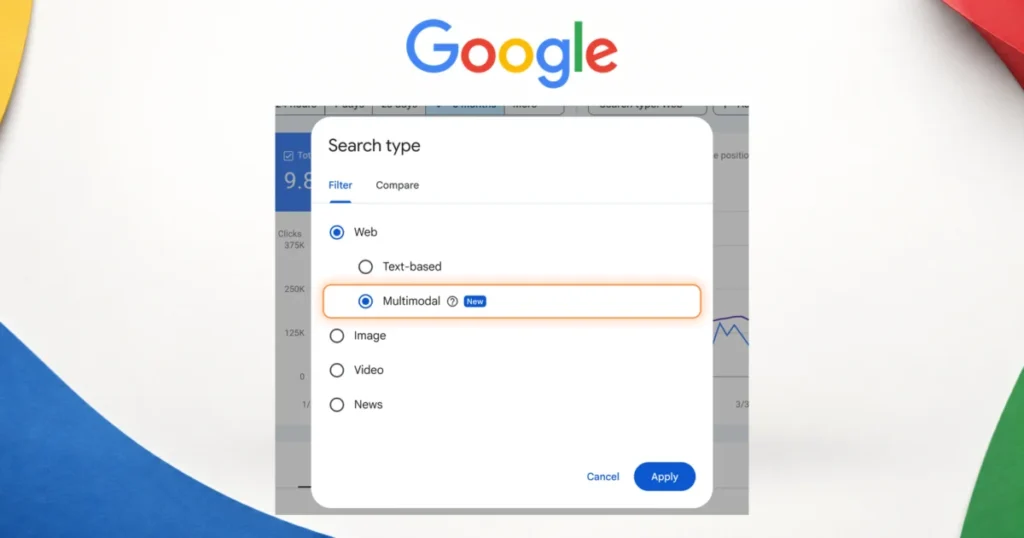
Within the Performance report, selecting the Web search type now yields a more granular breakdown. Google’s updated help documentation clarifies the distinction:
- Text-based traffic: Queries typed natively into the standard text search bar.
- Multimodal traffic: Web search results where an image was explicitly used as part of the search query mechanism.
+-----------------------------------------------------------------+
|                       SEARCH CONSOLE PERFORMANCE                |
+-----------------------------------------------------------------+
|  Search Type: [ Web v ]                                         |
|    - [X] Text-based traffic (Standard typed queries)            |
|    - [X] Multimodal traffic (Lens, Circle to Search, Uploads)   |
+-----------------------------------------------------------------+
The Query Data Limitation
A critical technical constraint of the new filter is the absence of specific text query data. Harsh Kharbanda (Product Manager Lead for Google Lens) and Moshe Samet (Product Manager Lead for Search Console) noted in documentation that because multimodal searches rely primarily on pixel data rather than strings of text, traditional keyword tracking is non-existent.
When a user selects the multimodal search type within the Performance report, the Queries tab becomes inactive. Instead, analysts must rely on Pages, Countries, and Devices dimensions.
- What you can see: Which specific URLs on your website are surfacing when users execute visual searches.
- What you cannot see: The exact image the user uploaded, snapped, or circled to reach your page.
Data Extraction and API Limitations
For advanced data processing, site owners can utilize the Export button within the Search Console UI. However, as of the initial rollout, the Search Analytics API reference (last updated August 11, 2026) lists standard report types (web, image, video, news, Discover, Google News) without a dedicated, standalone multimodal value for the type parameter, meaning programmatic retrieval relies on the updated web filters.
Official Responses and Expert Insights
Google’s product leadership emphasized that this update is a direct response to changing consumer habits, specifically the shift toward mobile-first and camera-first digital interactions.
In a joint statement released via the Google Search Central blog, Harsh Kharbanda and Moshe Samet explained the core philosophy behind the release:
"This update is designed to give you insights into how your content is surfaced when users search using images (such as with a smartphone camera). As visual discovery becomes a primary method for users to explore the web, providing transparency to site owners is essential for comprehensive digital strategy."
Furthermore, Google’s updated documentation highlights that these metrics will dynamically appear only for websites and web properties that actively receive organic traffic originating from visual and multimodal touchpoints. Sites with negligible visual search discovery will see minimal or zero changes to their baseline reports.
Strategic Implications for Webmasters, SEOs, and E-commerce
The introduction of the multimodal filter fundamentally changes how digital marketers must evaluate their organic performance, forcing a strategic pivot toward visual asset optimization (often referred to as Visual SEO).
1. A Game-Changer for E-commerce and Product Catalogs
For online retailers, fashion brands, home decor sites, and publishers of visual goods, this update is transformative. Previously, if a shopper used Circle to Search on an Instagram post or took a photo of a jacket on the street to find a retailer, the resulting traffic was obscured within general web analytics.
Now, e-commerce managers can:
- Identify which product pages are driving traffic via visual queries.
- Evaluate whether mobile camera searches are outperforming desktop right-click searches.
- Justify investments in high-resolution product photography, alt-text optimization, and structured data markup (such as Product Schema).
2. Shifting Focus from Keywords to Visual Context
Because traditional keyword data is absent in multimodal reports, SEO professionals must alter their analytical frameworks. Optimization strategies must move beyond keyword density and metadata targeting to encompass:
- Image Quality and Clarity: Ensuring product shots are shot against clean backgrounds with optimal lighting, making them easily identifiable by computer vision algorithms like Google Lens.
- Structured Data Excellence: Implementing robust schema markup to help Google’s algorithms contextualize what is inside an image file.
- Contextual Page Content: Surrounding images with rich, descriptive text so that Google’s multimodal models can successfully match visual queries to the appropriate landing page.
3. Adapting to Generative AI and Multimodal Reporting
With multimodal metrics also flowing into generative AI performance reporting, site owners gain a unified view of how modern, AI-driven discovery engines interact with visual web assets. Because generative AI reports track impressions rather than traditional clicks, marketers can measure brand visibility and top-of-funnel reach in visual search environments where direct click-through rates may be lower.
Looking Ahead: Actionable Advice for Webmasters
As the global rollout continues to propagate across all Search Console properties, webmasters should take proactive steps to evaluate their data:
- Verify Property Access: Check your Google Search Console account regularly to see if the multimodal filter has populated under your Web search type settings.
- Establish a Baseline: Once available, compare your historical Web totals against the newly separated text-based and multimodal traffic streams to understand your baseline visual footprint.
- Audit Visual Assets: Review top-performing landing pages identified by the multimodal filter to ensure your images are optimized, fast-loading, and backed by comprehensive structured data.
By embracing this update, digital strategists can unlock new avenues for growth in an increasingly visual and AI-driven search ecosystem.