India’s Startup Ecosystem in FY26: Scaling Revenue, Chasing Sustainable Profits, and Hitting the Public Markets
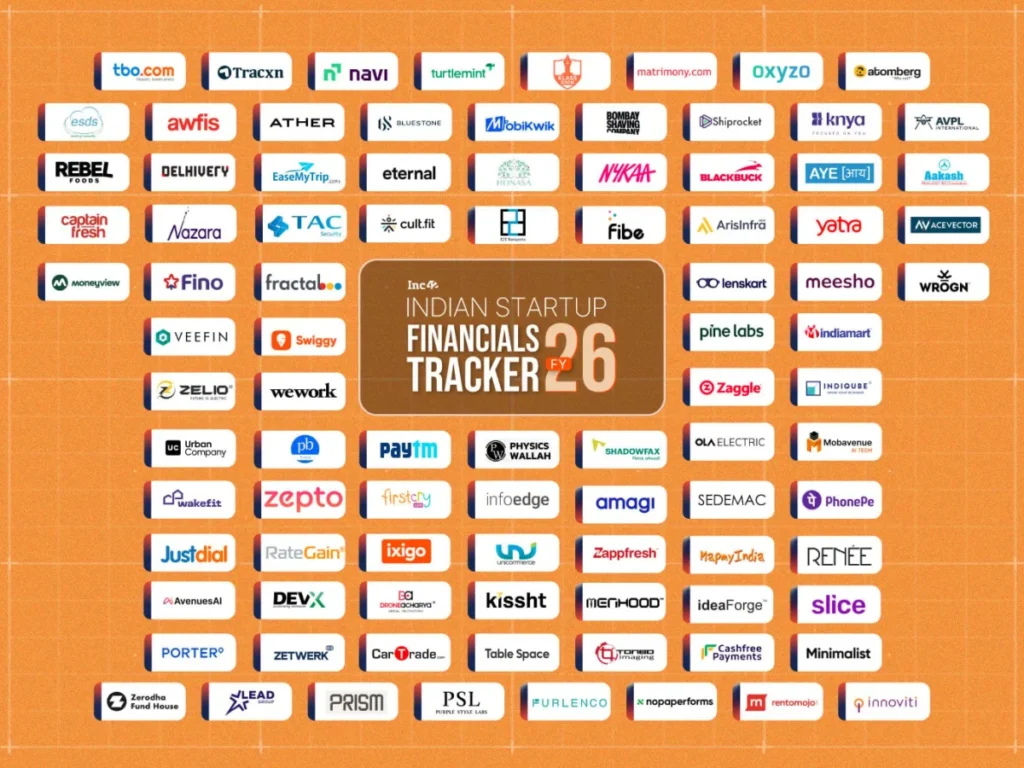
The Indian startup ecosystem demonstrated remarkable structural maturation through fiscal year 2026 (FY26). Moving past the turbulence of previous funding winters, new-age tech companies aggressively balanced growth with fiscal discipline.
A prominent indicator of this maturity is the public market activity: 22 new-age tech companies made their coveted public market debuts in FY26, a significant leap from the 13 listings recorded in FY25. Concurrently, a growing cross-section of the ecosystem successfully pivoted toward profitability or narrowed historical burn rates, relying on multi-year cost-rationalization programs to adapt to tightening macroeconomic realities.
Despite a challenging fourth quarter marked by geopolitical headwinds and supply chain bottlenecks, India’s startup sector managed to bolster both its top- and bottom-line metrics across the board.
The Macro Picture: Revenue Expansion vs. Uneven Profitability
An analysis of 97 leading new-age tech companies tracked in the ecosystem reveals a massive expansion in scale. Together, these 97 firms generated ₹3.22 Lakh Cr in operating revenue during FY26, marking a sharp 44.25% surge from the ₹2.23 Lakh Cr reported in FY25.
However, the profitability landscape remains deeply polarized:
- The Profitable Cohort: Out of the 97 tracked companies, 65 firms (approximately 67%) reported net profits in FY26. Combined, these profitable entities generated a net profit of ₹14,511.8 Cr.
- The Loss-Making Cohort: The remaining 32 startups posted a cumulative net loss of ₹21,426.8 Cr, underlining that sustainable, company-wide profitability remains a work in progress for capital-heavy sectors like quick commerce and electric mobility.
Sector-by-Sector Performance Chronology and Financial Breakdown
1. Education & Edtech: Cost Rationalization and Offline Pivots
- Aakash Educational Services: The test-prep major narrowed its net loss by 15.5% to ₹186.5 Cr (down from ₹220.8 Cr in FY25) on a flat top line. Operating revenue inched up 0.4% to ₹2,040.5 Cr, while total expenses remained controlled at ₹2,397.8 Cr.
- PhysicsWallah: The edtech major slashed its net loss by 90% to ₹24.2 Cr from ₹243.3 Cr. Operating revenue surged 35% to ₹3,899.5 Cr, propelled by a 31% expansion in its offline learning centers, which now account for 45% of total revenues.
- LEAD Group: The edtech unicorn trimmed its net loss by 20% to ₹34.5 Cr, supported by a 10% increase in operating revenue to ₹386.7 Cr.
2. Quick Commerce and Food Delivery: High Stakes, High Burn
- Eternal (Zomato/Blinkit): Zomato’s parent entity reported a 31% dip in net profit to ₹366 Cr (compared to ₹527 Cr in FY25) as it continued aggressive capital deployment into quick-commerce arm Blinkit and transitioned toward an inventory-led model. Operating revenue skyrocketed 168.6% to ₹54,364 Cr.
- Swiggy: The food delivery major saw its net loss widen by 33% to ₹4,154 Cr from ₹3,117 Cr. Operating revenue jumped 51% to ₹23,053 Cr, driven by aggressive expansion in its quick-commerce vertical, Instamart.
- Zepto: Quick-commerce major Zepto doubled its operating revenue to ₹22,623.6 Cr (up from ₹11,109.9 Cr). However, its net loss widened 25.6% to ₹5,905.2 Cr as total expenses surged 78.7% to ₹29,026.7 Cr.
3. Fintech, Payments, and Lending: Turning the Corner
- Paytm: Marking a historic milestone, Paytm posted its first full year of profitability with a net profit of ₹552 Cr, reversing a net loss of ₹663 Cr in FY25. Operating revenue rose 22.3% to ₹8,437 Cr, while total expenses contracted over 6% to ₹8,521 Cr.
- PB Fintech (Policybazaar): Net profit nearly doubled, surging over 90% to ₹670 Cr from ₹352 Cr. Operating revenue grew 36.5% to ₹6,794 Cr, with PAT margins expanding to 10%.
- PhonePe: The IPO-bound fintech giant saw its net loss widen by 62% to ₹2,792 Cr from ₹1,727.4 Cr, driven by elevated marketing spends, ESOP expenses, and employee costs. Operating revenue grew 11.5% to ₹7,920.5 Cr.
- Groww: Discount brokerage Groww crossed a major profitability milestone, with net profit rising 14% to ₹2,083 Cr on an operating revenue of ₹4,645 Cr.
- Fibe: IPO-bound digital lender Fibe more than doubled its net profit, jumping 126.4% to ₹257.4 Cr alongside a 31.1% rise in operating revenue to ₹1,584.5 Cr.
4. Logistics, Supply Chain, and Mobility
- Delhivery: Logistics major Delhivery posted a net profit of ₹152.5 Cr (down 5.9% from ₹162.1 Cr in FY25). Operating revenue grew 17.6% to ₹10,508.3 Cr.
- Shadowfax: Express logistics firm Shadowfax witnessed a staggering 1,758% surge in net profit to ₹115.2 Cr (up from ₹6.2 Cr), powered by a 65.4% jump in operating revenue to ₹4,080.3 Cr.
- Porter: The logistics unicorn saw its net profit multiply over 4x to ₹229 Cr (a 314% YoY jump), with operating revenue scaling 54% to ₹6,650 Cr.
- Ola Electric: EV major Ola Electric narrowed its net loss by 19.5% to ₹1,833 Cr (down from ₹2,276 Cr). This came despite a 50% drop in operating revenue to ₹2,253 Cr, caused by consumer demand headwinds and after-sales service challenges.
5. D2C, Beauty, and Personal Care (BPC)
- Nykaa: Operating revenue crossed the ₹10,000 Cr mark, growing 26% to ₹10,022.3 Cr. Net profit surged 182.8% to ₹203.9 Cr, bolstered by robust offline retail expansion and new brand launches.
- Honasa Consumer (Mamaearth): Mamaearth parent Honasa surpassed the ₹200 Cr profit mark, recording a net profit of ₹200.2 Cr (up 175.4% YoY) on operating revenues of ₹2,391.9 Cr.
- Minimalist: HUL-backed Minimalist returned to the black, posting a net profit of ₹25.9 Cr against a loss of ₹270.5 Cr previously, with revenues up 36% to ₹690.2 Cr.
Supporting Financial Data Matrix
To contextualize the financial health of the ecosystem, key metrics across selected high-growth startups for FY26 are summarized below:
| Company Name | Operating Revenue (₹ Cr) | YoY Growth (%) | Net Profit / Loss (₹ Cr) | Total Expenses (₹ Cr) |
|---|---|---|---|---|
| Eternal (Zomato) | 54,364.0 | +168.5% | +366.0 | 55,145.0 |
| Swiggy | 23,053.0 | +51.4% | -4,154.0 | 27,701.0 |
| Zepto | 22,623.6 | +103.6% | -5,905.2 | 29,026.7 |
| Delhivery | 10,508.3 | +17.6% | +152.5 | 10,707.8 |
| Nykaa | 10,022.3 | +26.0% | +203.9 | 9,707.5 |
| Paytm | 8,437.0 | +22.2% | +552.0 | 8,521.0 |
| PhonePe | 7,920.5 | +11.5% | -2,792.0 | 10,588.5 |
| Groww | 4,645.0 | +19.0% | +2,083.0 | 1,992.0 |
| Ather Energy | 3,671.8 | +62.8% | -517.2 | 4,335.2 |
| Info Edge | 3,284.7 | +15.2% | +1,762.8 | 2,262.5 |
Official Responses and Strategic Pivots
Founders and executives across sectors have highlighted intentional structural changes to combat global headwinds.
- The Pivot to Efficiency: Companies like Paytm and BlueStone (which posted its first full year of profitability with a net profit of ₹13.2 Cr) attributed their turns to the black to disciplined cost optimization. Employee benefit expenses, which historically scaled uncontrollably during the 2021–2022 boom, saw moderate single-digit to low double-digit growth rates across most mature firms.
- Supply Chain and Geopolitical Pressures: EV players like Ather Energy noted structural headwinds, citing export restrictions on critical components (such as rare-earth magnets from international suppliers) that temporarily dragged production lines and delayed top-line recognition.
- Offline Integration: Edtech and D2C leaders alike noted that omnichannel models are no longer optional. PhysicsWallah’s offline expansion and Nykaa’s aggressive retail storefront rollouts were cited as core drivers protecting margins against hyper-competitive online customer acquisition costs (CAC).
Ecosystem Implications: What Lies Ahead for FY27
The FY26 financial disclosures signal a clear divide within the Indian startup economy. On one side, a robust cohort of 65 profitable companies generating ₹14,511.8 Cr proves that the path to sustainable unit economics is viable at scale. Conversely, capital-intensive frontiers like quick commerce and logistics continue to burn significant capital to capture market share.
With 22 public market debuts completed in FY26 and a deep pipeline of tech companies preparing filings for FY27, investor scrutiny has shifted permanently away from "growth at all costs." Moving forward, the public markets will continue to reward clear paths to operating leverage, disciplined capital allocation, and sustainable bottom-line growth.