AWS Glue 6.0 Launches with Full Apache Iceberg v3 Support and a 30% Price Reduction
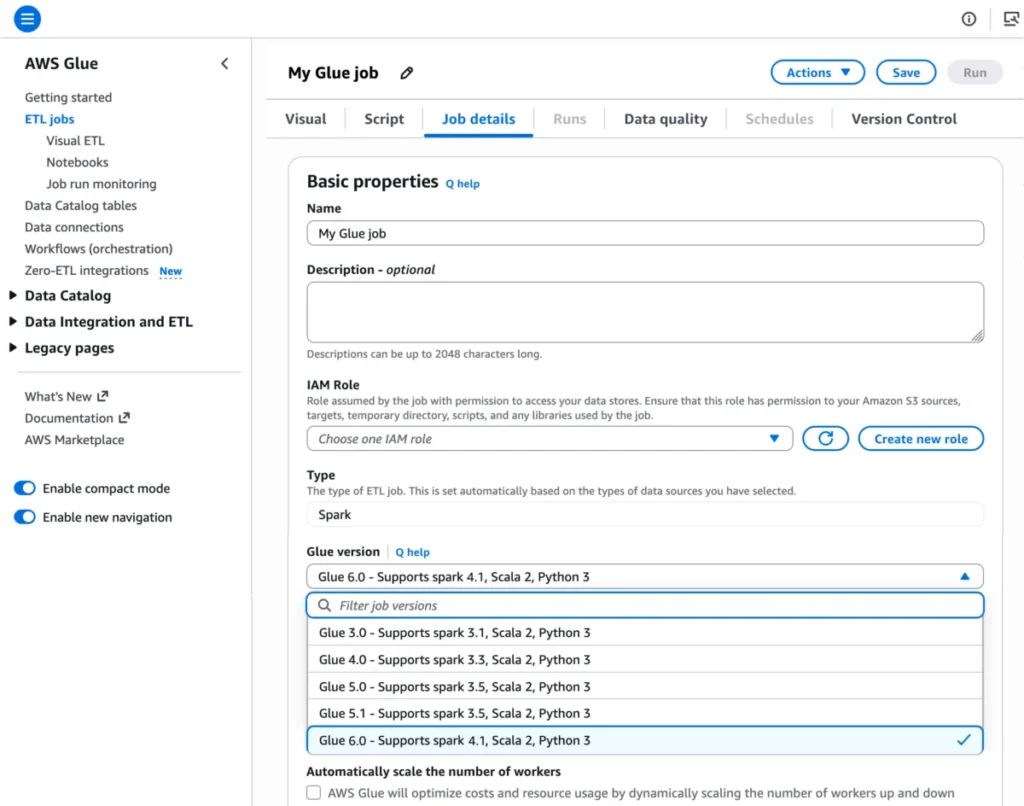
SEATTLE — Amazon Web Services (AWS) has officially announced the general availability of AWS Glue 6.0, marking a massive leap forward for serverless data integration and extract, transform, and load (ETL) operations. The latest iteration of the flagship service introduces a completely modernized runtime stack anchored by Apache Spark 4.1, Python 3.13, and Scala 2.13. Alongside these performance enhancements, AWS has instituted a sweeping 30% price reduction compared to previous versions, signaling an aggressive push to make enterprise-scale data processing more accessible and cost-effective.
Perhaps the most defining element of the AWS Glue 6.0 release is its comprehensive integration of the Apache Iceberg v3 specification. Built on Iceberg 1.11.0, the update establishes AWS Glue as home to the most complete Iceberg v3 implementation available on any fully serverless managed Spark service. For data engineers and architects grappling with the complexities of semi-structured data, lakehouse management, and real-time streaming, AWS Glue 6.0 arrives as a transformative tool designed to streamline workflows, eliminate infrastructure bottlenecks, and dramatically lower cloud expenditures.
Main Facts: What’s New in AWS Glue 6.0
AWS Glue 6.0 introduces a robust suite of architecture upgrades designed to optimize modern data pipelines. The release centers on three core pillars: modernized runtime performance, comprehensive Apache Iceberg v3 support, and a significant reduction in operational costs.
The Modernized Runtime Stack
Under the hood, AWS Glue 6.0 runs on Apache Spark 4.1, paired with Python 3.13 and Scala 2.13. This upgrade brings the latest performance tuning, memory management optimizations, and execution engine enhancements from the open-source Spark community directly into a serverless environment. Developers can leverage PySpark with fewer performance bottlenecks, streamline ETL authoring, and run real-time streaming jobs capable of achieving single-digit millisecond latency.
The Power of Apache Iceberg v3 and VARIANT Shredding
The headline feature of the Iceberg v3 implementation in Glue 6.0 is the introduction of the VARIANT data type, complete with built-in shredding support. Traditionally, querying semi-structured data like JSON objects, raw application logs, and event streams required teams to flatten complex schemas, maintain duplicate copies of data, write custom parsing code, and risk pipeline failure whenever upstream schemas inevitably changed.
With VARIANT shredding, engineers can ingest, store, and query semi-structured data natively. The database engine automatically optimizes how this data is stored and read, resulting in significantly faster query performance compared to legacy string-type columns. This capability eliminates the friction of schema evolution, ensuring that downstream data consumers can query dynamic datasets without pipeline-breaking disruptions.
A 30% Price Reduction
In a move that will resonate deeply with FinOps teams and enterprise budget planners, AWS has slashed pricing for Glue 6.0 by 30% across the board. By passing infrastructural efficiencies gained through the Spark 4.1 runtime modernization down to the customer, AWS aims to accelerate the migration of legacy workloads to modern, open table formats without expanding cloud budgets.
Chronology: The Evolution Leading to Glue 6.0
To understand the significance of AWS Glue 6.0, it is helpful to trace the rapid evolution of cloud-based data integration and the open lakehouse architecture over recent years.

- The Early Serverless ETL Era: AWS Glue originally launched to provide a fully managed, serverless Spark environment, sparing data engineering teams from the operational overhead of provisioning, configuring, and scaling clusters manually. However, early versions were often criticized for cold-start latency and rigid runtime dependencies.
- The Rise of Open Table Formats: As data lakes matured into modern data lakehouses, organizations increasingly turned to open table formats like Apache Iceberg to bring ACID (Atomicity, Consistency, Isolation, Durability) transactions, time-travel queries, and schema evolution to object storage like Amazon S3.
- Incremental Version Updates: AWS steadily iterated on its platform, introducing Glue 3.0 and 4.0 to incorporate newer iterations of Spark and Python. Throughout this period, demand for native, high-performance support for Iceberg grew exponentially as enterprises abandoned proprietary data warehouses in favor of open, decoupled architectures.
- The Spark 4.1 and Iceberg v3 Horizon: With the open-source stabilization of Apache Spark 4.1 and Iceberg v3, AWS engineers began developing a unified runtime that could handle massive semi-structured workloads natively.
- General Availability (August 2026): AWS officially rolls out Glue 6.0 globally, combining the long-awaited Iceberg v3 features, the
VARIANTdata type, runtime engine updates, and a 30% structural price reduction into a single flagship release.
Supporting Data and Technical Architecture
The technical underpinnings of AWS Glue 6.0 reflect a meticulous alignment with modern enterprise requirements for speed, flexibility, and cost control.
Performance Metrics and Benchmarks
Internal evaluations and early adopter tests indicate that the combination of Spark 4.1 and Iceberg v3 optimizations yields marked improvements in execution speed. Specifically:
- Query Read Performance: Queries executed against semi-structured datasets utilizing the new
VARIANTshredding feature run significantly faster than identical queries executed against traditional string columns, drastically reducing compute cycles and job execution times. - Streaming Latency: Real-time streaming workloads benefit from architectural enhancements in Spark 4.1, enabling end-to-end processing latencies down to single-digit milliseconds.
- Cost Efficiency: The 30% reduction in hourly rates applies directly to extract, transform, and load (ETL) jobs as well as data crawlers. Combined with the metadata catalog pricing model—where the first million objects stored and the first million accesses remain entirely free—organizations can scale their metadata repositories without incurring runaway costs.
Seamless Migration Pathways
A major design goal for AWS Glue 6.0 was ensuring backward compatibility and effortless adoption. AWS has confirmed that no API changes are required to transition existing workflows to the new version. Teams can target AWS Glue 6.0 simply by updating the existing --glue-version parameter via the AWS Command Line Interface (AWS CLI), AWS SDKs, AWS Glue Studio, Amazon SageMaker Unified Studio, or any preferred integrated development environment (IDE).
    "Name": "MyExampleETLJob",
    "Role": "arn:aws:iam::123456789012:role/GlueExecutionRole",
    "Command":
        "Name": "glueetl",
        "ScriptLocation": "s3://my-bucket/scripts/etl_script.py",
        "PythonVersion": "3.13"
    ,
    "GlueVersion": "6.0"
For organizations managing large fleets of legacy jobs, AWS has introduced automated tooling. The Spark upgrade agent available within AWS Glue Studio assists engineers in identifying deprecated syntax or compatibility issues. Additionally, an auto-upgrade feature allows teams to transition existing jobs to Glue 6.0 smoothly with minimal manual intervention.
Official Responses and Industry Perspective
Industry analysts and cloud architects have responded enthusiastically to the release, viewing AWS Glue 6.0 as a definitive endorsement of the open lakehouse paradigm.
Speaking on the strategic vision behind the release, AWS leadership emphasized the importance of removing friction from data engineering workflows. "Data teams should spend their time deriving business insights, not writing custom parsing code to handle messy, evolving JSON logs," noted a senior product spokesperson during the launch. "With AWS Glue 6.0, we have delivered a serverless engine that not only embraces the full Apache Iceberg v3 specification but does so at a price point that makes large-scale data processing more economical than ever before."
Data architects across the enterprise landscape have similarly praised the introduction of the VARIANT data type. In enterprise environments where telemetry, clickstreams, and application logs continuously alter their underlying schemas, the ability to query semi-structured data without exhaustive data preparation pipelines represents a paradigm shift. By abstracting the complexity of schema management away from the developer, AWS Glue 6.0 reduces maintenance overhead and accelerates time-to-insight.
Furthermore, the 30% price reduction has been widely interpreted as a strategic response to competitive pressures in the data warehouse and lakehouse market. By lowering the financial barrier to entry, AWS is encouraging customers to consolidate their data workloads onto Amazon S3 and AWS Glue, positioning the service as the undisputed control plane for modern data architectures.

Implications for Enterprises and Data Engineers
The launch of AWS Glue 6.0 carries profound implications for how organizations design, execute, and monetize their data operations.
1. Simplification of Data Architectures
For years, organizations have maintained complex, multi-layered architectures to handle unstructured or semi-structured data—often routing logs through specialized NoSQL databases or ingestion pipelines before loading them into a data lake. AWS Glue 6.0 collapses these multi-step architectures. Because Iceberg v3 and VARIANT shredding handle complex hierarchies natively within object storage, data teams can build leaner, more maintainable data pipelines.
2. Accelerated FinOps and Budget Optimization
Cloud cost optimization remains a top priority for CIOs and CTOs. The 30% price cut on Glue 6.0 jobs and crawlers directly addresses cloud spend visibility. Enterprises running thousands of daily ETL jobs can immediately realize substantial cost savings, freeing up capital to reinvest in artificial intelligence, machine learning, and advanced analytics initiatives.
3. Deepening AI and LLM Integration
As enterprises increasingly feed corporate data into Large Language Models (LLMs) and generative AI applications, the cleanliness, accessibility, and real-time freshness of underlying data stores become paramount. The single-digit millisecond latency capabilities of Glue 6.0 streaming jobs, paired with the robust transactional guarantees of Apache Iceberg v3, ensure that AI applications are trained and augmented on fresh, reliable, and well-governed data.
4. Developer Productivity and AI Tooling Integration
AWS has also ensured that Glue 6.0 is tightly integrated with modern AI-assisted development workflows. Developers can leverage the AWS MCP (Model Context Protocol) Server and associated plugins with their preferred AI tools to search documentation, verify regional availability, query APIs, and troubleshoot migration issues effortlessly. This integration shortens the learning curve for teams adopting the new Spark 4.1 runtime.
Getting Started with AWS Glue 6.0
AWS Glue 6.0 is generally available today across all commercial AWS Regions where AWS Glue operates. Getting started requires minimal effort:
- Via AWS Glue Studio Console: Navigate to the AWS Glue Studio console, open any existing job, and on the Job Details tab, select the version labeled Glue 6.0 – Supports Spark 4.1, Scala 2, Python 3.
- Via Interactive Notebooks: For exploratory data analysis, users can configure an AWS Glue Studio notebook or Jupyter notebook session by setting
%glue_version 6.0in the magic commands. - Via Automation: Automate job creation and updates using the AWS CLI or AWS SDKs by specifying
--glue-version 6.0in your deployment scripts.
Organizations looking to plan their migration paths can consult the official documentation resources, including the AWS Glue 6.0 Version Details and the Migrating AWS Glue for Spark Jobs to AWS Glue Version 6.0 guides provided by AWS. Feedback and community discussions can be shared via AWS re:Post for AWS Glue.
As enterprises continue to migrate en masse toward open table formats and serverless data lakehouses, AWS Glue 6.0 establishes a new benchmark for performance, cost-efficiency, and developer productivity in the cloud.