Beyond the Prompt: Navigating Brand Visibility, Accuracy, and Strategy in the Era of AI Search
By Digital Marketing News Desk
Published: October 2023
Main Facts
In the rapidly evolving landscape of digital search, securing a mention for your brand in an AI-generated answer can feel like a major victory. However, marketing professionals are quickly realizing that a superficial nod from an artificial intelligence model offers little strategic direction on its own. A competitor may dominate the share of voice, an AI tool might describe an obsolete version of a product, or critical brand assets may remain entirely invisible to web-crawling bots due to technical barriers.
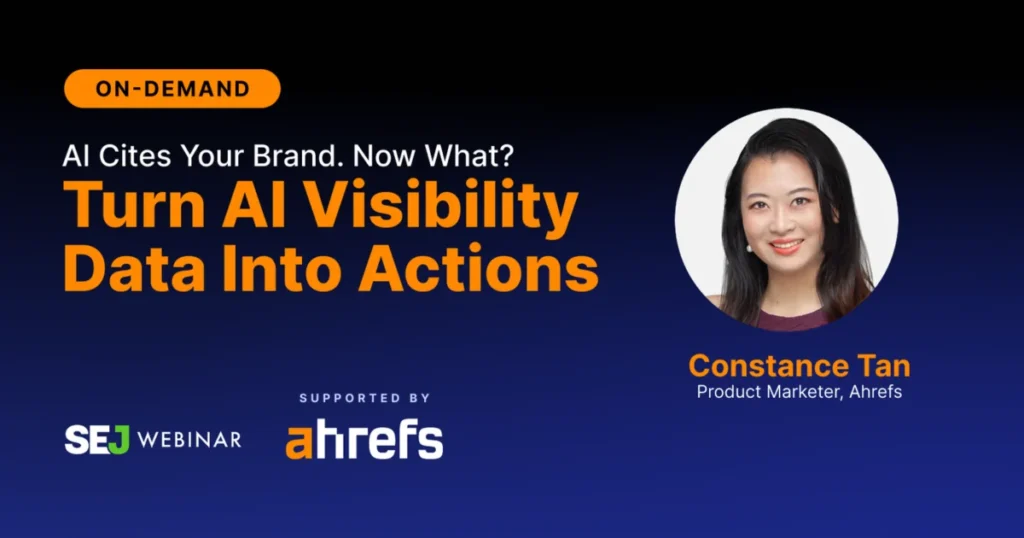
To address these blind spots, industry experts are urging digital marketers to move past vanity metrics and adopt structured frameworks for tracking and improving artificial intelligence visibility. Recently, Ahrefs Product Marketer Constance Tan detailed a comprehensive strategy during an exclusive webinar hosted by Search Engine Journal (SEJ). Tan’s core thesis is straightforward: rather than chasing individual prompts or celebrating isolated mentions, marketers must analyze recurring patterns across the entire customer journey.
The primary takeaways from the expert session highlight four critical pillars of modern AI optimization:
- Customer-Centric Tracking: Building monitoring strategies around questions that reflect how buyers actually make decisions.
- Competitor Source Analysis: Tracing where competitors get their citations and identifying the formats—such as reviews, videos, and specialized forums—that influence AI models.
- Internal and External Accuracy: Fixing outdated information on owned properties while strategically determining when to pursue third-party corrections versus creating new, authoritative content.
- Technical Accessibility: Ensuring that AI crawlers are not blocked by firewalls, broken URLs, or restrictive JavaScript execution.
Chronology
The paradigm shift toward generative engine optimization (GEO) and AI search visibility has accelerated dramatically over the past 24 months. As search engines integrate conversational AI assistants directly into the primary results page, traditional search engine optimization (SEO) has had to adapt to conversational interfaces.
- Early 2023: The widespread public adoption of conversational AI models like ChatGPT, Google Bard (now Gemini), and Microsoft Copilot sparked industry-wide panic and excitement. Marketers immediately began testing how often their brand names appeared in AI-generated responses.
- Mid 2023: Early metrics revealed a chaotic landscape. Brands noticed inconsistent results where AI models frequently hallucinated features, quoted outdated pricing tiers, or heavily favored legacy competitors without clear attribution paths.
- Late 2023: Forward-thinking organizations began developing specialized testing frameworks. Rather than treating AI visibility as a black box, companies like Ahrefs started analyzing the underlying mechanics of how large language models (LLMs) retrieve, weigh, and synthesize external sources.
- Recent Developments (Present): Industry leaders have shifted focus from sheer volume of mentions to qualitative metrics. Webinars and masterclasses—such as Constance Tan’s presentation for Search Engine Journal—have begun codifying best practices into repeatable processes, teaching marketers how to audit bot access, conduct targeted outreach, and align AI insights with tangible business outcomes.
Supporting Data and Methodological Insights
Evaluating AI visibility requires moving away from traditional keyword ranking reports. Because generative AI synthesizes answers dynamically based on intent, context, and training data, static tracking tools fall short.
During her presentation, Constance Tan emphasized that generating hundreds of random queries yields little actionable data. Instead, marketing teams must organize their monitoring around specific questions reflecting the customer journey. This data can be harvested from multiple organizational touchpoints:
- Search Query Logs: Understanding what terms users type into traditional engines before migrating to conversational platforms.
- Support Conversations: Reviewing recurring customer service tickets to identify common pain points and feature confusion.
- Sales Inquiries: Capturing the exact phrasing prospective clients use when evaluating solutions.
- Community Discussions: Monitoring authentic conversations on platforms where target audiences congregate. (Tan noted, however, that marketers must look beyond generalized platforms like Reddit and Quora, as the most influential forums vary wildly by niche and industry).
To measure the effectiveness of these efforts, Ahrefs relies heavily on self-reported discovery data—such as tracking new sign-ups who explicitly mention interacting with AI chatbots—rather than attempting to calculate a rigid, direct "revenue-per-citation" formula. According to Tan, digital marketers should view impressions and AI share of voice as top- and mid-funnel indicators that must be evaluated alongside traditional conversion paths and multi-touch attribution models.
When evaluating competitor dominance, data shows that AI models often lean on diverse media formats. Articles alone are no longer sufficient; reviews, dedicated discussion threads, and video content heavily influence how an AI perceives market leaders versus emerging challengers.
Official Responses and Expert Insights
The challenges of managing brand reputation within AI outputs have prompted responses from both software developers and enterprise marketers. Experts emphasize that while algorithms are complex, many of the underlying issues stem from foundational digital hygiene problems.
Addressing the challenge of factual inaccuracies in AI responses, Constance Tan shared a telling case study from the Ahrefs marketing team. When the company noticed AI models propagating outdated information regarding API access across various tiers, they launched a targeted content outreach campaign:
- Outreach Volume: The team contacted 26 different authors and platform managers regarding inaccurate brand descriptions.
- Response Rate: 10 out of the 26 authors replied.
- Successful Updates: Only 4 of the authors ultimately updated their content.
This real-world experiment illustrates the immense friction involved in trying to correct external narratives. As Tan noted during the session, third-party corrections require immense patience and yield low conversion rates.
"Sometimes outreach is not always the answer," Constance Tan explained. "Sometimes it’s better to create the new sources of information, new pages that answer or cover the topic in a better way, a more comprehensive way, or with more up-to-date information."
This sentiment underscores a vital strategic shift: when third-party corrections fail or prove impractical, the most efficient path forward is often publishing superior, highly authoritative original content that naturally earns the trust of AI crawlers.
Furthermore, technical experts stress that content quality is irrelevant if the delivery mechanism fails. Before diagnosing a visibility gap as a content shortcoming, technical audits must verify whether retrieval bots can actually access the site. Firewalls, restrictive robots.txt files, server timeouts, and heavy reliance on client-side JavaScript can completely blind AI crawlers to valuable corporate web pages.
Implications for the Future of Digital Marketing
The maturation of generative AI search carries profound implications for SEO professionals, product marketers, and digital strategists. As search transitions from a list of blue links to synthesized, authoritative answers, brand survival depends on adapting to new rules of engagement.
1. The Redefinition of "Share of Voice"
Share of voice in the age of AI is no longer just about ranking position #1 for a specific keyword. It represents how comprehensively and accurately a brand is understood across thousands of potential conversational pathways. Marketers must optimize not just for keywords, but for semantic authority, conceptual clarity, and contextual relevance.
2. Operational Convergence Between SEO, Product, and Support
AI visibility audits frequently unearth fundamental disconnects between marketing messaging and product realities. When AI models quote outdated pricing or obsolete features, it often points to an internal communication gap. Fixing these issues requires cross-departmental collaboration:
- Product Teams must ensure that feature rollouts are immediately documented and broadcasted.
- Support Teams must feed real-time customer confusion directly into the content pipeline.
- Marketing Teams must maintain pristine, unambiguous digital profiles across all owned and earned channels.
3. The Technical Imperative
As search engines rely increasingly on automated retrieval-augmented generation (RAG) systems, technical infrastructure is paramount. Ensuring seamless bot accessibility is no longer optional background maintenance; it is the absolute foundation of digital visibility. Sites that fail to optimize their server response times, fix broken links, or render content cleanly without heavy JavaScript execution will find themselves entirely erased from AI-driven discovery loops.
Looking Ahead: The Next Frontier of AEO
As organizations digest these strategic insights, the conversation around Answer Engine Optimization (AEO) continues to expand. Upcoming industry sessions—such as forthcoming webinars featuring marketing leaders from organizations like CallTrackingMetrics—promise to explore how teams can extract granular FAQ structures, structured data, and authentic customer phrasing out of existing customer datasets.
Ultimately, the chaotic emergence of AI search should not be viewed as the death of traditional search marketing, but as an evolution. By abandoning vanity metrics, auditing technical accessibility, maintaining rigorous internal accuracy, and mapping out the full customer journey, modern brands can secure not just a fleeting mention in a prompt, but sustainable, qualified visibility that drives long-term business growth.