Cracking the Black Box: How to Measure AI Search Visibility Beyond Traditional Clicks and Citations
By Search Industry Insights Desk
Published in partnership with Search Engine Journal (SEJ)
As generative artificial intelligence fundamentally reshapes how people find information, digital marketers and search engine optimization (SEO) professionals are facing a profound measurement crisis. Traditional metrics—built on the reliable bedrock of keyword rankings, organic traffic, and direct click-through rates (CTR)—are increasingly failing to capture the full picture of consumer discovery.
When an AI answer engine like ChatGPT, Google Gemini, or Microsoft Copilot recommends a product, it often does so without providing a direct link back to the brand’s website. A user might read the recommendation, conduct a subsequent branded search weeks later, navigate directly to the site, or even make a purchase offline. To standard analytics platforms, this entire journey remains invisible, categorized as direct traffic or untraceable organic search.
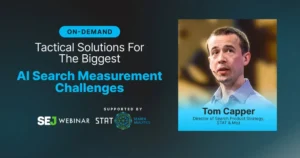
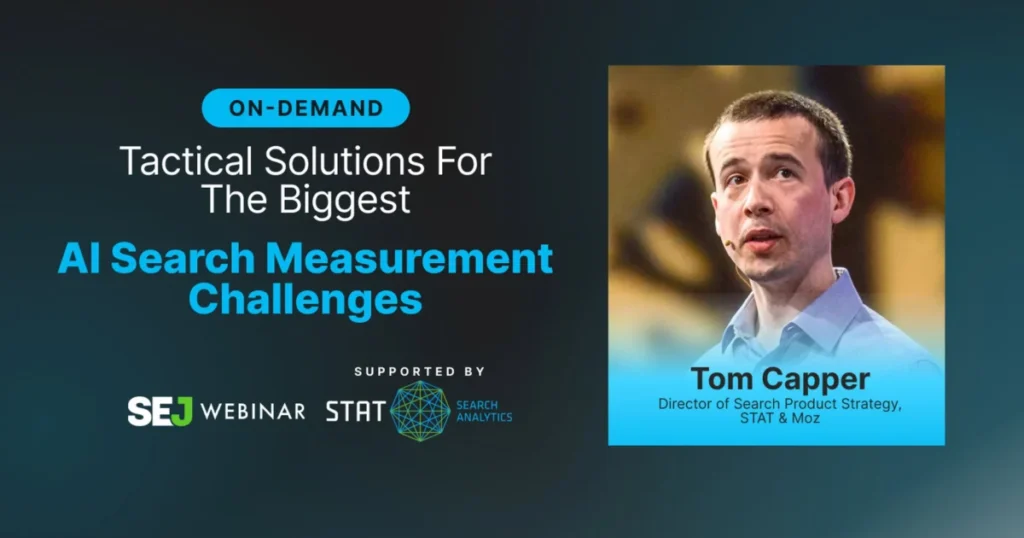
This core dilemma—the modern measurement crisis of zero-click AI search—was the focal point of a recent industry webinar titled Tactical Solutions For The Biggest AI Search Measurement Challenges. Hosted by Search Engine Journal, the session featured Tom Capper, Director of Search Product Strategy at STAT, who outlined a radical paradigm shift for how businesses must approach visibility in an era dominated by Large Language Models (LLMs).
Main Facts: The Death of the Traditional Click-Through Paradigm
The rapid evolution of search engines from blue links to conversational, synthesized answers has broken traditional attribution models. According to Capper and industry experts, the primary challenge is not merely a traffic problem—it is a fundamental attribution failure.
- The Zero-Click Reality: AI-driven search environments frequently fulfill user intent without requiring a click to an external website.
- The Disconnect in Analytics: Traditional web analytics tools cannot bridge the gap between an AI model mentioning a brand in conversation and a downstream consumer conversion.
- Citations vs. Mentions: A critical realization in AI search optimization is that a brand can be recommended without its specific URL ever being cited as a source. Conversely, a URL can be cited while another brand is the primary beneficiary of the recommendation.
- The Shift in KPIs: Leading practitioners argue that key performance indicators (KPIs) must evolve from measuring pure web traffic and link citations to tracking brand entity presence, share of voice, and qualitative visibility within AI-generated responses.
Chronology: The Evolution of Search Measurement and the AI Disruption
To understand where search measurement is heading, it is helpful to trace how the industry arrived at this crossroads:
Phase 1: The Era of Deterministic Rankings (Late 1990s – Early 2010s)
For decades, SEO was largely transactional and deterministic. Brands targeted a specific list of keywords, optimized their on-page content, acquired backlinks, and monitored their positions from 1 to 100 on a search engine results page (SERP). Success was measured linearly: higher rankings led to higher CTRs, which directly correlated with website sessions and revenue.
Phase 2: The Fragmentation of the SERP (2010s – Early 2020s)
Search engines began introducing rich snippets, knowledge graphs, local packs, and featured snippets. Zero-click searches began to rise as search engines answered user queries directly on the results page. However, marketers could still track featured snippet ownership and attribute traffic through tools like Google Search Console.
Phase 3: The Generative AI Revolution (2023 – Present)
The mass adoption of generative AI interfaces fundamentally shattered the deterministic model. Instead of returning a list of discrete links, models synthesize information from multiple sources, generating bespoke answers tailored to the user’s explicit and implicit context. Click-through rates for traditional organic listings have plummeted for informational queries, leaving SEO professionals scrambling for new ways to prove ROI to executive stakeholders.
Supporting Data and Technical Realities: Dissecting the AI Search Ecosystem
During the webinar, Capper dove deep into the mechanics of how AI search functions and why standard tracking methodologies fall short.
1. Separate Brand Mentions From Source Citations
To illustrate this phenomenon, Capper presented a hypothetical scenario involving an AI-generated car recommendation. Imagine a user asking an AI assistant: "What is the best family SUV for under $40,000?"
The AI might explicitly recommend an Audi model as the top choice. However, the footnotes or inline citations attached to that recommendation might point to third-party review aggregators like Edmunds, Car and Driver, or a dealership blog—not Audi’s official domain.
If a brand’s analytics team builds their dashboard purely around tracking domain citations or backlink acquisitions, Audi would completely miss the fact that it won the AI’s recommendation.
"So yeah, citations have URLs. That’s still valuable tactical data, but I don’t think it should be your KPI. Mentions have entities."
— Tom Capper, Director of Search Product Strategy at STAT
2. Building Representative Prompt Samples
A common objection from digital marketers is that AI outputs are too volatile; asking the same question twice can yield different results. Capper countered that this variability should be treated as a sampling problem, much like traditional SEO teams already account for location- and device-specific SERP fluctuations.
Tracking a tiny, rigid list of keywords in an AI tracker yields an unstable and misleading picture. Instead, marketers must build robust prompt samples that reflect real-world user behavior. Capper recommended mining "People Also Ask" data, customer support tickets, and sales logs to understand the personas, budgets, geographic locations, and underlying needs driving user queries.
Furthermore, Capper emphasized the technical environment used for data collection. STAT utilizes web interfaces rather than raw API responses for tracking, noting that API outputs can occasionally diverge from what everyday users actually experience in the browser.
3. Using Citations as Diagnostic Tools
While citations should not serve as headline KPIs, they are invaluable diagnostic tools. When a competitor wins an AI recommendation, marketers should examine the cited URLs. These third-party sources—ranging from niche review sites to industry trade publications—reveal the external authorities shaping the AI’s worldview.
By working to improve brand representation on those specific influential sources, marketing teams can actively influence future AI recommendations.
Official Responses and Expert Insights: Bridging the Attribution Gap
The complexities of AI measurement generated a robust discussion during the webinar’s Q&A session, notably when Search Engine Journal founder Loren Baker posed a critical question: How can marketing teams connect high-level AI visibility to a customer journey when multi-touch attribution models cannot observe the initial exposure?
Capper’s answer challenged the industry to move away from the expectation of a single, flawless attribution model.
Combining Quantitative Tracking with Qualitative Surveys
Instead of relying entirely on automated tracking tools, Capper advocated for a hybrid approach:
- Post-Purchase Surveys: Implement checkout or onboarding surveys asking customers how they discovered the brand. If a significant percentage of respondents spontaneously cite AI recommendations, it provides qualitative proof of channel efficacy.
- Passing Survey Data into Analytics: By feeding survey responses back into core analytics platforms as custom dimensions, teams can compare self-reported discovery channels with the attribution models credited by software like Google Analytics.
- Avoiding Survey Bias: Capper cautioned teams to randomize the order of survey options, as static lists can inadvertently bias respondents toward selecting the first available choice.
Implications: Building a Modern Measurement Plan
For organizations looking to future-proof their digital marketing strategies, the shift away from pure click-based measurement requires structural changes to reporting cycles, team KPIs, and technological tooling.
Here are the key takeaways and actionable steps digital marketers should implement:
1. Audit and Redefine Your KPIs
Move away from reporting solely on traffic and keyword rankings. Incorporate brand share of voice within generative search engines, tracking how frequently your brand entities and key products are mentioned across targeted prompt samples compared to competitors.
2. Map Entity Hierarchies, Not Just Domains
Ensure your tracking includes all relevant sub-brands, product lines, and variations of your corporate identity. AI models recognize entities conceptually; your measurement framework must do the same.
3. Treat AI Optimization as PR Meets SEO
Because AI models rely heavily on third-party consensus, digital PR, review management, and digital footprint expansion are now critical components of search strategy. Winning citations on authoritative review sites directly influences whether an AI engine trusts your brand enough to recommend it.
4. Adopt a Holistic View of the Customer Journey
Accept that direct, un-attributed traffic and delayed branded searches are often the downstream effects of top-of-funnel AI visibility. By combining programmatic prompt tracking with direct customer surveys, businesses can finally illuminate the dark funnel of generative search.
To watch the full discussion, explore deep-dive case studies, and access tactical prompt-tracking frameworks, you can watch the complete on-demand webinar through Search Engine Journal.