Inside the Black Box: OpenAI Unveils the Architecture, Mechanics, and Growth of the ChatGPT Ad Stack
By Tech & Digital Media Desk
Published: October 2026
Featured Image Credit: Samuel Boivin / Shutterstock
OpenAI has pulled back the curtain on the mechanics powering its rapidly scaling monetization engine, offering a comprehensive technical breakdown of how the ChatGPT advertising system operates. In a newly published whitepaper, the artificial intelligence pioneer detailed the complex choreography required to interpret multi-turn user conversations, extract contextual nuances, dynamically select relevant ads, and maintain a strict operational firewall between commercial promotions and organic model responses.
The revelations come at a time of explosive commercial growth for the company. According to the technical disclosures, ChatGPT Ads has officially crossed the milestone of $1 billion in annualized revenue run rate in under 200 days since its initial rollout. More than 100,000 unique advertisers have tested or deployed campaigns on the platform.
Yet, beneath the glittering financial metrics and sophisticated engineering diagrams lies a complex ecosystem. While OpenAI’s disclosures illuminate how the platform’s "orchestrator" model reads between the lines of a user prompt, critical questions remain unanswered regarding campaign performance transparency, attribution modeling, and actual return on investment (ROI) for brands navigating this new digital frontier.
1. Main Facts: Core Mechanics of the ChatGPT Ad Stack
The newly released technical breakdown answers long-standing industry inquiries regarding how a generative AI interface can seamlessly weave commercial content into a conversational user experience without degrading the core product.
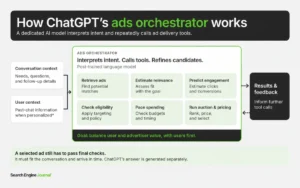
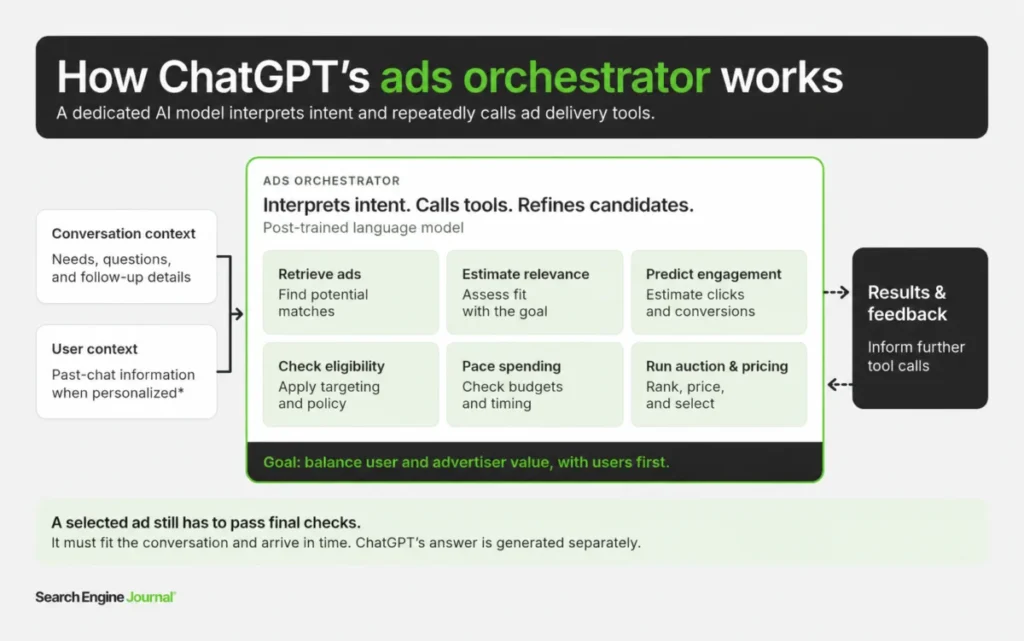
At its core, the system relies on a structural division of labor: the ad selection apparatus operates completely independently from the model that generates ChatGPT’s answers.
[ User Prompt / Multi-Turn Conversation ]
                │
                ├──────────────────────────────┐
                ▼                              ▼
    ┌───────────────────────┐      ┌───────────────────────┐
    │  Answer Generation    │      │    The "Orchestrator" │
    │  (Separate Code/LLM)  │      │    (Ad Selection)     │
    └───────────────────────┘      └───────────────────────┘
                │                              │
                ▼                              ▼
       [ Organic Answer ]              [ Search Queries & Embeddings ]
                │                              │
                │                              ▼
                │                  ┌───────────────────────┐
                │                  │  Eligibility Checks   │
                │                  │  (Geo, Policy, etc.)  │
                │                  └───────────────────────┘
                │                              │
                │                              ▼
                │                  ┌───────────────────────┐
                │                  │    Auction Tool       │
                │                  │  (Ranking & Pricing)  │
                │                  └───────────────────────┘
                │                              │
                │                              ▼
                │                  ┌───────────────────────┐
                │                  │ Post-Auction Filtering│
                │                  │  (Contextual Fit)     │
                │                  └───────────────────────┘
                │                              │
                └──────────────┬───────────────┘
                               ▼
               [ Final Output: Answer + Sponsored Ad ]
Absolute Separation of Church and State
OpenAI emphasizes that the system choosing advertisements runs on entirely separate models, codebases, and infrastructure from the response generator. Both systems have access to the conversational context, but their execution paths diverge immediately:
- Asynchronous Execution: ChatGPT does not wait for the advertising system to find a match before outputting its response. If the ad engine experiences latency or fails to find a suitable match in time, the organic answer is delivered completely unhindered. Late-arriving ads are simply discarded for that interaction.
- Firewalled Logic: The selection of an ad has zero feedback loop into what ChatGPT writes. This architectural constraint is designed to preserve the neutrality and objective integrity of the AI’s core answers.
Labeling and Contextual Framing
When an ad successfully clears all system hurdles and appears on screen, it is visibly distinguished by a standardized "Sponsored" label placed beneath the response. Furthermore, the advertising system dynamically generates a short, contextual introduction explaining why the specific ad connects to the ongoing discussion. This AI-written framing copy remains strictly compartmentalized from the advertiser’s core assets—such as headlines, descriptions, and calls to action (CTAs).
2. Chronology: The Rapid Ascent of ChatGPT Ads
The trajectory of OpenAI’s advertising apparatus represents one of the fastest commercial expansions in the history of digital technology.
- Early Experimentation & Prototyping: Rumors and early test sightings of visual ads and native ad integrations began surfacing in industry trackers, signaling that OpenAI was actively exploring ways to offset the immense compute costs of running frontier models at a global scale.
- The Official Launch: OpenAI formally rolled out ChatGPT Ads, introducing a native advertising ecosystem integrated directly into the conversational interface.
- The $1 Billion Milestone (Present Day): In less than 200 days post-launch, the platform achieved an annualized revenue run rate of $1 billion, backed by participation from over 100,000 advertisers spanning diverse industries.
- The Technical Transparency Release: Prompted by marketer demands for operational clarity, OpenAI published its comprehensive architecture breakdown, detailing the inner workings of the "orchestrator" model and stateful context management.
3. Supporting Data & Technical Deep Dive: The Orchestrator and Stateful Context
To truly grasp how ChatGPT Ads targets users, marketers must understand how OpenAI handles conversation history. Traditional search advertising relies on single-intent queries (e.g., typing "best CRM software"). Conversational AI, however, builds intent progressively across dozens of messages.
Stateful Sessions and Evolving Intent
OpenAI refers to its ad matching environment as utilizing "stateful" sessions. Instead of treating every new user prompt in isolation, the system tracks relevant details as the dialogue develops.
- The Project Management Analogy: Consider a user who opens a session asking general questions about streamlining business workflows. Four prompts later, they narrow down to comparing project management software, noting specifically that they run a small agency, require strict client approval workflows, and want to avoid paying for extra guest accounts. When that user eventually asks a brief question about "pricing," the underlying ad system interprets that query through the rich context of the entire conversation.
- Targeting Nuance: An advertiser offering free guest access can leverage this depth. However, OpenAI notes a significant strategic challenge: the model must successfully distinguish between current active intent and hypothetical questions or outdated historical data. An ad might be contextually relevant to a topic discussed 20 messages ago, but if the user has moved on to a completely different subject, serving that ad risks wasting impressions.
The Orchestrator Engine: From Embeddings to Auctions
At the heart of ad selection is a dedicated language model mechanism that OpenAI calls the "orchestrator." The orchestrator’s workflow moves through distinct phases:
- Query Translation: The orchestrator reads the multi-turn conversation and converts relevant conversational segments into search queries.
- Embedding Generation: These queries are transformed into "embeddings"—mathematical, numerical representations of semantic meaning. This allows the system to surface relevant ads even if the user’s phrasing does not match the exact keywords chosen by the advertiser.
- Multi-Query Expansion: A single complex conversation can generate multiple queries simultaneously if the user exhibits diverse needs. The orchestrator dynamically refines these searches as the dialogue evolves.
- Eligibility Filtering: Potential ad candidates are evaluated against strict filters, including geographic targeting constraints, brand safety policy restrictions, current budget limits, and pacing configurations.
- Scoring & Auction Entry: The system scores ads based on conversational fit, historical performance metrics, and the predicted likelihood of user engagement (view, click, or conversion). Surviving candidates are then passed to a separate, dedicated auction tool that handles final ranking and clearing prices.
4. Official Responses and Industry Blind Spots
While OpenAI’s engineering transparency provides a fascinating look under the hood, the disclosures also highlight several gaps between platform mechanics and advertiser needs.
Winning the Auction Doesn’t Guarantee an Impression
One of the most eye-opening revelations in the whitepaper is that an ad can successfully win an auction and still never appear to the user.
OpenAI applies a rigorous post-auction filtering layer. Even if an ad clears all standard advertising policies and wins the pricing auction, the system may run a final contextual check and determine that the ad feels intrusive or inappropriate for that specific conversational micro-moment. Furthermore, if the ad fails to return from the auction tool before the answer generation stream is finalized, it misses its delivery window entirely.
[ Ad Wins Auction ] ──► [ Post-Auction Context Check ] ──► Pass? ──► [ Rendered with Response ]
                               │
                               └── Fails (or Latency Timeout) ──► [ Ad Dropped / Zero Impression ]
This structural reality means that low impression counts on campaigns cannot be diagnosed through traditional search marketing assumptions. An advertiser experiencing poor delivery cannot simply raise their bids; they must first determine whether their ads are failing at the eligibility stage, losing auctions, getting filtered out by post-auction checks, or running into latency timeouts.
The Visibility Gap in Reporting
OpenAI notes that its internal logging systems record exact outcomes—such as searches that produced zero potential ads, ads that failed specific eligibility hurdles, and ads that successfully rendered and received user engagement.
However, the public technical post does not explicitly detail how granularly this internal data is exposed to advertisers within their dashboards. Without transparent visibility into where a campaign is dropping off in the funnel, brands are forced to optimize in the dark.
5. Implications: What This Means for Marketers and the Future of AI Ads
The rapid scaling of ChatGPT Ads to a $1 billion run rate proves beyond a shadow of a doubt that brand spend is shifting toward conversational AI interfaces. However, the lack of performance benchmarks leaves major strategic questions unresolved.
Rethinking Campaign Strategy
- Focus on Problem Requirements, Not Just Keywords: Because the orchestrator matches ads based on deep contextual needs established across multiple messages (such as the project management guest-account example), advertisers must move beyond rigid keyword targeting. Creative copy and landing pages must explicitly address specific customer pain points that might surface organically during an AI consultation.
- Demand Diagnostic Transparency: Marketers must pressure platform reps for clearer funnel diagnostics. Knowing why an impression was lost—whether due to a failed relevance check, a delivery timeout, or a lost auction—is essential for efficient budget allocation.
- The Return on Investment (ROI) Question Mark: Despite the impressive tally of 100,000+ participating advertisers and rapid revenue growth, OpenAI has not published comprehensive return on ad spend (ROAS), cost-per-acquisition (CPA), or conversion-rate benchmarks across industries. Crucially, there are no published controlled studies proving whether ChatGPT Ads generate incremental purchases (sales that would not have happened otherwise) versus capturing demand that would have converted naturally anyway.
The Road Ahead
OpenAI’s engineering disclosures successfully validate how the company has built technical safeguards to protect the integrity of its AI answers while commercializing its platform. Yet, as the digital advertising community matures past the initial honeymoon phase of testing ChatGPT Ads, the burden of proof will inevitably shift from technical elegance to measurable, repeatable business outcomes.
For brands currently allocating budgets to the platform, the mandate is clear: embrace stateful, context-driven ad design, monitor campaign delivery diagnostics closely, and demand the reporting visibility necessary to prove that AI-driven conversations translate directly to bottom-line profitability.