A City Under Siege: Supreme Court Demands Accountability Amidst Spate of Sexual Violence in Delhi-NCR
By Investigative Desk
September 28, 2026
The national capital region of India, a sprawling metropolis that serves as the political and administrative heart of the nation, is currently grappling with a profound crisis of public safety. On Monday, September 28, 2026, the Supreme Court of India took suo motu cognisance of a harrowing series of sexual assaults against minors and women. In a scathing observation, a Bench comprising Justices J.B. Pardiwala and K. Vinod Chandran declared that the capital’s public spaces—ranging from tranquil parks to transit arteries—have effectively morphed into "zones of high risk."
The judicial intervention comes as a direct response to a string of brutal incidents that have shaken the conscience of the nation. The court’s message was unequivocal: administrative negligence, lax patrolling, and systemic failures can no longer be masked by mere expressions of solidarity. The judiciary is now demanding a measurable, structural response to what it identifies as a fundamental collapse of the state’s duty to protect its citizens under Article 21 of the Constitution.
The Catalyst: A Pattern of Brutality
The Supreme Court’s decision to intervene was triggered by a series of specific, high-profile crimes that highlight the vulnerability of women in Delhi-NCR.
The Astha Kunj Park Incident
Earlier this month, a 17-year-old girl was allegedly gang-raped at the Astha Kunj park, situated in close proximity to the prestigious Lady Shri Ram College. The perpetrators reportedly posed as police officers, exploiting a false sense of security to commit their heinous crime. What makes this incident particularly damning for local law enforcement is that students from the nearby college had repeatedly filed complaints regarding sexual harassment in the area—complaints that, according to the court, were met with institutional apathy.

The Transit Horror: The 47-km Nightmare
Perhaps the most chilling incident cited by the Bench is the gang-rape of a minor inside a moving bus traveling from Greater Noida to Delhi. The vehicle traversed a distance of nearly 47 kilometers, passing through various checkpoints and arterial roads, without being intercepted by a single police picket. This specific case has drawn direct and "painful parallels" to the 2012 Nirbhaya case, forcing the court to ask whether law enforcement mechanisms have made any "meaningful progress" in the intervening fourteen years.
The Swaroop Nagar Case
Adding to the gravity of the situation is the gang-rape of another minor in Swaroop Nagar, a case that further underscores the pervasive nature of sexual violence in the region, affecting victims across different demographics and neighborhoods.
Judicial Observations: The Crisis of Accountability
In its proceedings on Monday, the Supreme Court Bench did not merely seek reports; it interrogated the very nature of public governance in the capital.
Beyond Solidarity
The Bench was sharply critical of the political tendency to offer condolences or "solidarity" after the fact. "Expressing solidarity is not a solution to this social evil," the judges remarked. The court emphasized that the right to live with dignity, free from the fear of violence, is a fundamental guarantee. When the state fails to provide a secure environment, it fails in its primary constitutional obligation. The court stressed that "accountability must be fixed" upon the authorities responsible for maintaining public order.
Administrative Deficiencies as ‘Zones of High Risk’
The court identified specific infrastructure and operational failures that contribute to the current environment:

- Inadequate Illumination: Poor street lighting in public areas provides cover for perpetrators.
- Surveillance Gaps: A lack of functional, high-definition CCTV coverage in transit hubs and parks.
- Lax Patrolling: The failure of police presence in known "hotspots," as evidenced by the unchecked movement of the bus in the Greater Noida incident.
- Unaddressed Grievances: The systemic failure to act upon prior warnings or complaints, such as those made by the Lady Shri Ram College students.
Chronology of Institutional Failure
To understand the gravity of the current situation, one must look at the timeline of events that led to this week’s judicial crackdown:
- Mid-September 2026: A surge in reported sexual violence across Delhi-NCR creates a palpable sense of fear among the student population and working women.
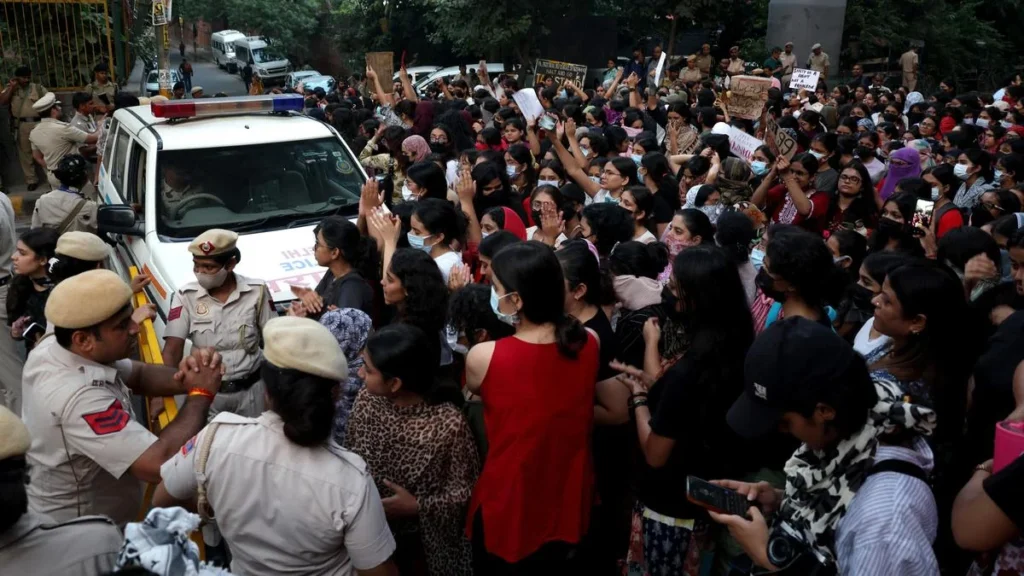
- September 20, 2026: Protests intensify across Delhi as student unions and civil society groups demand immediate action from the police commissioner.
- September 23, 2026: Massive solidarity marches are held in the city, with students demanding enhanced security measures, better lighting, and the immediate deployment of police in public transit and parks.
- September 25, 2026: Public outcry peaks following revelations regarding the "moving bus" incident, with media reports highlighting the total lack of police intervention over a 47-km route.
- September 28, 2026: The Supreme Court of India invokes its suo motu powers to summon responses from the Delhi Police and the administration, setting the stage for a comprehensive judicial audit of the city’s safety protocols.
Official Responses and the Road Ahead
The Delhi Police, currently under the scanner, are expected to file a detailed status report regarding their security deployment and response protocols. However, the court’s skepticism is palpable. By questioning why prior complaints were ignored, the court has signaled that it will not accept standard bureaucratic excuses.
The Legal and Constitutional Stakes
Article 21 of the Indian Constitution, which guarantees the right to life and personal liberty, has historically been interpreted by the Supreme Court to include the right to live with dignity and safety. By framing the current wave of violence as a violation of this Article, the Court is elevating these crimes from local law-and-order issues to matters of constitutional crisis.
Experts suggest that the court may move toward:
- Mandatory Audit of Public Spaces: Ordering an immediate lighting and surveillance audit of all high-risk zones.
- Police Accountability Framework: Establishing a mechanism where senior officers are held accountable for lapses in their jurisdiction.
- Fast-Track Judicial Oversight: Implementing a more rigorous monitoring system for the investigation and prosecution of crimes against women and minors.
Implications for the Capital
The events of the past week have cast a long shadow over the administration. For the residents of Delhi, the sentiment is one of exhaustion and betrayal. The "painful parallel" to the 2012 Nirbhaya case is not merely rhetorical; it represents a collective memory of unfulfilled promises of reform.

As the Supreme Court continues to exert pressure, the focus will likely shift to the structural disconnect between police technology and human enforcement. The availability of modern surveillance equipment is moot if it is not monitored effectively; similarly, the existence of police pickets is irrelevant if they are not active.
In the coming weeks, the nation will be watching closely as the Delhi Police and the Union Ministry of Home Affairs prepare their responses. The judiciary has made it clear: the era of reactive governance is over. The state must now transition to a model of proactive, accountable, and transparent public safety, or face the prospect of a judicial oversight that may fundamentally alter the way the national capital is policed.
For now, the streets of Delhi remain tense. The student-led protests are a reminder that the demand for safety is not a request—it is a mandate from the citizenry that can no longer be ignored by those in the corridors of power. The Supreme Court has provided the platform; it remains to be seen whether the administration has the political will to bridge the gap between policy and reality.