The Silicon Achilles’ Heel: Why India’s Defense Modernization Hinges on Domestic Semiconductor Autonomy

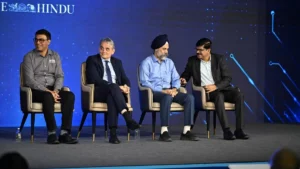
NEW DELHI — As India accelerates its transition toward advanced network-centric warfare—showcased by lethal assets like the BrahMos cruise missile and the conceptualized Sudarshan Chakra multi-layered air defense shield—the nation’s top defense scientists have issued an urgent warning. Speaking at the ‘Chips for the Next Battlefield: Semiconductors, AI & the Future of Defense’ panel during The Hindu Semiconductor Summit 2026, leading technologists emphasized that India’s cutting-edge military hardware remains profoundly vulnerable.
The core of the vulnerability lies in reliance on foreign-supplied microchips. According to the defense architects who shaped India’s modern missile and aerospace programs, true strategic autonomy cannot be achieved through indigenous platform design alone; it requires an end-to-end domestic semiconductor ecosystem encompassing material sourcing, chip design, fabrication, and advanced packaging.
Main Facts: The Intersection of Silicon and Modern Warfare
Modern military strategy has undergone a paradigm shift. Warfare has migrated from "platform-centric" engagements—where the individual tank, fighter jet, or warship determined victory—to "network-centric" operations. In this new ecosystem, command, control, communications, computers, intelligence, surveillance, and reconnaissance (C4ISR) systems dictate outcomes. At the heart of C4ISR are semiconductors.
- The BrahMos Precision Benchmark: Dr. A. Sivathanu Pillai, founder, CEO, and Managing Director of BrahMos Aerospace, highlighted that the phenomenal precision of the supersonic cruise missile relies entirely on microprocessors. When a BrahMos missile receives target coordinates and dynamically alters its trajectory within milliseconds to secure a direct hit, it is driven by high-speed computing and complex onboard software.
- Data Explosion: Dr. Pillai noted that the Indian Air Force’s Light Combat Aircraft (LCA) Tejas Mark 2 processes more data on a single combat mission than the entire legacy MiG-21 fleet processed collectively during the 1971 war. Even deep-space endeavors, such as the landing software of Chandrayaan-3, relied heavily on imported semiconductor systems—a stark reminder of systemic dependency.
- The Technological Gap: While global commercial and advanced military nodes have advanced to 3 nanometers (nm) and below, the vast majority of Indian defense systems currently operate on legacy 28nm chips. Meanwhile, domestic fabrication facilities lag even further behind, with the state-run Semiconductor Complex Limited (SCL) in Chandigarh operating at the 180nm node—technology equivalent to mid-1990s global commercial standards.
Chronology: A History of Missed Opportunities and Catch-Up
India’s current semiconductor predicament is not a sudden development; it is the culmination of decades of divergent technological trajectories, funding gaps, and geopolitical supply chain controls.
- The 1970s–1980s (The Early Promise): India initially held promising cards in semiconductor technology. Notably, India received complementary metal-oxide-semiconductor (CMOS) technology from the Radio Corporation of America (RCA) before Taiwan did.
- The 1980s Setback: Momentum stalled drastically following a devastating fire at SCL Chandigarh in the late 1980s, which forced the facility to shut down for a prolonged period, severely crippling indigenous fabrication evolution.
- Geopolitical Chokepoints: Former DRDO Director General Dr. V.K. Saraswat recalled how external controls crippled early indigenous programs. When India launched its Integrated Guided Missile Development Programme, foreign supplies of the 8086/8087 microprocessors used in the first Prithvi missiles were abruptly curtailed. Restrictions tightened further under the Missile Technology Control Regime (MTCR).
- The Investment Drought: According to Dr. Saraswat, India failed to make substantial capital investments in semiconductor manufacturing infrastructure right up until 2021, leaving the country decades behind global manufacturing superpowers like Taiwan, South Korea, and China.
- The 2020s Pivot: Under the modern India Semiconductor Mission (ISM), initial steps are finally being taken. Notably, the Tata Group is establishing a semiconductor fab in Gujarat in partnership with Taiwan’s Powerchip Semiconductor Manufacturing Corporation (PSMC), targeting the workhorse 40nm node. However, defense experts warn that commercial foundries targeting consumer electronics will not automatically satisfy specialized military needs.
Supporting Data & Technical Realities: The Hardware-Software Trade-Off
The panel discussions laid bare the stark technical metrics dividing India from its geopolitical rivals on the semiconductor front.
| Metric / Domain | Global Military / Commercial Standard | Current Indian Defense Baseline | Indigenous Fab Capability (SCL) |
|---|---|---|---|
| Node Size | 3nm to 5nm (Advanced AI/Hypersonics) | 28nm (Standard Defense Systems) | 180nm (Legacy Technology) |
| AI Processing | Edge AI & Large Language Models | Compensated via software / multi-GPS | Developing (GAETEC for GaAs/GaN) |
| Lithography Access | EUV (Extreme Ultraviolet) | Dependent on foreign supply chains | 4-5 year waiting lines for EUV tools |
| Design Share | Globalized | ~20% of global chip design capability | Targets for workforce expansion |
Software as a Crutch
Because India lacks domestic military-specification positioning satellites providing absolute tactical accuracy, the armed forces currently compensate for weaker hardware by utilizing complex software. This includes collating data from multiple civilian GPS sources. However, defense scientists warned that this workaround will fail when applied to future hypersonic glide vehicles, saturation drone swarms, and high-speed directed energy weapons.
The Special Case of Compound Semiconductors
Beyond standard silicon, compound semiconductors such as Gallium Arsenide (GaAs) and Gallium Nitride (GaN)—vital for the front-end components of modern military radars, electronic warfare suites, and thermal imaging systems—are researched domestically by the DRDO’s Gallium Arsenide Enabling Technology Centre (GAETEC). Yet, scaling these technologies for mass deployment remains an uphill battle.
Official Responses and Expert Warnings
The consensus among the summit panelists was uniform: time is running out.
Dr. Pillai criticized the timeline proposed by official policy frameworks, which project that India will achieve domestic 3nm manufacturing capabilities between 2030 and 2035.
"That is too late in the present situation," Dr. Pillai warned. "Controls on materials, devices, and chip-making equipment are coming. If you want to wait for 2030 to 2035 to achieve it, you will miss the bus. The equipment needed to make a foundry, and not just the foundry itself, must be produced in India."
Dr. Saraswat echoed these concerns, emphasizing that advanced nodes of 5nm, 3nm, and 2nm are non-negotiable for future artificial intelligence applications at the tactical edge, including autonomous combat drones and large language models tailored for battlefield decision-making.
Comparing India’s trajectory with its northern neighbor, Dr. Saraswat pointed out that China’s dominance stems from two strategic pillars: sustained, unyielding financial investment since the 1980s, and a calculated reverse-brain-drain policy that repatriated Chinese-origin engineers trained in U.S. universities and foundries.
Furthermore, Professor Deleep Nair of the Department of Electrical Engineering at IIT Madras pointed out that while commercial packaging plants are emerging, academic and research infrastructure must mirror advanced international models. Both Saraswat and Pillai advocated for the establishment of specialized R&D fabrication facilities within India’s premier academic institutes—modeled on Belgium’s renowned Interuniversity Microelectronics Centre (IMEC)—to pioneer next-generation paradigms like neuromorphic computing chips.
Strategic Implications: Security, Supply Chains, and the Threat of Compromise
The ultimate peril of importing military-grade semiconductors goes far beyond supply chain disruptions; it strikes at the very heart of national sovereignty.
1. The Trojan Horse Threat (Hardware Trojans)
Dr. Saraswat offered a chilling reminder of the vulnerabilities inherent in foreign supply chains, citing the historical Stuxnet cyberattack. In that incident, a microscopic flaw introduced deliberately during the manufacturing process allowed a remote actor to override controllers running uranium enrichment centrifuges in Iran.
"These devices, if they are compromised while they are being manufactured, then your weapon is compromised," Dr. Saraswat stated plainly. If an adversary has visibility over or access to the fabrication lines of chips destined for Indian cruise missiles or air defense systems, the strategic deterrent value of those weapons is instantly neutralized.
2. Cloud Infrastructure and Telemetry Risks
Modern network-centric warfare relies on continuous data streaming. However, reliance on foreign cloud infrastructure and foreign Position, Navigation, and Timing (PNT) systems creates fatal blind spots. Dr. Saraswat warned: "If the cloud is sitting outside, the entire information going through my network-centric warfare system through the cloud—I am compromised."
3. The Critical Minerals Bottleneck
While India boasts immense strength in software—currently accounting for roughly 20% of global chip design capabilities, a figure Dr. Pillai argues should be aggressively pushed to 50%—it severely lags in raw material security.
"We don’t even stockpile," Dr. Pillai cautioned regarding critical rare-earth elements and minerals essential for semiconductor fabrication. "China has done it very effectively, and there is going to be a big control coming on us; before that, we should do it. We are behind many, many years."
Path Forward
To secure the "next battlefield," India must rapidly transition from a consumer of imported silicon to an end-to-end semiconductor powerhouse. As the Sudarshan Chakra air defense shield and future hypersonic weapon systems take shape on drawing boards, the ultimate test of India’s defense preparedness will not be measured solely by the range of its missiles, but by the sovereign origin of the microscopic silicon brains that guide them.