AI Industry Alert: Access to Anthropic’s Claude Fable 5 and Mythos 5 Restricted Following New US Export Controls
Date: June 12, 2026
Subject: Regulatory Compliance Update regarding Amazon Bedrock Model Availability
In a significant development for the generative AI sector, Anthropic and Amazon Web Services (AWS) have announced a mandatory suspension of access to two of their most powerful language models—Claude Fable 5 and Claude Mythos 5. This decision, effective immediately, follows the issuance of a new US Government export control directive concerning advanced AI technologies.
While the industry continues to grapple with the rapidly shifting regulatory landscape, this move highlights the growing tension between the rapid acceleration of artificial intelligence capabilities and the strategic security concerns of the United States government.
1. Main Facts: The Scope of the Restriction
As of June 12, 2026, all users—including enterprise clients and developers—have lost access to Claude Fable 5 and Claude Mythos 5 via Amazon Bedrock and the Claude Platform on AWS.
Key Takeaways for Developers:
- Status of Affected Models: Both Fable 5 and Mythos 5 are currently unavailable.
- Continued Support for Legacy Models: Anthropic has confirmed that all other models, including the highly capable Opus 4.8, remain fully operational. Users can continue to integrate these models into their production pipelines without disruption.
- The Trigger: The suspension is a direct response to a US Government export control directive. Compliance with these federal mandates is a prerequisite for Anthropic’s partnership with AWS.
- Mitigation: For those currently relying on the Fable architecture, Anthropic suggests shifting workloads back to Opus 4.8 while the company works alongside federal regulators to resolve the compliance status of its latest-generation models.
2. Chronology of Events: From Launch to Limitation
The release and subsequent restriction of the Fable 5 and Mythos 5 models have occurred within a condensed, high-pressure timeframe, reflecting the volatility of the AI arms race.
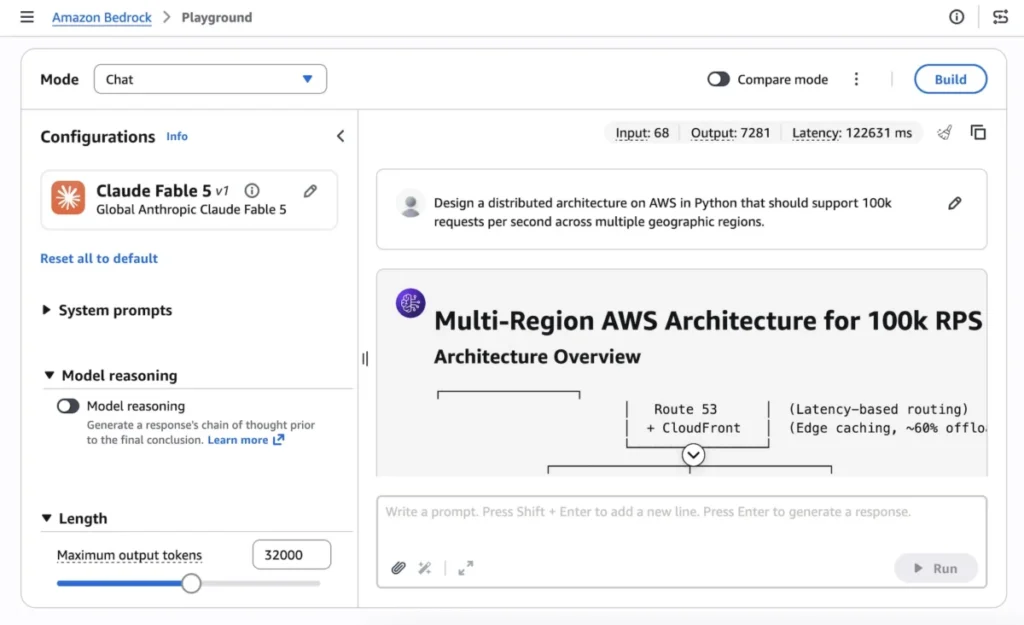
- Early June 2026: Anthropic announces the release of Claude Fable 5 on Amazon Bedrock. The model was marketed as a "step-change" in AI capability, particularly in software engineering, complex knowledge work, and advanced computer vision tasks.
- June 9, 2026: Technical documentation updates are issued to assist users in navigating the
bedrock-mantleandbedrock-runtimeAPI endpoints. Refinements are made to the data retention protocols required to access the model. - June 10, 2026: AWS expands documentation, providing developers with guidance on using AWS SigV4 and CLI commands to manage the necessary data sharing requirements for the Fable 5 model.
- June 12, 2026: Following a federal directive, Anthropic and AWS issue a joint notice suspending access to Fable 5 and Mythos 5. The rapid shift from public availability to total lockdown underscores the sensitivity of the underlying technology.
3. Supporting Data: Capabilities and Architectural Safeguards
Before the regulatory suspension, Claude Fable 5 was touted as the pinnacle of Anthropic’s engineering. It was designed specifically for ambitious, long-running tasks that required sustained reasoning and high-fidelity output.
Performance Benchmarks
Fable 5 was rated as state-of-the-art across nearly all industry-standard benchmarks. Its architecture was uniquely tuned for:
- Software Engineering: Automating complex code refactoring and architecture design.
- Knowledge Synthesis: Processing vast datasets to extract actionable insights.
- Multimodal Reasoning: Advanced vision processing for interpreting technical diagrams and environmental inputs.
The "Fable" vs. "Mythos" Distinction
Anthropic employed a tiered release strategy for its latest models. Claude Fable 5 included built-in, aggressive safety filters. If a user submitted a prompt related to sensitive domains—such as cybersecurity, advanced chemistry, or biological engineering—the system was programmed to automatically fall back to the Opus 4.8 model to ensure the output remained within safe parameters.
Claude Mythos 5, by contrast, was the unrestricted, "raw" version of the model. It was never intended for wide release and was restricted strictly to a small cohort of vetted, high-trust customers. The government directive has now effectively shuttered both the commercialized, safeguarded Fable 5 and the restricted Mythos 5.
4. Official Responses and Industry Context
In a brief statement, Anthropic emphasized that the decision was not a choice of their own making but a necessity of compliance. "To support compliance with the US Government export control directive, Anthropic has asked AWS to revoke access to Claude Fable 5 and Claude Mythos 5 for all users," the company noted in its official news portal.
For AWS, the event highlights the complexity of managing a cloud-based AI ecosystem. By providing access through both the Amazon Bedrock managed service and the Claude Platform on AWS, the company had hoped to provide a seamless transition for enterprises.
Why the Data Retention Policy Matters
A critical part of the initial Fable 5 rollout was the requirement for users to opt into a "Data Retention API." To ensure safety and accountability, Anthropic required a 30-day retention window for all inputs and outputs, subject to human review for abuse detection. This policy was intended to provide a "safety net" for the powerful model, but it ultimately served as a tool for authorities to monitor the model’s trajectory before the eventual shutdown.
5. Implications for the AI Ecosystem
The suspension of these models has profound implications for the global AI landscape.
A. The "Regulatory Ceiling"
This incident signals that AI development is no longer solely an engineering challenge—it is a diplomatic and geopolitical one. As models approach "Mythos-level" capabilities, they enter a realm of dual-use technology that falls under the purview of national security agencies. Developers must now anticipate that a model’s availability may change overnight based on executive action.

B. Enterprise Risk and Dependency
Businesses that were in the process of integrating Fable 5 into their CI/CD pipelines or automated knowledge work systems now face an urgent "fail-over" situation. The incident serves as a harsh reminder of the risks of vendor lock-in with cutting-edge models that are subject to external regulatory control. Relying on a model that can be "switched off" via an API call is a major risk factor for enterprise infrastructure.
C. The Future of "Safe" vs. "Unrestricted" Models
Anthropic’s strategy of having a "safe" version (Fable) and an "unrestricted" version (Mythos) was a bold experiment in balancing accessibility with security. The failure of this strategy to satisfy government regulators suggests that the threshold for what constitutes a "dangerous" model is moving downward. Developers should prepare for a future where the most powerful versions of these models remain permanently siloed in closed-access environments.
D. The Path Forward for Developers
For those currently navigating this transition:
- Audit Workloads: Immediately revert production-critical applications to stable, long-term supported models like Opus 4.8.
- Monitor Compliance Channels: AWS and Anthropic have promised to keep users updated via their respective news channels.
- Diversification: The situation strengthens the case for a model-agnostic approach to AI architecture, where developers build layers that allow for the swapping of underlying models (e.g., switching between Anthropic, AWS-native models, and other third-party providers) without rewriting core logic.
Conclusion
The restriction of Claude Fable 5 and Mythos 5 is a landmark event in the timeline of the 2026 AI revolution. It marks the end of an era where "state-of-the-art" was synonymous with "publicly available." As government oversight tightens, the industry must prepare for a more bifurcated future—one where the most potent tools are accessible only under the strict, evolving scrutiny of global export control regimes.
For ongoing updates, users are advised to consult the Anthropic Newsroom and the AWS Bedrock documentation.