Amazon ECS Revolutionizes Elasticity: Introducing High-Resolution Scaling for Containerized Workloads
In the high-stakes world of cloud-native computing, the ability to respond to traffic spikes is not merely a convenience—it is a requirement for maintaining service level agreements (SLAs) and ensuring cost efficiency. Amazon Web Services (AWS) has long provided the tools to manage these fluctuations through Amazon Elastic Container Service (Amazon ECS). Today, AWS is fundamentally shifting the performance baseline for container orchestration by introducing high-resolution metrics for ECS Service Auto Scaling. By moving from standard 60-second intervals to a lightning-fast 20-second cadence, AWS is enabling developers to build more responsive, resilient, and efficient distributed systems.
The Core Transformation: Speeding Up the Feedback Loop
For years, Amazon ECS users have relied on a robust suite of scaling mechanisms, including predictive scaling, scheduled scaling, and reactive target tracking. While these tools have proven highly effective for many use cases, the industry’s shift toward microservices and event-driven architectures has necessitated a more granular approach to resource management.
The primary limitation of traditional auto-scaling has been the “time-to-react” factor. When traffic surges, every second counts. If a system takes several minutes to detect a load increase and provision the necessary compute resources, the user experience suffers, potentially resulting in latency, queue backups, or service degradation.
With this new release, AWS has significantly narrowed this window. By supporting high-resolution 20-second metrics, ECS can now detect and respond to load changes with unprecedented speed. This optimization represents a paradigm shift for applications that experience sudden, sharp spikes in demand, such as flash sales, viral social media activity, or unpredictable background job processing.

Chronology: The Evolution of ECS Scaling
To understand the significance of this update, one must view it within the broader timeline of AWS container orchestration:
- Early Foundations: The initial launch of ECS focused on basic orchestration, allowing developers to manage clusters of EC2 instances. Scaling was largely manual or required external scripting.
- The Introduction of Service Auto Scaling: AWS introduced native auto-scaling, allowing services to scale based on CloudWatch metrics. At the time, standard resolution metrics (60 seconds) were the industry gold standard.
- The Era of Predictive Scaling: Recognizing that reactive scaling has inherent limits, AWS integrated machine learning to predict demand patterns, allowing systems to preemptively provision capacity.
- The 2024 Breakthrough: AWS recognized that even with predictive models, the "reaction time" for unexpected events was a bottleneck. By optimizing the metric publishing pipeline and integrating 20-second high-resolution monitoring, AWS has effectively compressed the scaling lifecycle, bringing the "time-to-provision" down to levels previously unattainable in a managed container environment.
Supporting Data: Quantifying the Performance Gains
The most compelling argument for this update lies in the benchmarking data provided by AWS engineering teams. When comparing the new high-resolution metric approach to the traditional 60-second baseline, the improvements are substantial:
- Time to Trigger Scale-Out: Previously, the average time to trigger a scale-out event was 363 seconds. With the new 20-second resolution, this has plummeted to just 86 seconds. This represents a 76% improvement in responsiveness, or a 4.2x increase in speed.
- Total Provisioning Latency: Perhaps most critical is the end-to-end time—the duration from the initial load surge to the point where new tasks are fully provisioned and ready to handle traffic. This metric improved from 386 seconds to 109 seconds, a 72% reduction, or 3.5x faster throughput.
These numbers illustrate a clear reality: for developers, the "cost" of a traffic spike is now significantly lower. The system is no longer waiting for the next minute-long interval to check for CPU or memory saturation; it is constantly evaluating, resulting in a system that breathes in sync with the actual traffic patterns of the end user.
Implementation: How to Deploy High-Resolution Scaling
The transition to high-resolution auto-scaling is designed to be seamless for existing users. Whether managing workloads on AWS Fargate, ECS Managed Instances, or traditional Amazon EC2, the configuration steps are straightforward.

Enabling the Feature
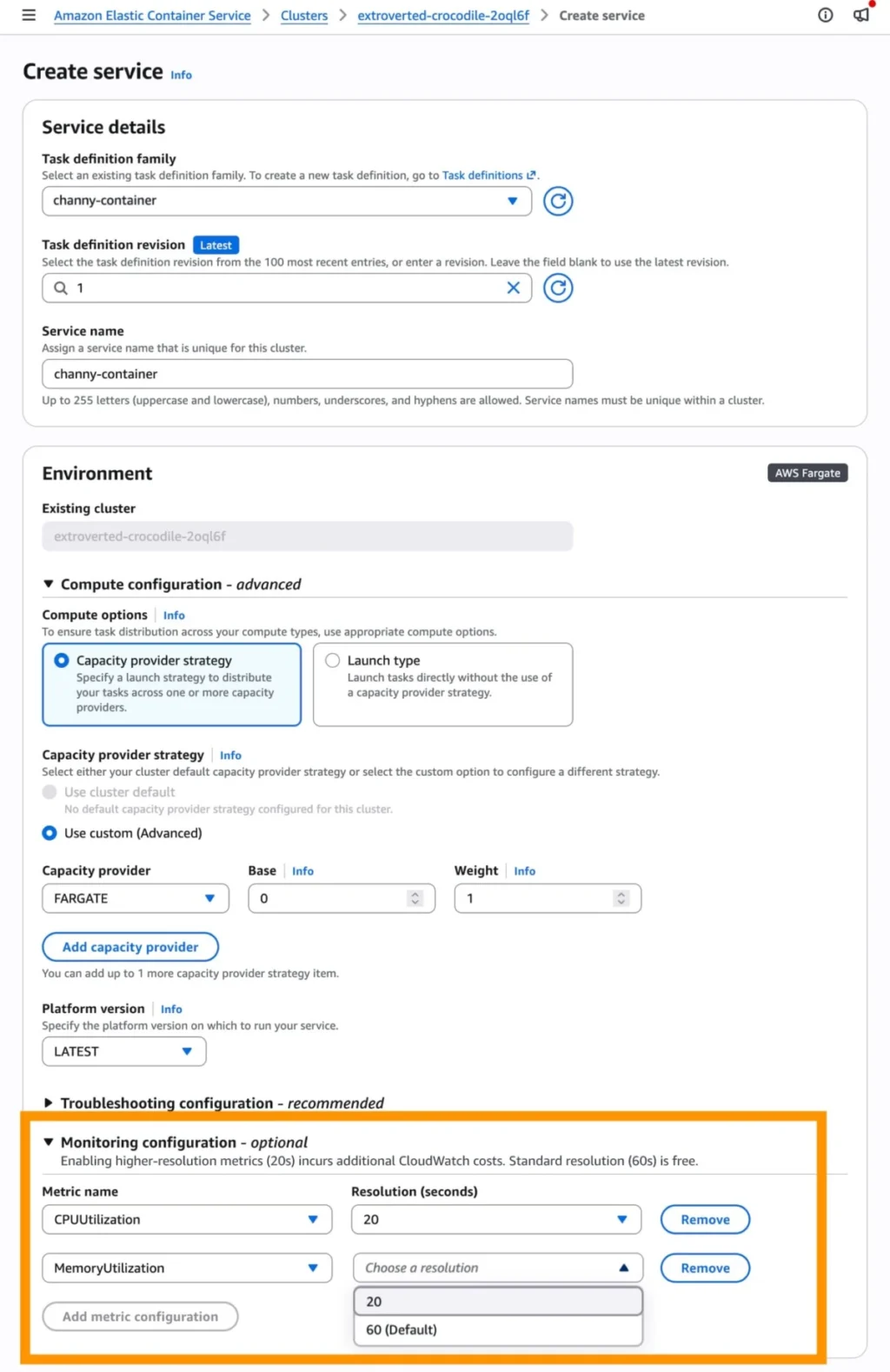
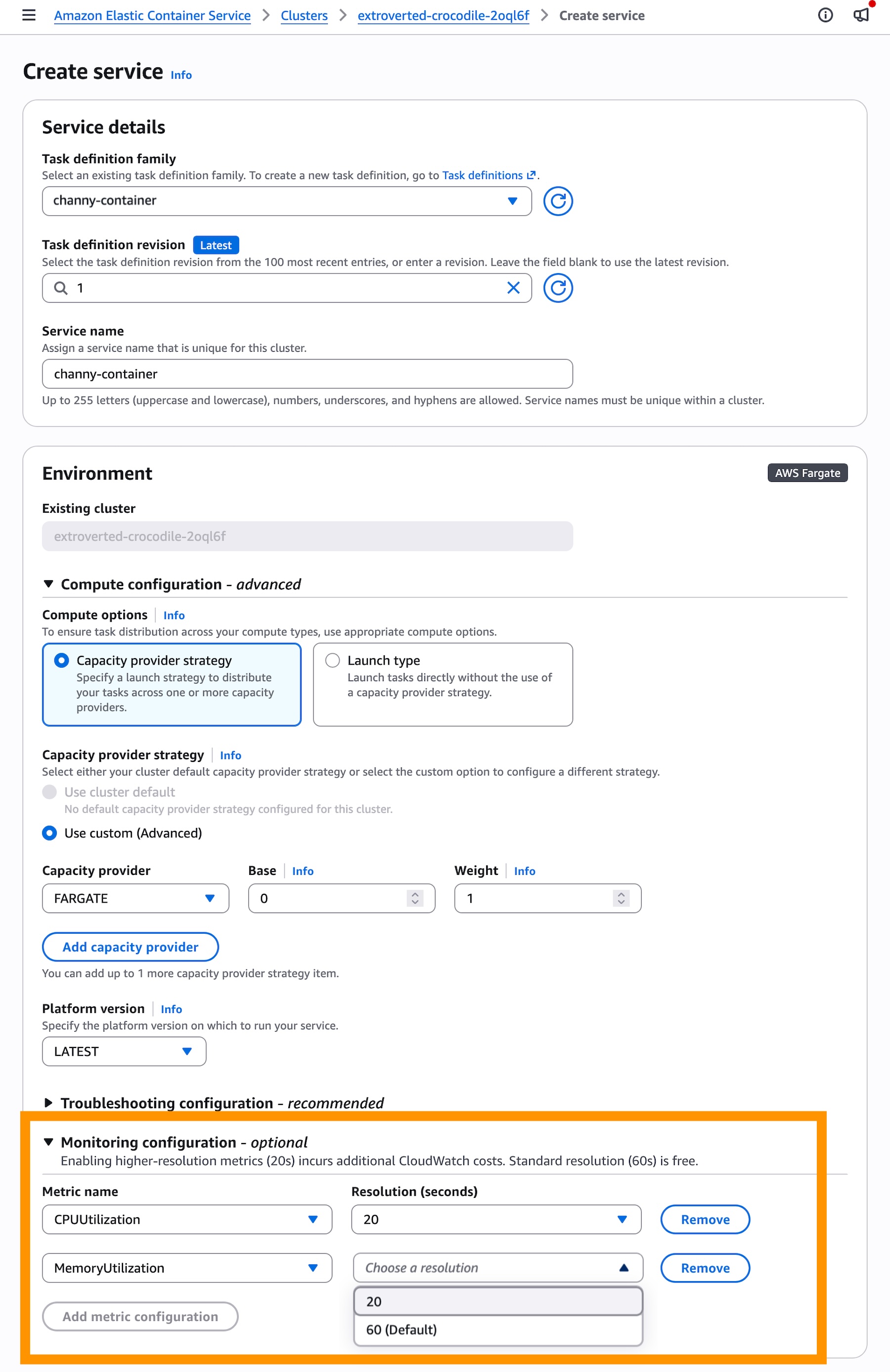
- Configure High-Resolution Metrics: When creating or updating an ECS service in the AWS Console, users can now toggle high-resolution metrics within the "Monitoring configuration" section.
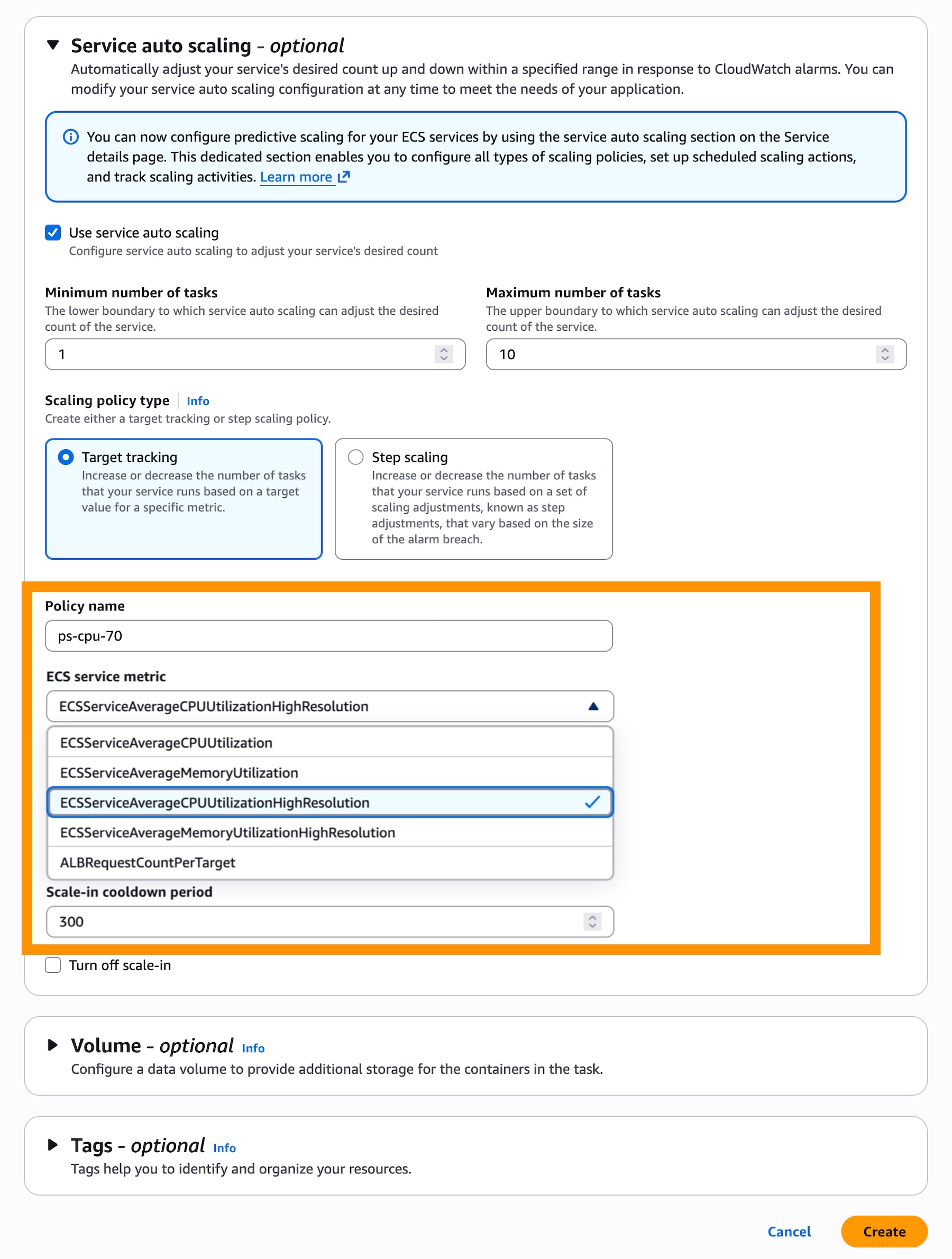
- Select the Scaling Policy: Once the service is generating high-resolution telemetry, users must navigate to the "Service auto scaling" tab. By selecting "Target Tracking," users can now choose specific high-resolution metrics such as
ECSServiceAverageCPUUtilizationHighResolutionorECSServiceAverageMemoryUtilizationHighResolution. - Deployment via Infrastructure-as-Code: For teams relying on automation, these settings are fully supported through the AWS SDKs, the AWS Command Line Interface (CLI), and AWS CloudFormation templates, ensuring that the new scaling capabilities can be integrated into CI/CD pipelines without manual intervention.
A Note on Cost
While the feature itself is a native enhancement to the ECS service and carries no direct “per-use” fee, it is important to note that high-resolution metrics incur costs associated with Amazon CloudWatch. Because these metrics publish data more frequently, the ingestion volume increases, which is reflected in standard CloudWatch pricing. Architects should evaluate their cost-to-performance ratio to determine which services require this level of precision.
Implications for Modern Infrastructure
The implications of this update are far-reaching for enterprise-grade applications.
Enhanced User Experience
For customer-facing applications, the reduction in scale-out time directly correlates to a decrease in 5xx error rates during peak demand. By provisioning capacity before a queue overflows, companies can maintain consistent response times, directly impacting customer retention and conversion rates.
Operational Efficiency
By reducing the total time to scale, businesses can afford to run closer to their actual resource requirements. In the past, many teams over-provisioned their clusters to provide a "buffer" for the time it took for auto-scaling to kick in. With a 3.5x improvement in scaling speed, teams can confidently lower their minimum capacity, potentially resulting in significant monthly savings on compute costs.
Reliability in Volatile Environments
In architectures relying on bursty workloads—such as image processing, financial data analysis, or real-time event streaming—the 20-second resolution provides a level of control that was previously the domain of custom-built, highly complex autoscalers. AWS is effectively commoditizing high-performance scaling, allowing smaller teams to benefit from the same robust architecture that powers global-scale platforms.
Official Guidance and Future Outlook
AWS encourages developers to explore these new configurations immediately. The team behind the update emphasizes that this is not just a marginal gain but a foundational change in how ECS manages container density.
"We are committed to reducing the friction between traffic demand and infrastructure supply," noted Channy Yun, Principal Developer Advocate at AWS. "By providing the tools to scale in under two minutes, we are enabling our customers to build applications that are as dynamic as the internet itself."
For those ready to implement the change, the official AWS documentation for faster auto scaling provides a comprehensive guide, including CLI examples and troubleshooting tips. Users are encouraged to share their experiences and feedback via the AWS re:Post for ECS community.
As containerized workloads continue to grow in complexity, the importance of responsive infrastructure cannot be overstated. With this latest update, Amazon ECS has cemented its position as a leader in the orchestration space, providing a bridge between high-performance requirements and the ease of a managed service. Whether you are running a monolithic application or a complex network of microservices, the ability to scale 3.5x faster is a competitive advantage that is available to every AWS customer, starting today.