Amazon Revolutionizes Container Scalability: Introducing High-Resolution Auto Scaling for ECS
In the high-stakes environment of cloud computing, latency is the ultimate adversary. For organizations running microservices on the Amazon Elastic Container Service (Amazon ECS), the ability to react instantly to traffic spikes is not just a performance optimization—it is a business imperative. Today, Amazon Web Services (AWS) has announced a significant leap forward in container orchestration efficiency: the introduction of high-resolution (20-second) metric support for Amazon ECS Service Auto Scaling.
This enhancement drastically reduces the time required for containerized applications to scale in response to changing demand, promising a more resilient and cost-effective infrastructure for developers and system architects worldwide.
The Core Innovation: Moving to 20-Second Precision
At its core, Amazon ECS Service Auto Scaling is designed to ensure that container tasks are provisioned exactly when needed. Historically, ECS utilized standard 60-second resolution metrics provided by Amazon CloudWatch. While sufficient for many steady-state workloads, this one-minute interval could create a "lag gap"—a window of time where applications under sudden, intense load might experience degraded performance because the scaling mechanism hadn’t yet "seen" the surge.
The new update shifts the paradigm by allowing ECS services to leverage 20-second high-resolution metrics. By tripling the frequency at which scaling policies evaluate system performance, AWS has effectively compressed the reaction cycle of container clusters. This evolution ensures that the infrastructure is not merely following demand but is pacing it with unprecedented agility.

A Chronology of Scaling Evolution
To understand the magnitude of this update, one must look at the trajectory of AWS scaling services over the last decade.
- The Era of Reactive Scaling: Initially, AWS users relied on simple, reactive thresholds. Scaling was a manual or semi-automated process that often resulted in over-provisioning (to stay safe) or under-provisioning (during unexpected bursts).
- The Introduction of Target Tracking: The arrival of target tracking policies allowed users to specify a desired metric—such as 70% CPU utilization—and let AWS handle the heavy lifting. This was a massive productivity booster but remained tethered to the 60-second CloudWatch reporting cycle.
- The ML-Driven Predictive Wave: AWS eventually introduced predictive scaling, utilizing machine learning to analyze historical traffic patterns and scale proactively. While brilliant for predictable cycles (like daily morning surges), it could not account for "black swan" traffic events.
- The 2026 Milestone: The launch of 20-second high-resolution scaling marks the current pinnacle of this evolution. By bridging the gap between predictive ML models and real-time reactive adjustments, AWS has created a comprehensive framework that addresses both anticipated and spontaneous traffic fluctuations.
Supporting Data: Quantifying the Performance Gains
AWS conducted extensive internal benchmarking to validate the impact of this transition, and the results are profound. For organizations operating mission-critical applications, these numbers translate directly to improved user experiences and better resource utilization.
Scale-Out Velocity
In previous iterations, the time required to trigger a scale-out event—from the moment a load spike hit to the initiation of new task provisioning—averaged approximately 363 seconds. With the new high-resolution metrics, this trigger time has plummeted to just 86 seconds. This represents a 76% improvement in responsiveness, or a 4.2x increase in speed.
Provisioning Efficiency
The improvement extends to the entire lifecycle of the scaling event. When measuring the "total time to scale"—the duration from the onset of a spike to the moment new tasks are fully provisioned and ready to serve traffic—the time was reduced from 386 seconds to 109 seconds. This 72% (3.5x) improvement means that applications can now absorb sudden, massive traffic influxes before they impact the end-user, significantly mitigating the risk of service timeouts or errors during high-pressure events.

Implementation: How to Enable Faster Scaling
Integrating this capability into existing or new architectures is designed to be seamless. The configuration process is split across three primary compute environments: AWS Fargate, ECS Managed Instances, and Amazon EC2.
Step 1: Enabling High-Resolution Metrics
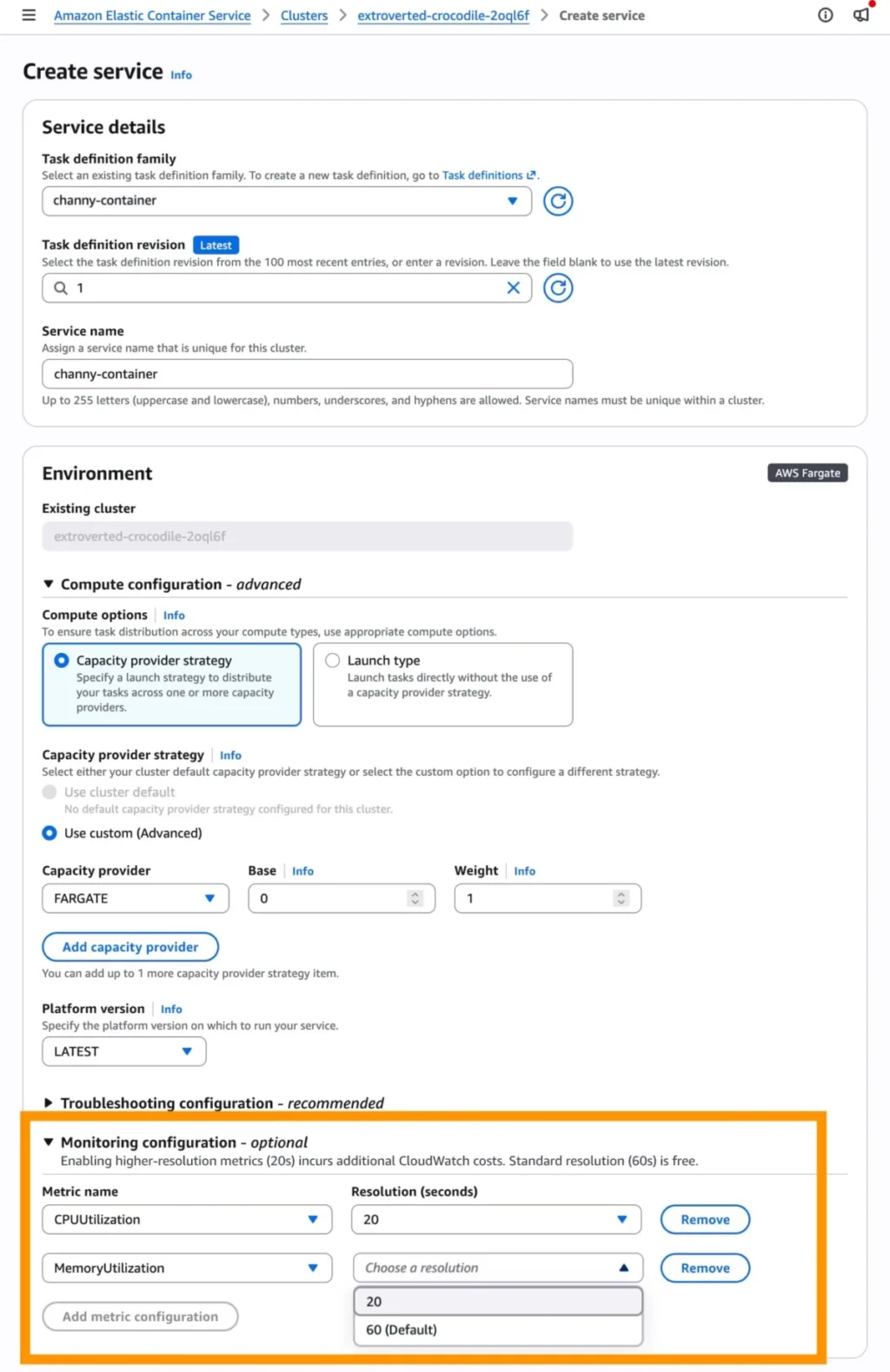
During the creation or update of an ECS service via the AWS Management Console, developers can now navigate to the Monitoring configuration section. By explicitly selecting the option for 20-second resolution metrics, the service begins pushing data to CloudWatch at the new frequency. It is important to note that while the feature itself incurs no additional fee, the high-resolution metrics do carry costs consistent with standard CloudWatch high-resolution pricing.
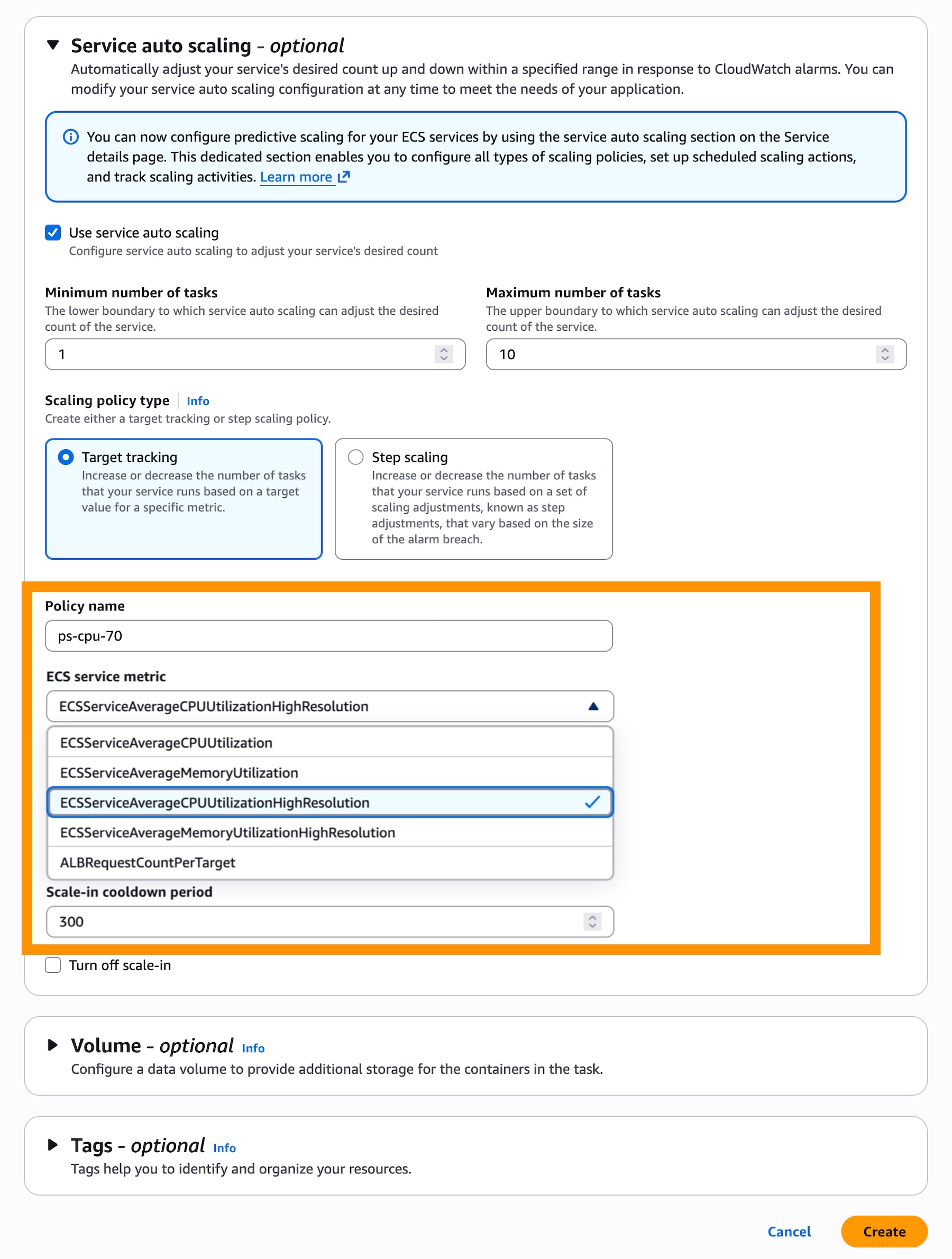
Step 2: Configuring Target Tracking
Once the metrics are active, the user proceeds to the Service auto scaling section. By selecting Target Tracking as the policy type, the user can now choose specific high-resolution metrics such as ECSServiceAverageCPUUtilizationHighResolution or ECSServiceAverageMemoryUtilizationHighResolution.
Step 3: Deployment and Monitoring
For existing services, the process is equally straightforward: update the service configuration to enable the metrics, allow the deployment to complete, and then update the scaling policy to reference the new, faster data streams. The AWS Command Line Interface (AWS CLI) and AWS CloudFormation templates also provide full support for these configurations, allowing for Infrastructure-as-Code (IaC) integration.
Strategic Implications for Enterprise Architecture
The move to 20-second scaling is more than a technical tweak; it has significant implications for how organizations design their cloud footprint.
1. Cost Optimization
Historically, many organizations over-provisioned their ECS clusters as a "buffer" against slow scaling times. Because scaling was slow, businesses kept extra containers running at all times to handle potential spikes. With 3.5x faster scaling, the need for this "safety buffer" is drastically reduced. Companies can now operate at much tighter margins, scaling down during lulls and scaling up rapidly when needed, leading to significant reductions in monthly compute costs.
2. Improved Application Resiliency
In a microservices architecture, a delay in scaling one service can cause a cascading failure throughout the stack. By ensuring that scaling events happen in seconds rather than minutes, AWS is providing a crucial layer of fault tolerance. This is particularly vital for e-commerce platforms during flash sales, gaming backends during matchmaking surges, and financial services handling high-frequency transaction windows.
3. Developer Velocity
By automating the "fine-tuning" of scaling intervals, AWS is allowing DevOps and SRE (Site Reliability Engineering) teams to focus on higher-level architectural challenges rather than spending hours troubleshooting "scale-lag" issues. The configuration is intuitive and aligns with existing workflows, ensuring that adoption does not require a steep learning curve.
Looking Ahead: The Future of Serverless Scaling
The introduction of 20-second high-resolution metrics is a clear signal of where the industry is heading. As containerized workloads become more ephemeral and granular, the infrastructure underneath must become increasingly fluid.
The integration of these metrics with existing machine learning algorithms—such as the predictive scaling models already present in ECS—suggests a future where scaling is not just fast, but near-instantaneous and increasingly intelligent. As AWS continues to refine its orchestration layer, the barrier between "code deployment" and "production capacity" continues to blur.
For engineers currently managing ECS services, the mandate is clear: the tools to build more responsive, cost-effective, and robust applications are now available. Whether you are running a monolithic web service or a complex, event-driven microservices architecture, adopting these high-resolution metrics represents the next logical step in optimizing your AWS environment. As always, feedback is welcomed through official channels like AWS re:Post, ensuring that the next generation of AWS features continues to be shaped by the needs of the global developer community.