AWS Unveils Lambda MicroVMs: Bridging the Gap Between Serverless Flexibility and Virtualized Security
In a major expansion of its serverless ecosystem, Amazon Web Services (AWS) has announced the launch of AWS Lambda MicroVMs, a new compute primitive designed to resolve the long-standing tension between high-performance isolation and operational efficiency. By leveraging the industry-proven Firecracker virtualization technology, AWS is empowering developers to deploy stateful, multi-tenant applications—such as AI coding assistants, interactive data science notebooks, and sandboxed game servers—without the administrative burden of managing traditional virtual machine (VM) fleets.
The Core Innovation: What are Lambda MicroVMs?
At its most fundamental level, AWS Lambda MicroVMs represent a paradigm shift in how cloud providers handle "untrusted code." Traditionally, developers have been forced to choose between the heavy isolation of standard virtual machines (which suffer from slow cold-start times) and the lightweight agility of containers (which require complex kernel-level hardening to prevent security escapes).
Lambda MicroVMs offer the best of both worlds. They provide virtual machine-level isolation—ensuring that a user’s code is physically and logically partitioned from other tenants—while delivering near-instantaneous launch and resume capabilities. Because they are built upon the Firecracker virtualization engine, the same technology that has powered over 15 trillion monthly AWS Lambda invocations, they offer a mature, battle-tested foundation for high-scale, secure computing.
The Genesis of a Compute Primitive: A Chronological Look
The journey toward Lambda MicroVMs began as a response to the rapid proliferation of generative AI and collaborative coding tools.

- The Rise of Multi-tenancy (2022–2024): As AI-driven coding assistants and interactive browser-based IDEs gained popularity, AWS engineering teams observed a recurring challenge: developers were struggling to provision secure, isolated environments for every end-user session.
- The "Hardening" Dilemma: Engineers attempted to use containers, but found that the shared-kernel architecture required significant "custom hardening" to safely run code supplied by users. This was not only time-consuming but also prone to security risks.
- The Prototype Phase (2025): Recognizing the gap, AWS engineers began experimenting with taking the Firecracker snapshot technology—which allows a running VM to be paused and saved to disk—and exposing it as a user-facing compute primitive.
- The Launch (June 2026): After rigorous internal testing and optimization of snapshotting speeds, AWS officially released Lambda MicroVMs, enabling developers to package Docker-based workloads into stateful, auto-resuming environments.
Supporting Data: Technical Capabilities and Performance
Lambda MicroVMs are not just a rebranded version of standard Lambda functions; they are a distinct API surface optimized for long-running, stateful sessions.
Technical Specifications at a Glance:
- Architecture: ARM64 native.
- Resource Ceiling: Up to 16 vCPUs and 32 GB of memory per MicroVM.
- Disk Storage: Up to 32 GB of persistent volume per instance.
- Persistence: Support for up to 8 hours of total session runtime.
- Latency: Near-instant resume from snapshotted memory state.
The efficiency of this service lies in its "image-then-launch" workflow. By creating a MicroVM image from a Dockerfile, the system performs a one-time initialization, effectively "freezing" the application state. When a user requests access, the service does not perform a cold boot; it simply resumes the snapshot. This eliminates the "warm-up" time that typically plagues VM-based deployments.
The "How-To": Streamlining the Developer Workflow
For developers, the transition to Lambda MicroVMs is designed to be seamless. The process involves three primary steps:
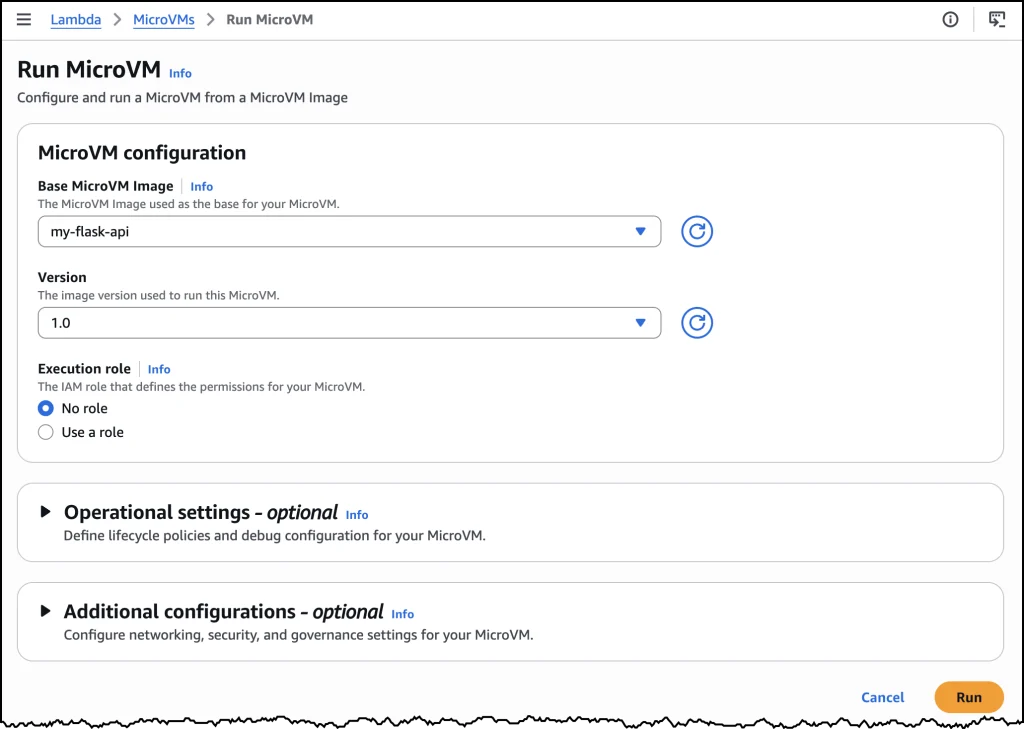
- Image Creation: Developers provide a Dockerfile and a zip artifact containing their code. AWS Lambda builds the container, initializes the application, and snapshots the memory and disk state.
- Configuration: Using the CLI or the AWS Management Console, developers define an "idle policy." This policy dictates how long the environment stays active after the last request before it enters a suspended state, significantly reducing compute costs.
- Execution: Once invoked, the MicroVM assigns a unique endpoint. The environment is immediately responsive, as it resumes from the pre-warmed snapshot rather than executing the entire initialization sequence again.
Official Perspective: Addressing the "Trade-off" Gap
During the announcement, AWS product leadership emphasized that this service was "purpose-built" to solve the "effort-to-product" trade-off. "For years, engineers have had to choose between performance and isolation," the product team noted. "If they wanted strong security, they built custom VM infrastructure, which pulled precious time away from the actual product. Lambda MicroVMs allow developers to focus on the business logic while we handle the heavy lifting of virtualization."

AWS maintains that this service is intended to complement, not replace, traditional Lambda functions. While functions remain the gold standard for event-driven, request-response workloads, MicroVMs provide the persistent state required for interactive sessions, such as long-running data analytics tasks or complex AI-driven code analysis.
Implications: A New Era for SaaS and AI
The introduction of Lambda MicroVMs carries significant implications for the software industry, particularly in the realm of SaaS and AI-integrated applications:
1. Democratizing Complex Infrastructure
Startups that previously lacked the engineering resources to build isolated, secure execution environments can now deploy enterprise-grade sandboxes with minimal effort. This lowers the barrier to entry for building competitive AI platforms.
2. Cost-Efficiency in Multi-tenancy
The "suspend and resume" feature is a game-changer for cost management. By allowing the system to automatically move inactive sessions to a low-cost, suspended state, companies can support thousands of concurrent users while only paying for the compute resources actually consumed during active interaction.

3. Enhanced Security Posture
By moving away from shared-kernel container architectures and toward dedicated, hardware-level isolation for every user session, businesses can significantly reduce their attack surface. This is particularly critical for platforms that execute third-party scripts or user-provided code, which are common vectors for modern cyberattacks.
4. Future-Proofing for AI
As AI models become more interactive and capable of writing code, the need for safe, stateful execution will only increase. Lambda MicroVMs provide a scalable foundation for the next generation of "agentic" applications that require memory, disk access, and long-running processes to complete their objectives.
Conclusion: A Strategic Pivot for AWS
With the launch of Lambda MicroVMs, AWS is further cementing its dominance in the serverless market by addressing the specific, high-friction requirements of modern, stateful applications. By abstracting away the complexities of virtualization while retaining the benefits of strong, hardware-level security, AWS has provided a powerful tool for developers looking to build the next wave of interactive, AI-powered software.
As this technology matures, we can expect to see an influx of new platforms that were previously considered too complex or too expensive to build. Whether it is an educational platform offering live coding environments to students or a data analytics firm providing sandboxed SQL execution to thousands of clients, Lambda MicroVMs provides the infrastructure to scale reliably, securely, and cost-effectively.
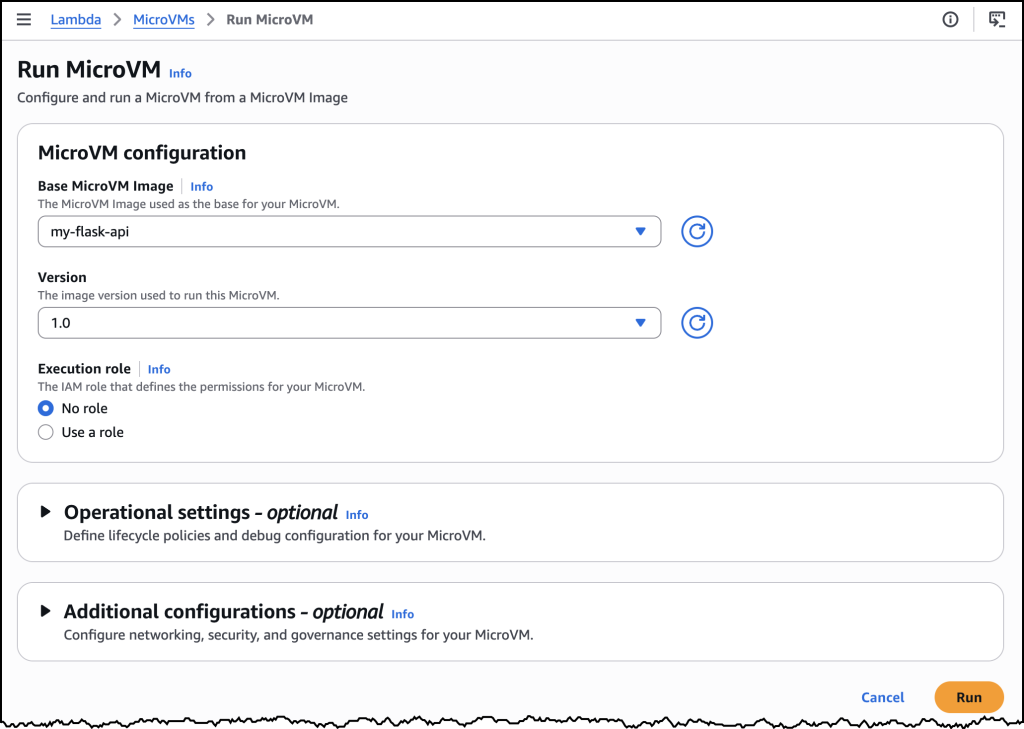
For developers eager to explore this new capability, the service is currently available in major regions including US East (N. Virginia, Ohio), US West (Oregon), Europe (Ireland), and Asia Pacific (Tokyo). With comprehensive documentation and native integration into the existing AWS console, the path from prototype to production has never been clearer.