Beyond the Leaderboard: A Deep Dive into the Reality of AI Agent Benchmarking
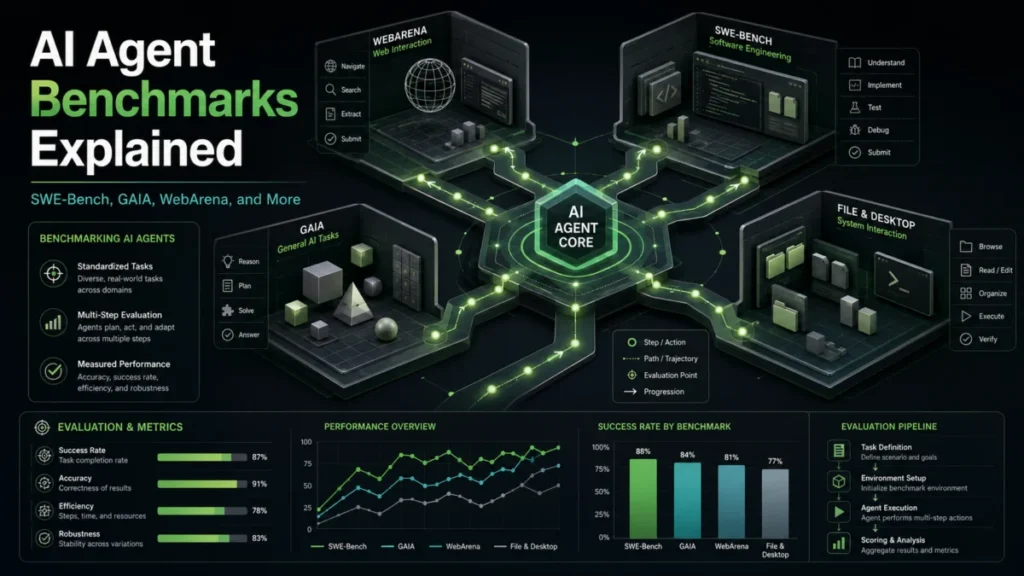
Every AI provider currently claims their agent is "state-of-the-art." Marketing landing pages are awash in vibrant, glowing charts, and leaderboards update with a frenetic cadence, pushing new models to the top of the hierarchy. But for the engineers, product managers, and CTOs tasked with deploying AI agents into production environments, the numbers on these dashboards often feel disconnected from reality.
The central question remains: Does the agent reliably perform the specific, nuanced job it was hired for? This guide serves as a diagnostic tool to help you cut through the marketing noise, understand exactly what today’s AI agent benchmarks measure, and learn how to treat these evaluations as directional signals rather than absolute guarantees of performance.
The Core Distinction: Agent vs. Model Benchmarks
To navigate the landscape of AI evaluation, one must first distinguish between the traditional "model" benchmark and the modern "agent" benchmark.
Traditional Benchmarks: The Written Exam
Benchmarks like MMLU (Massive Multitask Language Understanding) or HumanEval were designed for the era of the chatbot. They test a model’s ability to generate a correct, static response in a single, isolated turn. You input a prompt, the model outputs a string, and a judge scores the accuracy. These are essential for measuring raw linguistic reasoning, knowledge retrieval, and base syntax, but they are fundamentally static. They represent a "written exam" that evaluates a student’s knowledge in a vacuum.
Agent Benchmarks: The Work Simulation
Agent benchmarks, by contrast, introduce a dynamic, multi-dimensional challenge. They force a model into an environment where it must navigate a sequence of actions, utilize external software tools, handle feedback, and course-correct when a strategy fails. If a traditional benchmark is a multiple-choice test, an agent benchmark is a live, high-pressure work simulation. Failure here is not just an incorrect answer; it is a broken API call, an infinite loop, or a critical workflow abandoned halfway through.
Chronology of Evaluation: The Major Benchmarks Explained
The evolution of AI benchmarking has tracked the shift from language generation to functional autonomy. Here is a breakdown of the primary benchmarks currently shaping the industry.
1. SWE-Bench and SWE-Bench Verified: The Software Engineering Standard
SWE-bench is arguably the gold standard for evaluating autonomous software engineering agents. It presents the agent with real GitHub issues—bugs or feature requests—drawn from popular open-source repositories like Django or scikit-learn. The agent is expected to write, test, and commit a code patch that resolves the issue.
- The Nuance: The benchmark uses existing unit tests to score the patch.
- The Limitation: SWE-bench Verified, a curated subset, was created to address "contamination"—the reality that some tasks were ambiguous or flawed. Even so, passing a test suite is not a proxy for code quality. An agent might pass a unit test while introducing a security vulnerability, a memory leak, or unmaintainable, "spaghetti" code.
2. GAIA: Measuring General-Purpose Logic
GAIA (General AI Assistants) targets the ability to answer complex, multi-modal questions that require a chain of reasoning. A typical GAIA task might involve downloading a PDF, cross-referencing it with a live search result, performing a financial calculation, and synthesizing a report.
- The Nuance: GAIA is designed to be trivial for a human with a computer, but exceptionally difficult for an AI that lacks the ability to sequence tools correctly.
- The Limitation: Because these tasks are designed to have a "correct" answer, they fail to capture the ambiguity of real-world business environments where goals are often fluid and instructions are subject to interpretation.
3. WebArena and BrowserGym: Navigating the GUI
WebArena evaluates whether an agent can function as a digital worker by interacting with sandboxed versions of web applications—CMS platforms, e-commerce stores, and forums. BrowserGym extends this by providing a modular environment to test how an agent interprets UI elements like buttons, dropdowns, and text fields.
- The Limitation: The "Contamination Problem" is most acute here. Since these websites are standardized, models are often trained on the specific test environments, leading to high scores that reflect memorization rather than generalized navigation capability.
4. OSWorld: The Desktop Frontier
OSWorld represents the current apex of ambitious benchmarking. It places an agent inside a fully virtualized, sandboxed desktop operating system. The agent must manipulate files, coordinate across multiple applications (e.g., pulling data from an Excel file into a CRM), and adjust system settings.
- The Limitation: This is the most "brittle" benchmark. Because it involves an entire OS, a small rendering glitch or an unexpected UI pop-up can cause a total failure of the agent’s task, even if the agent’s logic was sound. Consequently, scores are often a measure of the infrastructure’s stability rather than just the model’s intelligence.
Supporting Data: What the Leaderboards Ignore
While leaderboards provide a helpful hierarchy of model capability, they systematically omit the "hidden costs" of production deployment. When evaluating these benchmarks, stakeholders must consider the following:
- Compute Efficiency (Cost): An agent that achieves an 80% success rate on SWE-bench by brute-forcing thousands of trial-and-error tokens is fundamentally different from one that achieves a 70% success rate with 10% of the compute costs. Leaderboards prioritize the result, not the bill.
- Latency: In production, a 20-minute task is often useless, even if it is accurate. The time-to-completion is a critical KPI that is almost entirely absent from current benchmarks.
- Safety and Boundary-Following: None of the major benchmarks consistently measure an agent’s ability to "refuse" dangerous instructions or recognize when it has hit a permission boundary. A high-scoring agent on a public benchmark might be a liability in a corporate environment where data privacy is paramount.
- Error Recovery: The hallmark of a reliable agent is how it behaves when it hits a "404" error, a broken interface, or a failed sub-task. Most benchmarks treat failure as a binary, ignoring the critical capability of graceful recovery.
Official Industry Stances and Implications
Leading AI research institutions, including those behind OpenAI, Anthropic, and Google DeepMind, have increasingly acknowledged that "benchmark saturation" is a real risk. There is a growing consensus that as models become more capable, the difficulty of the tasks must evolve from "task completion" to "process verification."
The implication for the industry is clear: Public benchmarks are merely a top-of-funnel filter.
- Use for Screening: Use SWE-bench or GAIA to narrow down your list of potential models or agent frameworks. If a model fails to pass these tests, it is likely not sophisticated enough for your specific enterprise needs.
- Abandon the "Global" Score: Stop looking for a model that is "best at everything." Instead, look for a model that excels at the specific, narrow tasks your business requires.
- Build Internal Evals: The most successful AI-first companies are currently shifting their budget away from leaderboard monitoring and toward building "Golden Datasets"—customized test suites that mirror their own proprietary workflows, security constraints, and UI environments.
Conclusion: The Path Forward
AI agent benchmarks like SWE-bench, GAIA, WebArena, and OSWorld are vital indicators of technological progress, but they are not the final word. They represent a significant, albeit limited, snapshot of current capabilities.
The teams that will successfully deploy autonomous agents in the coming years are not those that chase the highest score on a public leaderboard. Rather, they are the teams that treat benchmarks as a starting point, building private, rigorous, and automated evaluation frameworks that simulate the messiness of their own production environments. Use the leaderboards to start the conversation, but build your own evaluations to finish it. Only by testing for latency, cost, safety, and recovery in your own unique context can you transform a "state-of-the-art" agent into a reliable, value-generating asset.