Bridging the Operational Divide: Amazon Aurora PostgreSQL Integrates DuckDB to Query Data Lakes Directly
SEATTLE — In a major architectural leap for enterprise database management, Amazon Web Services (AWS) has announced a powerful new capability for Amazon Aurora PostgreSQL. The update enables developers and data engineers to directly query operational data alongside large-scale data lake formats—specifically Apache Iceberg and Apache Parquet—using standard PostgreSQL syntax and existing applications.
By embedding the high-performance analytical engine DuckDB directly into the database architecture, AWS has effectively bypassed the need for complex, costly, and resource-intensive Extract, Transform, Load (ETL) pipelines. Organizations can now seamlessly unify live transactional databases with multi-year historical archives, opening the door for real-time dashboards, contextualized transactions, and sophisticated AI agents capable of reasoning over both live and archived enterprise data through a single interface.
Main Facts: What the Aurora PostgreSQL Integration Delivers
The newly released capability fundamentally shifts how applications interact with split data architectures. Historically, enterprises kept transactional data in relational databases like Aurora and historical records in data lakes hosted on Amazon S3. Bridging this divide required building complex reverse-ETL pipelines to copy data back and forth, introducing latency, synchronization challenges, security overhead, and redundant infrastructure costs.
With the integration of DuckDB—courtesy of the DuckLabs team joining Amazon—Aurora PostgreSQL processes queries that span both live operational storage and external data lakes natively.
Key technical highlights of the release include:
- Zero-ETL Overhead: Queries run directly against data stored in Apache Iceberg tables and Apache Parquet files on Amazon S3 and S3 Tables without requiring data duplication or movement.
- Embedded DuckDB Engine: DuckDB executes high-performance analytical scans under the hood inside Aurora, eliminating additional network hops.
- Unified Federation via Iceberg REST Catalog (IRC): Through AWS Glue Data Catalog federation, users can query external Iceberg tables across a broad array of analytics ecosystems with a single registration step.
- Intelligent Query Optimizations: Aurora applies advanced operations such as predicate pushdown and column pruning, ensuring that only relevant data blocks are scanned from S3. Frequently accessed segments are cached within the Aurora instance for accelerated subsequent responses.
- Version Support: The feature is supported on Aurora PostgreSQL major versions 17 (starting from version 17.11) and 18 (starting from version 18.6) across all commercial and AWS GovCloud (US) Regions at no additional software charge.
Chronology: From Data Silos to Unified Engines
To understand the magnitude of this release, it is helpful to trace the evolution of data architecture and the strategic moves that led to this development.
The Era of Siloed Storage
For decades, relational database management systems (RDBMS) optimized for low-latency, high-concurrency transactional processing (OLTP) lived in a different universe from analytical data stores (OLAP) optimized for heavy, scan-intensive reporting. As data volumes exploded, companies adopted the "data lake" paradigm on object storage like Amazon S3. While this solved cost and scalability problems for deep historical records, it created an operational chasm. Applications needing both fresh operational metrics and deep history had to rely on scheduled batch jobs, data warehouses, or custom reverse-ETL tools.

The Rise of Embedded Analytical Engines
In recent years, the open-source project DuckDB emerged as a game-changer for in-process analytical data management. Known for its vector-optimized execution engine and extreme performance on analytical workloads, DuckDB proved that complex analytical queries do not always require massive, distributed clusters.
The Amazon-DuckLabs Synergy
Recognizing the potential to streamline cloud data architectures, the DuckLabs team—the core maintainers of DuckDB—recently joined Amazon. This move paved the way for embedding DuckDB’s engine directly into foundational AWS database services. By embedding the technology within Aurora PostgreSQL, AWS has bridged the gap between operational PostgreSQL tooling and modern open table formats like Apache Iceberg.
Supporting Data & Technical Implementation
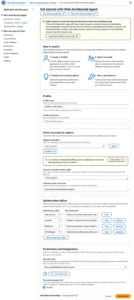
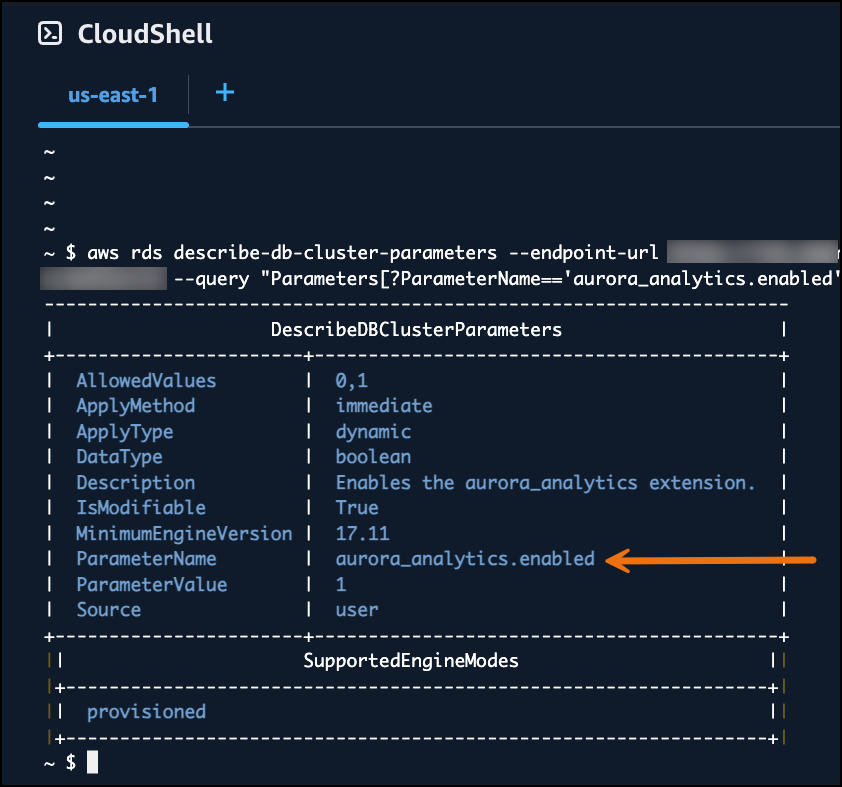
Implementing the new capability requires minimal configuration. Database administrators can activate the feature by attaching an IAM role with the AuroraAnalytics feature permission to an Aurora PostgreSQL cluster, enabling secure access to Amazon S3 and the AWS Glue Data Catalog.
Step-by-Step Execution
Once the environment is prepared, administrators run a simple command to enable the extension:
CREATE EXTENSION aurora_analytics;Rather than manually defining schemas for massive historical files, Aurora automatically infers schemas directly from file metadata. For instance, pointing an Aurora cluster to a historical Parquet file on S3 is accomplished via a foreign table declaration:
CREATE FOREIGN TABLE transaction_history ()
SERVER aurora_analytics_server
OPTIONS (
    location 's3://<my-bucket>/finance/transaction_history.parquet',
    format 'parquet'
);
For large-scale deployments featuring dozens or hundreds of data lake tables, administrators can execute a single IMPORT FOREIGN SCHEMA statement to automatically provision tables matching an entire AWS Glue Data Catalog database.
Combining Operational and Historical Data
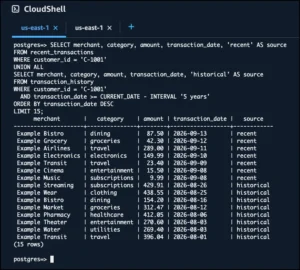
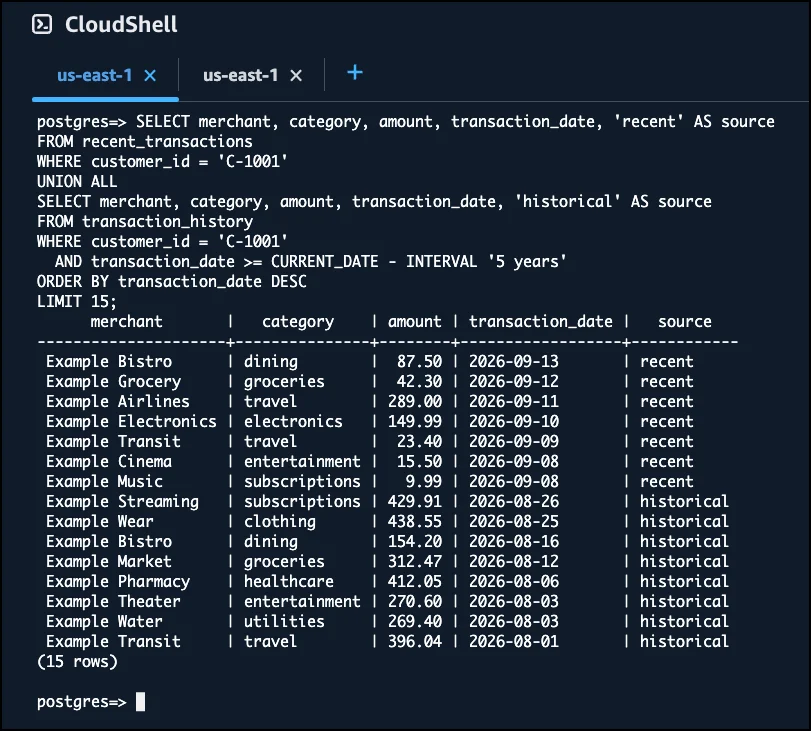
Once the foreign tables are established, developers can write standard SQL queries combining live tables with remote data lake files. For example, a unified query can pull the last seven days of transactions from a live Aurora table (recent_transactions) and union them with five years of historical data from S3 (transaction_history):

SELECT merchant, category, amount, transaction_date, 'recent' AS source
FROM recent_transactions
WHERE customer_id = 'C-1001'
UNION ALL
SELECT merchant, category, amount, transaction_date, 'historical' AS source
FROM transaction_history
WHERE customer_id = 'C-1001'
  AND transaction_date >= CURRENT_DATE - INTERVAL '5 years'
ORDER BY transaction_date DESC
LIMIT 15;
Under this hood, DuckDB executes the heavy analytical scan of the Parquet dataset, while Aurora manages the operational rows—delivering a unified result set instantly. Furthermore, workloads requiring single-digit-millisecond latency for hot data can easily materialize data lake subsets into native Aurora tables using standard commands like CREATE TABLE AS SELECT or MERGE INTO.
Official Responses and Strategic Significance
AWS leadership emphasizes that this capability addresses a core friction point for modern application developers, particularly those building generative AI and machine learning agents.
"Whether you’re powering real-time dashboards, enriching transactions with historical context, or building AI agents that reason over both live and archived data, you can now do it all through a single, familiar interface," AWS engineering representatives noted in the official release announcement.
As enterprises accelerate the deployment of autonomous AI agents, the unpredictability of data access patterns makes pre-built ETL pipelines impractical. An AI agent investigating fraudulent behavior, for instance, might simultaneously require the exact transaction executed three seconds ago and user behavioral trends logged three years ago. By removing architectural boundaries, Aurora PostgreSQL enables these agents to query disparate data repositories coherently without developer intervention.
Furthermore, AWS has structured the pricing model to encourage adoption. The capability itself incurs no additional software licensing fees. Customers pay only for the incremental Aurora compute resources consumed by the queries and standard Amazon S3 request and storage costs.
Implications for the Enterprise
The introduction of native data lake querying within Amazon Aurora PostgreSQL has profound implications across multiple facets of enterprise technology:
1. Reduced Infrastructure and Operational Complexity
By eliminating reverse-ETL pipelines, organizations can drastically cut down on the engineering hours spent maintaining synchronization jobs, debugging pipeline failures, and managing redundant storage tiers. Fewer moving parts mean lower total cost of ownership (TCO) and improved system reliability.
2. Empowering Application Developers
Developers no longer need to master specialized big-data frameworks or API layers to access historical data lake insights. By interacting exclusively through PostgreSQL endpoints and standard SQL dialects, standard application code gains immediate access to petabytes of historical context.
3. Unlocking Next-Generation AI Architectures
Autonomous agents and Large Language Model (LLM) applications thrive on context. By allowing database systems to read live transactional writes alongside open table formats like Apache Iceberg, AI systems gain comprehensive visibility into enterprise data landscapes, leading to more accurate reasoning and decision-making capabilities.
4. Future-Proofing via Open Standards
By supporting open standards like Apache Parquet, Apache Iceberg, and Iceberg REST Catalogs, AWS ensures that customers are not locked into proprietary data silos. Enterprises retain full ownership and flexibility over their data lake investments while leveraging Aurora as the intelligent query coordinator.
As organizations continue to grapple with exponential data growth and the demands of real-time intelligence, the convergence of operational databases and analytical data lakes via embedded engines like DuckDB marks a definitive step toward simpler, faster, and more cohesive cloud architectures.