Mastering LLM Reliability: Building a Custom Evaluation Harness from Scratch
In the rapidly evolving landscape of Large Language Models (LLMs), developers are increasingly moving beyond generic benchmarks. While standardized tests like MMLU (Massive Multitask Language Understanding) or GSM8K provide a snapshot of general intelligence, they are notoriously insufficient for production-grade applications. A model that ranks in the 99th percentile on a public benchmark might still fail catastrophically when tasked with adhering to a company’s specific refusal policy or navigating a complex RAG (Retrieval-Augmented Generation) pipeline.
To bridge this gap, engineers must adopt a "trust, but verify" approach by building custom evaluation harnesses. This guide explores how to construct a robust, modular testing framework in Python, giving developers total control over how their models are assessed, scored, and iterated upon.
The Core Philosophy: Why Build Your Own?
Public benchmarks measure general capability, but they do not account for domain-specific nuances. Whether you are building a customer support agent that must never provide financial advice or a coding assistant that must follow strict internal syntax rules, you need a custom evaluation harness.
A test harness acts as the specialized scaffolding that feeds inputs to a system, captures outputs, and scores them against a known, controlled baseline. By implementing this internally, developers can track pass rates, latency, and cost over time—the critical KPIs that determine whether an LLM is production-ready.
Component Architecture
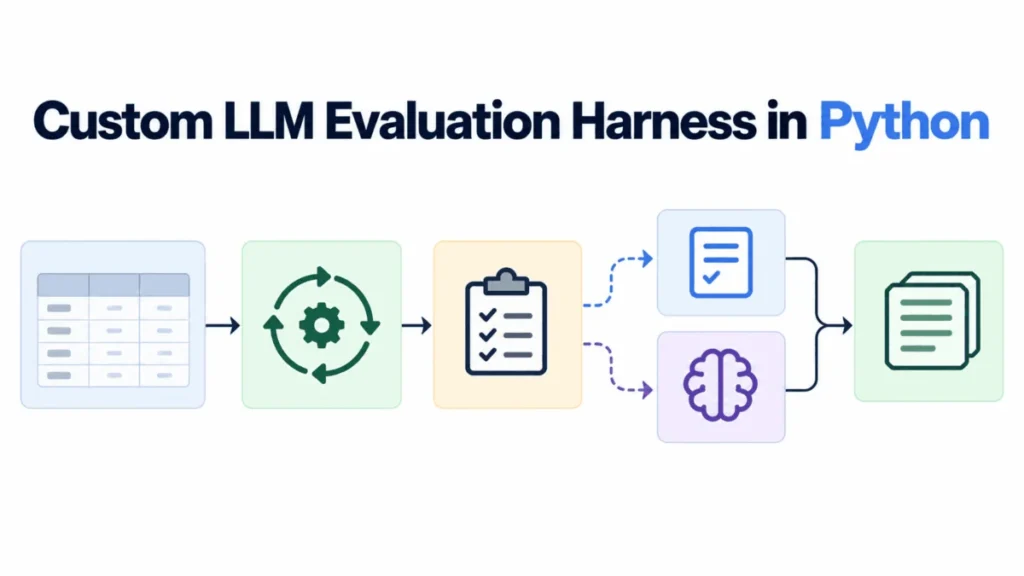
A professional evaluation harness is built on four modular components. By decoupling these, you ensure the system remains maintainable as your project scales.
- The Golden Dataset: The bedrock of your evaluation, consisting of curated inputs and expected outcomes.
- The Inference Runner: A scalable engine that manages model interaction and API orchestration.
- The Judge Layer: The decision-making module that determines whether a response meets the predefined criteria.
- The Logger: A persistent storage mechanism that allows for retrospective analysis and re-scoring.
Prerequisites and Setup
To build this system, you will need Python 3.10 or later. The use of native asyncio is paramount, as it allows for the concurrent execution of test cases, preventing your evaluation pipeline from becoming a bottleneck during large batch runs.
We rely on two primary dependencies:
- LiteLLM: Provides a standardized interface for calling various model backends (OpenAI, Anthropic, Google, etc.). This allows you to swap models with a single line of code.
- Pydantic: Ensures that the judge’s output is structured and typed, preventing the chaos of unparseable natural language responses.
pip install litellm pydanticChronology of an Evaluation Run
The lifecycle of an evaluation typically follows a linear path, yet each step must be handled with precision to ensure accuracy.
1. Curating the Golden Dataset
A "golden" dataset is not a collection of arbitrary prompts; it is a repository of your system’s most critical failure modes. Aim for 20 to 50 high-quality cases derived from actual production logs. Synthetic data often suffers from "happy path" bias, ignoring the messy, edge-case reality that users encounter.
Each case should include a unique id for longitudinal tracking, the input prompt, and an expected_concept. The latter serves as the ground truth for your scoring logic. By keeping this structure simple, you retain the flexibility to add metadata, such as difficulty levels or categorical tags, as your requirements evolve.
2. The Inference Runner: Managing Concurrency
The runner is the engine of your harness. By utilizing asyncio.gather, you can trigger multiple model calls simultaneously. This is essential when working with large datasets, as it transforms what would be hours of sequential API calls into a process that takes mere minutes.
Furthermore, implementing robust retry logic (num_retries=3) and strict timeouts is non-negotiable for production reliability. This ensures that your evaluation process doesn’t hang indefinitely due to transient network issues or rate limiting.
3. The Judge Layer: Deterministic vs. LLM-as-a-Judge
The judge layer is where the "pass/fail" decision is made. Choosing the right judge is a trade-off between speed and semantic depth.
- Deterministic Judges: Best for specific format checks or string matching. They are instantaneous and cost-effective.
- LLM-as-a-Judge: Necessary for semantic nuance. If your criteria involve identifying a "refusal" or "helpful tone," a secondary, more capable LLM (such as GPT-4o) acts as the grader.
By using Pydantic’s BaseModel to enforce response_format, you guarantee that the judge returns a structured object. This removes the ambiguity of subjective natural language grading.
4. Logging and Retrospective Analysis
Logging results to a .jsonl (line-delimited JSON) file is the industry standard for auditability. Because each line is a self-contained JSON object, the file is crash-safe—if the process is interrupted, your progress remains intact.
Crucially, by logging the raw_output alongside the final score, you create an opportunity for "retrospective grading." If you later discover your judge’s rubric was too strict or too lenient, you can simply run a new grading script over the existing raw_output logs without needing to burn money and time on re-running the inference.
Implications for Production Deployment
Moving from a prototype to a production-grade LLM system requires a shift in mindset: evaluation is not a one-time event; it is a continuous process.
CI/CD Integration
The ultimate goal of a custom harness is integration into your CI/CD pipeline. By automating these tests, you can catch "model drift" or "regression" every time a prompt template is updated or a model version is swapped. If a change causes the pass rate on your golden dataset to drop below a certain threshold, the build should fail.
Cost and Latency Management
While the primary focus is accuracy, the harness should also track performance metrics. By logging token usage and latency for every inference call, you can generate an "Efficiency vs. Effectiveness" dashboard. This allows engineering teams to make informed decisions about when to switch to smaller, faster models or when to invest in a more robust RAG architecture.
Official Best Practices and Future-Proofing
As your evaluation requirements grow, the modular architecture provided here ensures you are not boxed in. You can easily:
- Add Partial Scoring: Instead of a binary pass/fail, implement a 1-to-5 rubric.
- Route by Category: Send "safety" queries to a specialized judge while sending "factual" queries to a different model.
- Visualize Trends: Pipe your
.jsonlfiles into a database like PostgreSQL or a visualization tool like Grafana to track model performance across different releases.
Conclusion: The Path Forward
Building a custom LLM evaluation harness is the single most important step an organization can take to move from "toy" AI projects to reliable, production-ready systems. With roughly 60 lines of code, you have established a foundation that separates concerns, ensures reproducibility, and provides the transparency required to iterate with confidence.
In an industry defined by rapid change, the ability to objectively measure your model’s behavior is the only true competitive advantage. By owning your evaluation pipeline, you are no longer at the mercy of black-box model providers; you are the architect of your own reliability. Whether you are catching edge-case hallucinations or validating complex multi-step reasoning, this modular harness provides the visibility needed to scale your LLM applications securely and sustainably.