Pgvector vs. Dedicated Vector Databases: A Data-Driven Analysis for Production Architectures
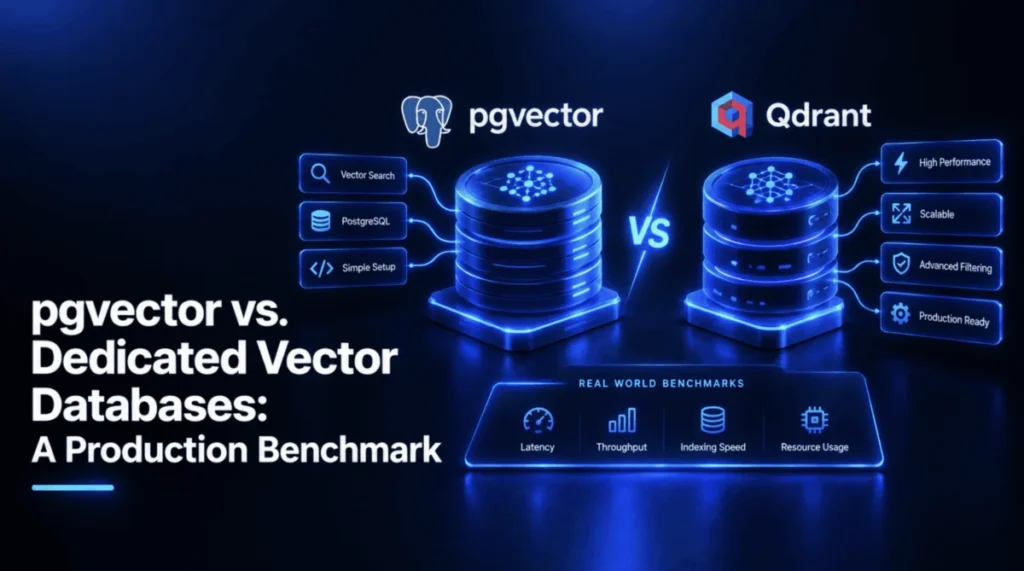
In the rapidly evolving landscape of generative AI and semantic search, few debates have generated as much industry friction as the choice between extending a relational database and deploying a purpose-built vector engine. When a development team integrates pgvector into their existing PostgreSQL instance on a Tuesday afternoon, they gain the ability to store embeddings alongside relational data in a single, unified transaction. However, within months, they are often bombarded by vendor pitches insisting that this "unified" approach is a ticking time bomb—a bottleneck waiting to crash their production environment.
For too long, this debate has been driven by marketing rhetoric rather than empirical evidence. This article cuts through the noise, offering a comprehensive, performance-measured analysis of how pgvector stacks up against dedicated vector databases, helping you decide which architecture truly fits your production workload.
The Core Conflict: Integration vs. Specialization
To understand the tension, one must first define the two combatants.
What is pgvector?
pgvector is an open-source PostgreSQL extension that transforms the world’s most popular relational database into a vector-capable store. By adding a native vector column type, it enables both exact and approximate nearest-neighbor (ANN) searches directly within the database infrastructure you likely already manage.
The architectural appeal is simplicity: your vector embeddings reside in the same table as the metadata they describe. There is no second system to synchronize, no network latency between disparate services, and—crucially—no need for complex distributed transaction management. With version 0.8.6, pgvector supports an array of distance metrics (L2, inner product, cosine, L1, and Hamming) and multiple vector types, including half-precision and sparse vectors.
The Rise of Dedicated Vector Databases
Dedicated vector databases—such as Pinecone, Qdrant, Weaviate, Milvus, and ChromaDB—are purpose-built services. They are designed from the ground up to handle high-dimensional vector data, typically utilizing storage engines optimized specifically for high-throughput similarity searches.
These platforms offer significant advantages for massive, distributed workloads. Pinecone, for example, provides a zero-setup, fully managed cloud experience. Qdrant leverages a high-performance Rust-based engine for complex JSON filtering, while Milvus offers advanced distributed, GPU-accelerated capabilities for billion-scale datasets. Choosing a dedicated database is not merely a product choice; it is an architectural commitment to a secondary system that must be deployed, monitored, backed up, and kept in sync with your source of truth.
Chronology of the Benchmark: From Local Labs to Production Scale
The debate often suffers from "toy-scale bias." To bridge the gap between anecdotal claims and hard evidence, we conducted a two-stage benchmarking process.
Stage 1: The Local Baseline
Our initial testing was conducted on a local development environment. We set up a Dockerized PostgreSQL 17 instance with pgvector and a parallel Qdrant container. Both systems were configured to store 100,000 vectors with 1,536 dimensions (matching OpenAI’s text-embedding-3-small model).
We used identical HNSW (Hierarchical Navigable Small World) index parameters: m=16 and ef_construction=64. By using identical parameters, we ensured that the comparison was based on system performance rather than index configuration variance.
The Result: At 100,000 vectors, the latency differences were negligible, hovering in the low single-digit millisecond range. This reinforced a vital, often-overlooked truth: for most startups and mid-market applications, the performance overhead of either system is largely invisible. At this scale, the "bottleneck" arguments frequently pushed by vendors are premature.
Stage 2: The Production Scale Reality
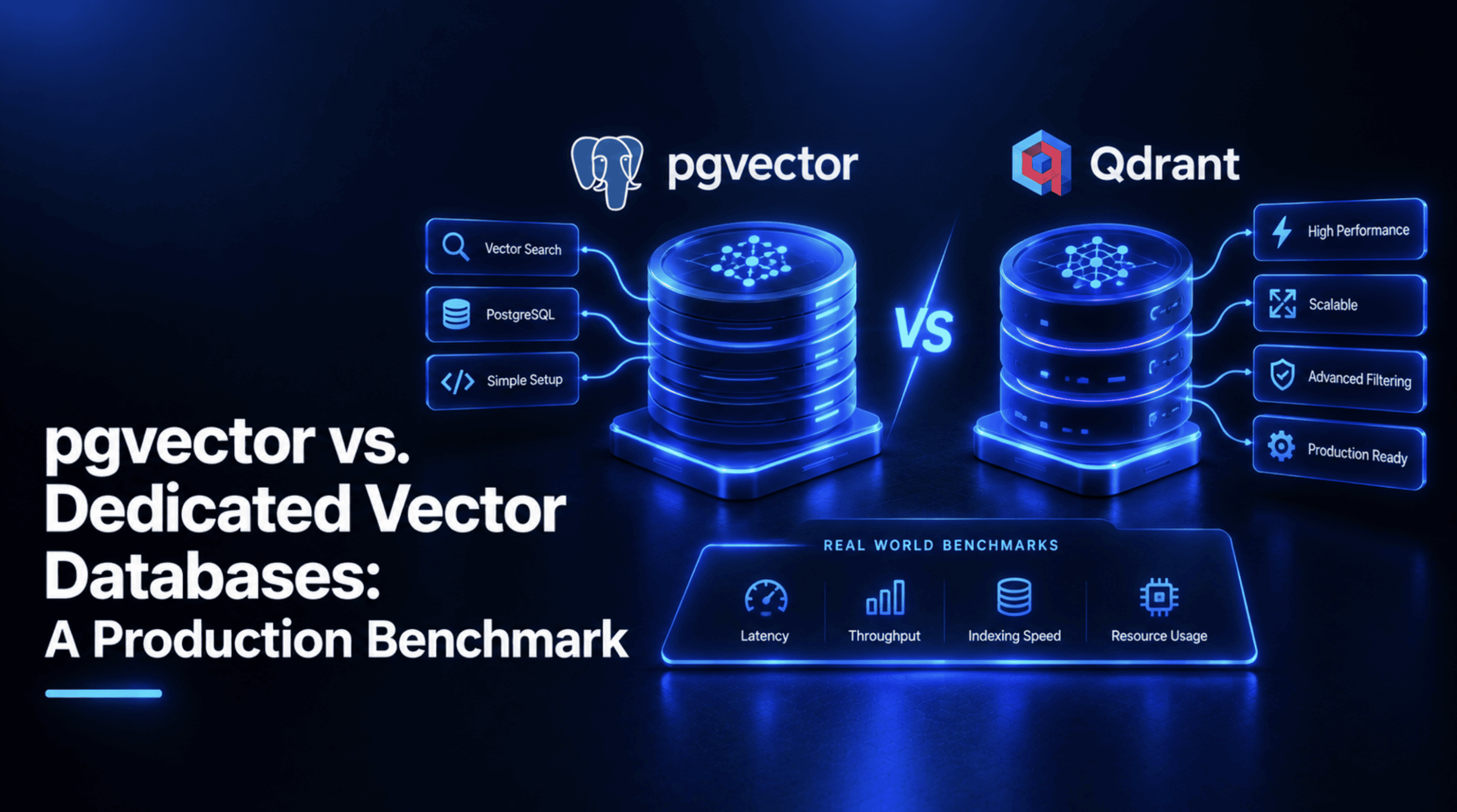
To simulate a true production environment, we looked to the methodology-transparent benchmarks provided by industry researchers (notably the work conducted by Tiger Data). They tested 50 million Cohere embeddings at 768 dimensions on matched AWS r6id.4xlarge hardware (16 vCPUs, 128GB RAM).
Note: The results for Postgres utilized pgvector paired with pgvectorscale, an extension by Timescale that introduces a StreamingDiskANN index. This is a critical distinction, as it demonstrates the power of the Postgres ecosystem to adapt and evolve.
Supporting Data: Performance at 50 Million Vectors
When analyzing the performance metrics at 99% recall, a nuanced picture emerges:
| Metric | pgvector + pgvectorscale | Qdrant |
|---|---|---|
| p50 Latency | 31.07 ms | 30.75 ms |
| p95 Latency | 60.42 ms | 36.73 ms |
| p99 Latency | 74.60 ms | 38.71 ms |
| Throughput (QPS) | 471.57 | 41.47 |
| Index Build Time | 11.1 hours | 3.3 hours |
Analyzing the Findings
The data suggests that the "winner" depends entirely on your specific bottleneck.
- Throughput Advantage:
pgvectorwithpgvectorscaleoutperformed Qdrant by a factor of 11 in raw throughput (471.57 QPS vs 41.47 QPS). If your application requires high concurrency for high-volume batch processing, the Postgres ecosystem is remarkably efficient. - Tail Latency Advantage: Qdrant demonstrated superior consistency in tail latency. Its p99 latency was nearly 48% faster than the Postgres configuration. If your product requires a strict, low-variance SLA for every individual user query, Qdrant’s architecture offers a more predictable "worst-case" performance profile.
- Operational Overhead: Qdrant built the index significantly faster (3.3 hours vs 11.1 hours), which is a crucial metric for teams dealing with rapidly changing datasets or frequent re-indexing cycles.
Official Responses and Industry Implications
The broader implications of these findings challenge the industry narrative. For years, the "Vector Database" sector has attempted to position itself as a necessary evolution away from "Legacy Relational Databases." However, the data proves that Postgres, when properly augmented, is not a legacy holdover; it is a competitive, high-performance engine for AI-native workloads.
When pgvector is Sufficient
For the vast majority of companies, pgvector is not just "good enough"—it is the optimal choice. If your dataset remains under 10 million vectors, the operational complexity of adding a dedicated database (and the associated cost of data synchronization, pipeline maintenance, and cross-system monitoring) far outweighs the marginal performance gains.
Furthermore, the transactional integrity offered by PostgreSQL is a feature that dedicated vector databases struggle to replicate. In a single COMMIT block, you can update a user’s relational profile and their vector embedding simultaneously. In a split-system architecture, you are forced to manage two-phase commits or eventual consistency, which inevitably leads to data drift and complex debugging.
When to Migrate to a Dedicated Database
The decision to migrate to a dedicated engine should be driven by specific, measurable needs rather than fear-based marketing:
- Massive Scale: Once you reach hundreds of millions or billions of vectors, the distributed nature of systems like Milvus or Qdrant becomes essential.
- Tight Tail-Latency SLAs: If your business model collapses when p99 latency exceeds 30ms, the performance stability of a purpose-built vector engine is worth the architectural tax.
- Specialized Hardware: If your indexing strategy relies on specific GPU-accelerated workflows, specialized engines are built to offload compute in ways that general-purpose databases are not.
- Low-Ops Preference: For teams with zero database administration bandwidth, a fully managed service (e.g., Pinecone) is a legitimate business expense that buys back engineering time.
Conclusion
The binary narrative—that you must choose between "always using pgvector" or "always using a dedicated database"—is a fallacy. The performance data reveals a more sophisticated reality: these technologies are optimized for different dimensions of the search problem.
pgvector provides unparalleled developer velocity, transactional consistency, and, when paired with the right extensions, high-throughput efficiency. Dedicated databases provide superior tail-latency predictability and architectural isolation for massive, high-concurrency enterprise workloads.
The honest path for an architect is to ignore the vendor pitches and look at the telemetry of their own application. If your p99 latencies are healthy and your data growth is manageable, stay the course with the infrastructure you already know. If you are hitting physical, insurmountable walls at scale, then—and only then—is it time to introduce the complexity of a dedicated vector database.