The AI Revolution: Navigating the New Frontier of Business Productivity
Artificial Intelligence (AI) has transitioned from a futuristic concept discussed in academic circles to the bedrock of modern commercial infrastructure. As the technology behind Large Language Models (LLMs) and generative algorithms matures, professionals and enterprises are moving past the "novelty phase" and into an era of deep, strategic integration. For businesses—ranging from ambitious startups to global conglomerates—the question is no longer whether to use AI, but how to deploy it to maximize efficiency and maintain a competitive edge.
The State of Play: Current Market Realities
The integration of AI into the workplace is accelerating at an unprecedented rate. According to recent data from AuthorityHacker, approximately 35% of companies have already fully integrated AI into their core operational processes. More importantly, 90% of business leaders now view AI assistance as a definitive competitive advantage. This paradigm shift suggests that organizations failing to adopt these technologies risk obsolescence in an increasingly automated marketplace.
Beyond the corporate office, AI has permeated the consumer experience. An estimated 77% of modern devices—from smartphones and smart home hubs to advanced e-commerce platforms—now rely on embedded AI to enhance functionality. This ubiquity provides a fertile ground for entrepreneurs and digital marketers to leverage machine learning for everything from predictive analytics to automated customer service.
Chronology of Adoption: From Automation to Autonomy
To understand the current landscape, one must look at the rapid evolution of AI over the past decade:
- 2014–2017: The Era of Narrow AI. During this period, AI was primarily used for specific, repetitive tasks. Chatbots were rudimentary, and predictive algorithms were confined to basic recommendation engines for e-commerce giants.
- 2018–2021: The Emergence of Generative Pre-trained Transformers. The release of early GPT models signaled a shift toward generative capabilities. Machines moved from classifying data to creating it—writing text, identifying patterns in code, and generating images.
- 2022–Present: The Democratization of AI. With the public release of user-friendly interfaces, AI became accessible to the non-technical professional. Tools shifted from command-line interfaces to intuitive, "prompt-based" workflows, allowing designers, marketers, and project managers to utilize AI without needing a background in data science.
Supporting Data: Why AI is No Longer Optional
The economic implications of AI adoption are profound. Beyond the 90% of executives who cite AI as a "competitive advantage," secondary research indicates that businesses utilizing AI-driven marketing tools see a significant reduction in customer acquisition costs (CAC). By automating content generation and personalizing customer journeys, brands can scale their operations without a linear increase in overhead.
Furthermore, the "AI-augmented" professional is becoming the new standard. Studies suggest that employees using AI tools for copywriting, data entry, and project management tasks can increase their output by 40% or more. This efficiency gain allows human teams to pivot toward high-level strategy, creative direction, and complex problem-solving—areas where human intuition remains unmatched.
Strategic Domains: Where AI Adds Value
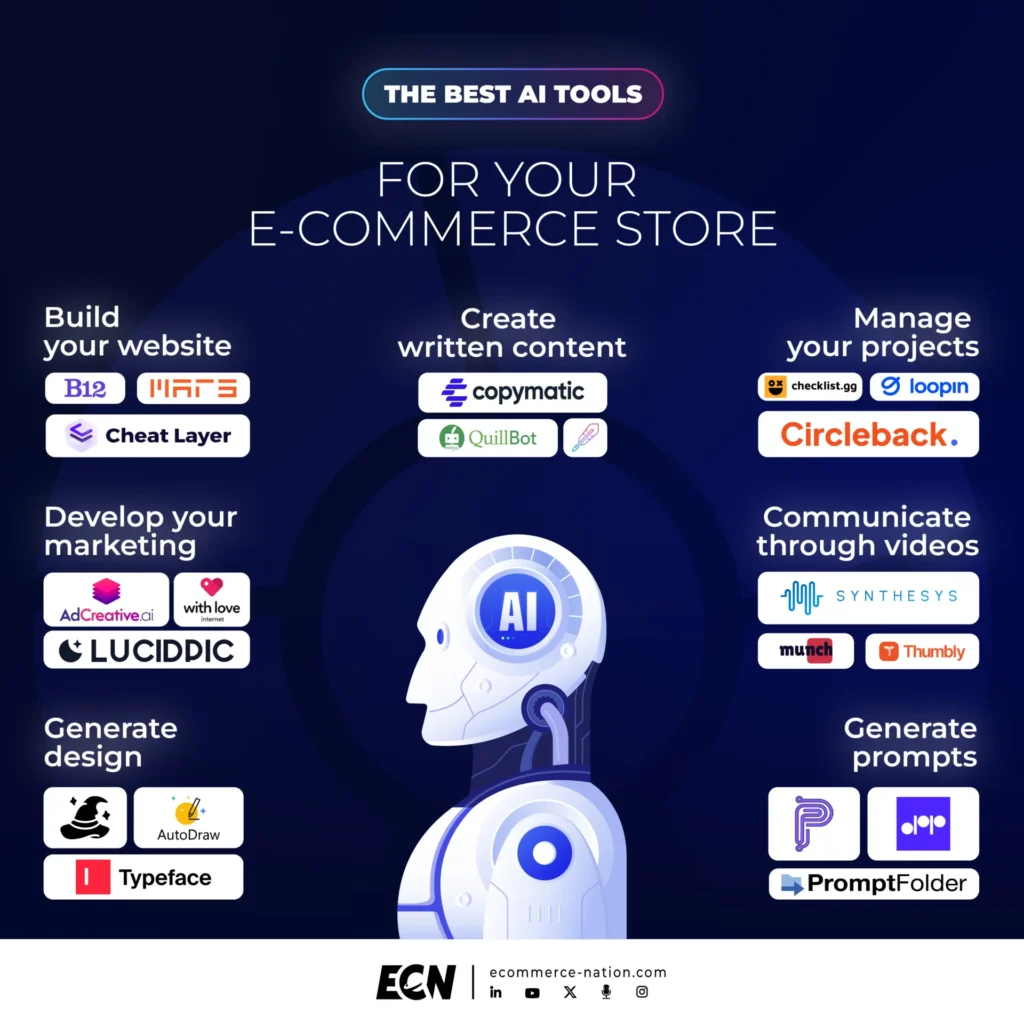
For business owners and digital leaders, the sheer volume of AI tools can be overwhelming. To simplify, we can categorize the most effective AI implementations into seven critical business pillars:
1. Web Development and User Experience
Modern AI web builders have replaced the need for expensive coding teams for basic site architectures. By using generative design tools, businesses can create responsive, SEO-optimized websites in hours rather than weeks. AI-driven testing tools can also analyze user heatmaps to suggest UI/UX adjustments that minimize bounce rates.
2. Marketing and Brand Strategy
AI-driven marketing platforms now offer predictive analysis for campaign success. Instead of relying solely on historical data, these systems analyze real-time market trends, social media sentiment, and competitor activity to adjust ad spend and creative messaging dynamically.
3. Video Production and Communication
Content is the king of digital marketing, but video is the emperor. New AI tools allow businesses to create professional-grade video content, complete with voiceovers and synthetic avatars, without needing a studio or a film crew. This is a game-changer for product demonstrations and social media engagement.
4. Project Management and Workflow Optimization
Project management tools are now integrated with "intelligent agents" that can predict bottlenecks, suggest resource allocation, and even draft status reports based on team communication. This minimizes the "administrative bloat" that often hampers creative teams.
5. Prompt Engineering: The New Skillset
The ability to communicate with AI—known as "prompt engineering"—is the most vital skill of the 2020s. Specialized platforms now exist to help users refine their prompts, ensuring that the outputs from LLMs are precise, brand-aligned, and actionable.
6. Content Marketing and SEO
Generative writing tools have evolved from producing generic text to creating high-quality, SEO-researched content that mirrors a brand’s unique voice. By automating the research and drafting phase, content marketers can maintain a consistent publishing schedule, which is essential for search engine authority.
7. Generative Design
Visual communication is critical in e-commerce. AI-powered design suites allow even the most inexperienced graphic designers to create professional product images, social media graphics, and promotional banners that adhere to brand identity guidelines, saving thousands in design agency fees.
Official Industry Perspectives: The Balancing Act
While the sentiment regarding AI is largely optimistic, it is not without nuance. Industry leaders—from tech CEOs to regulatory bodies—emphasize a "Human-in-the-Loop" approach.
The consensus among experts is that AI should be viewed as a "co-pilot" rather than a replacement. While AI excels at speed, scale, and pattern recognition, it lacks the ethical framework, nuanced cultural understanding, and accountability that human professionals provide. Official statements from major technology consortiums suggest that as AI becomes more autonomous, the human role will evolve into one of "editorial supervision"—ensuring that AI-generated content is accurate, fair, and aligned with human values.
Implications: Preparing for the Future
The implication for the modern business owner is clear: the divide between those who master AI and those who ignore it will only widen.
Immediate Action Items:
- Audit your current processes: Identify which repetitive tasks consume the most human capital.
- Start small: Integrate one AI tool into one specific department (e.g., use an AI copywriter for email newsletters).
- Invest in training: Ensure your team understands the capabilities and limitations of the tools they are using.
- Prioritize data security: As you feed business data into AI models, ensure you are using enterprise-grade tools that prioritize privacy and data ownership.
Conclusion
The artificial intelligence revolution is not a transient trend; it is the fundamental restructuring of how we conduct commerce. By leveraging the tools highlighted in this overview—ranging from automated web design to generative marketing strategies—businesses can unlock levels of productivity previously thought impossible.
As we look toward the future, the winners in this landscape will be those who balance the immense power of algorithmic speed with the irreplaceable quality of human creativity and strategic oversight. The technology is here, the tools are ready, and the competitive landscape is shifting. The only question left is: how will your business respond?