The D2C Renaissance: How India’s Next-Gen Brands are Redefining the $310 Billion Ecommerce Frontier
The narrative surrounding India’s Direct-to-Consumer (D2C) ecosystem has shifted from initial skepticism to unbridled conviction. What began as a fragmented collection of digital-first startups challenging entrenched legacy conglomerates has matured into a sophisticated $65 billion engine of the Indian economy. Far from facing market saturation, the sector is currently entering its most transformative phase yet—a period characterized by high-velocity growth, professionalized operations, and a relentless focus on unit economics.
Projections from industry analysts underscore the scale of this transition. While the broader Indian ecommerce market is expected to expand from $165 billion in 2026 to a staggering $450 billion by 2031, the D2C segment is forecasted to outpace the market, surging to $310 billion at a blistering 37% CAGR. Of the $285 billion in additional Gross Merchandise Value (GMV) anticipated by 2031, nearly 86% is expected to originate from the D2C ecosystem.
The Evolution of the Playbook: From "D2C 1.0" to "D2C 3.0"
The early days of the Indian D2C boom—often labeled "D2C 1.0"—were defined by a rudimentary formula: launch a Shopify store, flood Instagram with targeted ads, and hope for viral word-of-mouth. Today, that playbook is obsolete.
We are now firmly in the era of "D2C 3.0." In this landscape, the modern consumer’s baseline expectation is instant gratification, fueled by the rapid rise of quick commerce. Brands can no longer afford to be single-channel entities; they must navigate a complex omnichannel reality. Furthermore, with rising customer acquisition costs (CAC) and thinner margins, the industry’s focus has pivoted from "growth at any cost" to "profitable, sustainable scaling."
This shift is precisely what the Inc42 D2CX accelerator aims to address. By bridging the gap between raw ambition and operational maturity, the 12-week program provides founders with the playbooks necessary to survive and thrive. Having supported over 400 founders across eight cohorts, the program focuses on the technical nuances of unit economics, go-to-market (GTM) strategies, and the logistical agility required to compete in a crowded marketplace.
The Eighth Cohort: A Snapshot of Diversity and Innovation
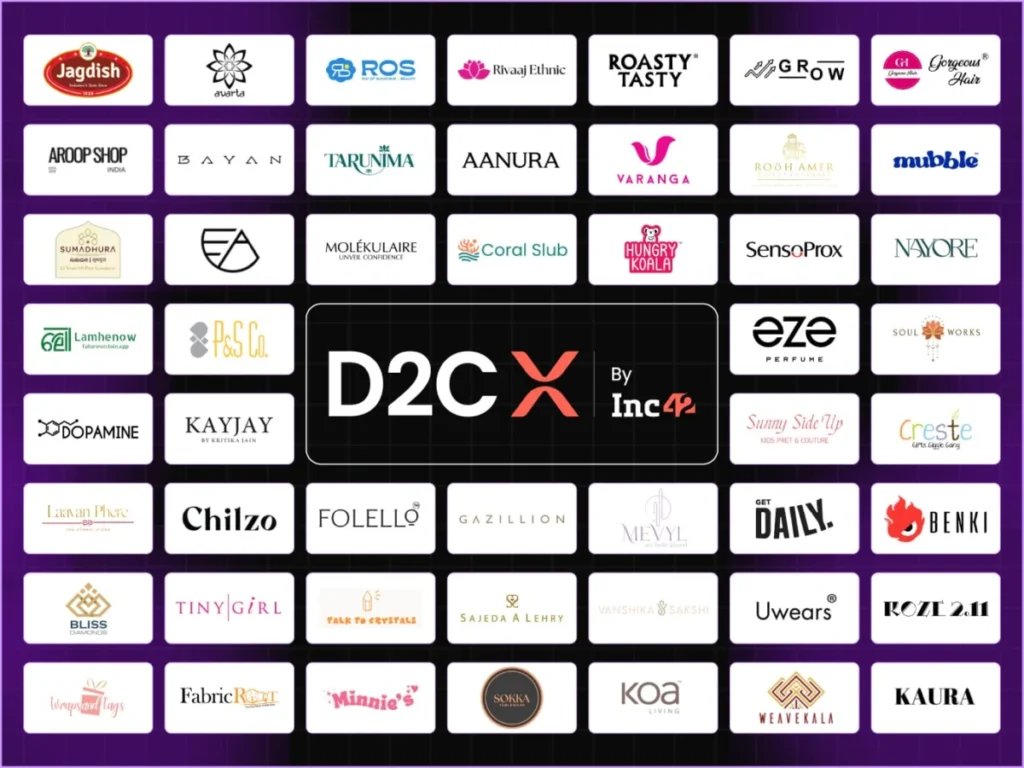
The eighth cohort of D2CX represents a fascinating cross-section of the Indian entrepreneurial spirit. From legacy businesses modernizing their digital presence to niche D2C-native brands, the cohort spans beauty, fashion, food, and home essentials.
The Rise of Modernized Heritage
A significant trend among this cohort is the "legacy-to-digital" pivot. Brands like Jagdish Farshan, with its roots dating back to 1938, exemplify this transition. By modernizing its retail-led model, the brand now commands an impressive MRR of ₹12 Cr. Similarly, Eze Perfumes leverages 75 years of manufacturing expertise to capture the modern, vegan-conscious fragrance market, while Uwears brings decades of B2B uniform manufacturing prowess to a D2C audience.
The Specialized Niche Players
The beauty and personal care segment continues to attract substantial interest. Brands like Molekulaire are prioritizing science-backed, dermatology-led solutions to stand out in a cluttered market. Dopamine Perfumes & Fragrances and Ray of Sunshine Beauty are tapping into the psychological and emotional connection of self-care, proving that product efficacy alone is no longer enough—brand story and mood-matching are the new competitive advantages.
The Sustainability and Lifestyle Vanguard
Sustainability has moved from a marketing buzzword to a core operational pillar for brands like Aroop India and Lamhenow. While Aroop India brings sustainable womenswear to the forefront of the Jaipur fashion scene, Lamhenow uses recycled materials to turn stationery into a "sanctuary for the mind." These brands highlight a growing consumer preference for conscious consumption, even in everyday items.
Strategic Implications and Market Dynamics
The data provided by the D2CX eighth cohort reveals a clear hierarchy of challenges and opportunities:
- Channel Diversification: Brands like Chilzo are leaning heavily into quick commerce, acknowledging that 80% of their sales are driven by the need for convenience. Conversely, high-ticket luxury brands like Sajeda A Lehry remain heavily offline, signaling that premium touchpoints still require physical validation.
- The Profitability Paradox: For many early-stage brands like Coral Slub or Mevyl, the primary challenge remains scaling performance marketing without eroding margins. The transition from a 100% website-based model to a diversified footprint is a common strategic objective across the cohort.
- Trust-Building as a Moat: In categories like jewelry and kidswear, trust is the currency. Avarta’s commitment to a 30-day money-back guarantee and lifetime protection on gold is a masterclass in building trust for first-time online buyers. Similarly, The Gorgeous Hair provides specialized products (chemo wigs) that demand high levels of reliability, positioning them uniquely against cosmetic-only competitors.
Future Outlook: The Road to 2031
As these 50 brands progress through the D2CX program, they are not just learning how to sell; they are learning how to build resilient organizations. The next five years will be the "Great Sorting" of the Indian D2C market. The winners will not necessarily be those with the most funding, but those with the most efficient supply chains, the most authentic brand narratives, and the highest repeat customer rates.
The influx of capital—over $10 billion raised across 1,400 deals since 2015—has validated the potential of the space. However, the next stage of growth will be defined by institutionalizing the "startup hustle." Whether it is AANURA fine-tuning its channel mix or Get Daily navigating the functional food landscape, the trajectory for these brands is upward.
Summary of Key Performance Insights (Select Cohort Brands)
| Brand | Primary Category | Revenue Focus | Key Differentiator |
|---|---|---|---|
| Jagdish Farshan | Food & Bev | Legacy Modernization | Heritage brand equity |
| Molekulaire | Skincare | Science-backed | Clinical efficacy focus |
| Hungry Koala | Kids Nutrition | Clean-label | Pediatric-led formulation |
| Talk To Crystals | Wellness | D2C-native | High digital-only growth |
| Sensoprox | Oral Care | Innovation-led | Proprietary bristle tech |
Conclusion: A Maturing Ecosystem
The D2C boom in India is far from over; it is merely shedding its experimental skin. The brands listed in the eighth D2CX cohort reflect the diversity of the Indian market—a mix of high-growth digital natives and established players transitioning to the modern era. As these founders navigate the complex, data-driven landscape of "D2C 3.0," their success will serve as the blueprint for the next generation of Indian entrepreneurs. The future of Indian ecommerce is not just about moving goods; it is about building enduring brands that resonate with the aspirations of a billion-plus consumers.
List of D2CX Eighth Cohort Brands (Alphabetical):
AANURA, Aroop India, Avarta, Bayan Jewelry, Benki Store, Bliss Diamonds, Chilzo, Coral Slub, Creste, Dopamine Perfumes & Fragrances, Eshaa Amin Label, Eze Perfumes, Fabricroot, Folello, Gazillion, Get Daily, Grow Athleisure, Hungry Koala, Jagdish Farshan, Kaura India, Kayjay, Koa Living, Laavan Phere, Lamhenow, Mevyl, Minnies World, Molekulaire, Mubble, Nayore, P & S Co, Ray of Sunshine Beauty, Rivaaj Ethnic, Roasty Tasty, Rooh Amer, ROZE 2.11, Sajeda A Lehry, Sensoprox, SOKKA Tableware, Soul Works, Sumadhura Foods, Sunny Side Up, Talk To Crystals, Tarunima, The Gorgeous Hair, Tiny Girl Clothing, Uwears, Vanshika & Sakshi, Varanga, Weavekala, Wrapsandtags.