The Death of the Content Treadmill: Why B2B Brands Must Build Compounding Distribution Engines
Main Facts
In the modern digital landscape, the traditional content creation model is fundamentally broken. Content marketing has largely devolved into a transactional treadmill: brands spend weeks conceptualizing, writing, and designing a piece of content, publish it once, share it briefly, and immediately abandon it in an archive to sprint toward the next deadline. This “renting attention” strategy resets every Monday, failing to build any long-term equity.
Industry data reveals that the vast majority of digital content dies within 48 hours of publication. To combat this, leading modern organizations are shifting away from standalone campaign approaches and toward documented, repeatable internal systems known as content distribution engines. Rather than treating distribution as an afterthought, these engines take a single core asset and systematically push it across multi-channel ecosystems for months.
This structural pivot has taken on unprecedented urgency due to the explosive growth of Artificial Intelligence search engines and Large Language Models (LLMs). According to a B2B AI visibility study conducted by Foundation—analyzing 50 B2B brands, 5.1 million AI responses, and 57.2 million citations—only 10.15% of AI citations point to brand-owned domains. For unbranded queries, that figure plummets to a staggering 2.2%. Building a compounding distribution engine is no longer just a tactic to drive web traffic; it is a defensive and offensive necessity to ensure brand visibility within the algorithmic fabric of modern discovery.
Chronology and Evolution of Content Strategy
The Era of Commodity Content
For over a decade, content marketing operations scaled horizontally. The prevailing playbook dictated that volume equaled authority. Brands hired armies of writers to churn out high-volume, generic blog posts designed primarily to target keyword search volume. Distribution was largely passive: post a link to social media channels once, push an email blast, and wait for search engine optimization (SEO) to take effect.
The Algorithmic Shift and Saturation
As the internet filled with commoditized, AI-assisted content, traditional search engines and discovery platforms began adjusting their algorithms. Google explicitly signaled a shift in preference away from generic commodity content toward differentiated, high-value, non-commodity assets. Simultaneously, organic social media reach on major platforms underwent severe algorithmic throttling, rendering single-share distribution models obsolete.
The Rise of the Distribution Engine (2025–2026)
Recognizing that the old campaign model led directly to brand invisibility, progressive marketing teams began re-architecting their internal workflows. Instead of investing 90% of their resources into creation and 10% into distribution, vanguard organizations inverted their approach. By 2026, industry benchmarks established that treating distribution as a continuous, systematic engineering problem—rather than a manual marketing chore—was the defining differentiator between market leaders and stagnant brands.

Supporting Data and Analytics
Data underscores the financial and operational futility of the old content model, while illuminating the mechanics of compounding growth.
- The AI Citation Gap: Foundation’s 2026 visibility study of 57.2 million LLM citations proved that brand domains struggle immensely to capture direct citations in AI responses. Securing visibility requires multi-channel digital footprints, high-authority backlinks, and widespread third-party mentions that feed LLM training data.
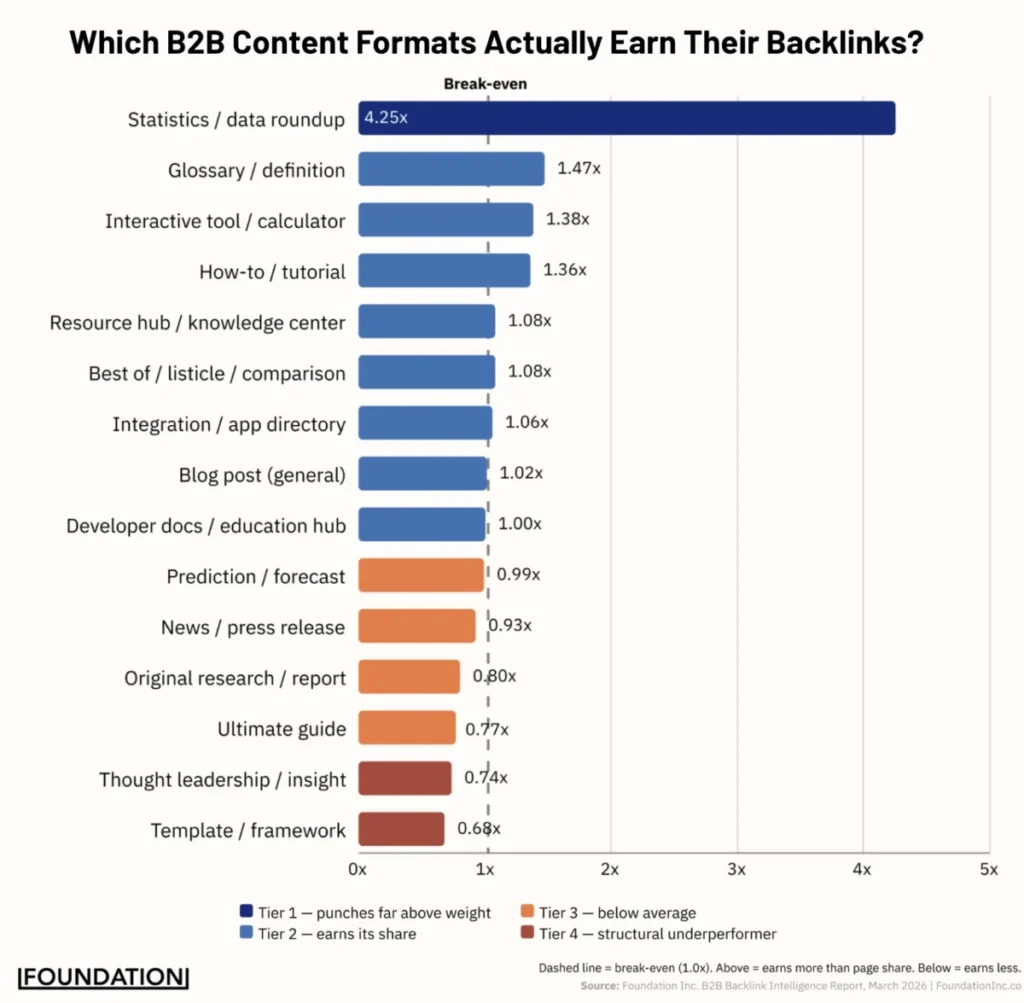
- The Anatomy of Linkable Assets: An analysis of over 12,000 B2B pages revealed a direct correlation between content format and backlink acquisition. Pages that incorporated original research, proprietary data, and hard statistics dominated the top tiers of backlink profiles.
- The Reddit SERP Phenomenon: Research into over 8,500 bottom-of-funnel (BOFU) B2B keywords demonstrated that niche-specific community platforms, particularly specialized Subreddits like
/r/CRM, frequently outrank corporate landing pages in search engine results pages (SERPs) for high-intent queries. - The CEO and Employee Amplification Multiplier: LinkedIn platform data indicates that 80% of CEOs at top global companies are active online, and half of all employees naturally post about their workplace. Employees who share content regularly experience up to a 6x increase in profile views, establishing a symbiotic relationship where internal employee advocacy drives external brand reach.
Official Responses and Industry Insights
Forward-thinking companies are already redefining what a corporate media arm looks like. A prime example cited by industry analysts is Ramp, a corporate card and spend management software provider operating in a historically commoditized category.
Rather than relying on traditional software marketing, Ramp leveraged its transaction data to establish an internal research division known as the Ramp Economics Lab. Their flagship asset, the Ramp AI Index, tracks enterprise artificial intelligence adoption through actual transactional business spend rather than speculative surveys.
By turning proprietary exhaust data into heavyweight research, Ramp secured placement on the Bloomberg Terminal and earned editorial citations from premier global publications including The New York Times, The Wall Street Journal, The Economist, CNBC, and Reuters.
Industry experts emphasize that this approach changes the economics of content. Every turn of a well-maintained distribution wheel makes subsequent marketing efforts more efficient:
- Shares earn high-value backlinks.
- Backlinks build domain and topical authority.
- Authority improves organic rankings and search visibility.
- Rankings grow proprietary email lists.
- Growing lists ensure larger day-one engagement for future product launches.
- Expanded footprints trigger increased citations across LLMs, routing high-intent buyers back into the loop.
Strategic Implications and Implementation Frameworks
To transition from the content treadmill to a compounding distribution engine, organizations must adopt a rigorous operational framework across eight core pillars.

1. Conduct Rigorous Channel Research
Teams must abandon habit-based channel selection (e.g., posting on LinkedIn simply because competitors do). Category-specific research must dictate channel investments. Brands must audit how search engines index community discussions, forums, and niche platforms for their specific bottom-of-funnel keywords before allocating resources.
2. Prioritize Heavyweight, Non-Commodity Assets
Quality vastly outperforms quantity. Producing one heavyweight asset per month featuring original research, proprietary data, or a sharp contrarian viewpoint yields exponentially better results than four forgettable articles. The guiding rule is simple: If nobody would cite it, quote it, or screenshot it, do not build it.
3. Assign a Dedicated Owner to Distribution
Shared accountability is the death of distribution. Organizations must formally assign ownership over the distribution function.
- For Solopreneurs: Cap channels at five, batch distribution tasks into bi-weekly blocks, and dedicate equal hours to creation and spread.
- For Teams of 3–5: Hire a dedicated distribution specialist before hiring a second content creator. The distribution owner manages repurposing, scheduling, community outreach, and analytics.
- For Teams of 8+: Expand into specialized roles covering community (Reddit/forums), video, email lifecycle, and dedicated analytics reporting.
4. Rebalance the Calendar to a 50/50 Split
Internal audits frequently reveal that teams spend 90% of their time creating and 10% distributing. Reallocating calendar time toward an equal 50/50 split radically alters output efficiency. Furthermore, organizations should allocate a small paid advertising budget exclusively toward amplifying organic posts that have already proven successful.
5. Document Standard Operating Procedures (SOPs)
Distribution strategies cannot live exclusively in the mind of a single employee. Organizations must build standardized checklists detailing exact channels, formats, responsible owners, and publishing timelines. If a new hire cannot execute the distribution play within their first week without extensive oversight, the system does not yet exist.
6. Reverse-Engineer Distribution at Ideation
Distribution planning must precede writing. The modern content workflow must run backward: begin with audience research and channel analysis, determine how the asset will travel across digital ecosystems, and only then begin the drafting process.

7. Execute the Launch-Week and 90-Day Playbook
A disciplined cadence ensures maximum content mileage:
- Launch Week: Publish on-site and deploy the newsletter on Day One, emphasizing sharp insights over generic announcements. Follow immediately with data-driven LinkedIn posts, X (formerly Twitter) threads with embedded charts, native community contributions (such as Reddit), internal team amplification via Slack snippets, and short-form video breakdowns.
- Weeks 2–4: Share narrative anecdotes, challenge industry assumptions with contrarian angles, pitch podcast hosts and newsletter curators, and engage in forum discussions.
- Days 30–90: Reshare winning hooks, transform assets into webinar slide decks or lead magnets, update core pages with internal linking structures, and optimize content schema for AI citation discovery engines like ChatGPT and Perplexity.
8. Review the Scoreboard Monthly
Every 30 days, teams must review performance metrics: traffic by channel, engagement rates, earned backlinks, qualitative conversations initiated, and pipeline revenue sourced directly from content. Double down on channels delivering results, cut underperforming vectors, and continuously optimize existing high-value assets.
Conclusion
Creation is a tactical sprint executed once; distribution is an operational engine that runs indefinitely. While building a compounding distribution system requires upfront structural discipline and process re-engineering, the long-term compounding effects ensure that an organization’s archive works continuously—ranking in search results, feeding AI citation models, and engaging new audiences around the clock.