The Fall of a Giant: PayPal Honey’s Expulsion from Major Affiliate Networks Sends Shockwaves Through the Industry

The affiliate marketing landscape, a multi-billion dollar engine driving e-commerce, witnessed a tectonic shift in mid-January. PayPal Honey—the ubiquitous browser extension acquired by PayPal for $4 billion in 2020—was abruptly removed from two of the world’s most prominent affiliate networks: Rakuten Advertising and impact.com. This unprecedented move, which saw a massive publisher unceremoniously ousted, has sparked a firestorm of discussion regarding attribution integrity, the "last-touch" model, and the responsibilities of network policing.
As the industry grapples with the fallout, the incident serves as a definitive case study in the risks of unchecked publisher behavior and the necessity for rigorous, proactive program management.
The Chronology of an Industry Disruption
The downfall of Honey’s presence in these networks did not happen in a vacuum. It was the culmination of mounting scrutiny, led by industry investigators and vocal observers such as Ben Edelman and the YouTube channel MegaLag, whose exposé on browser extension behavior brought the technical nuances of "link hijacking" into the public eye.
January 12, 2026:
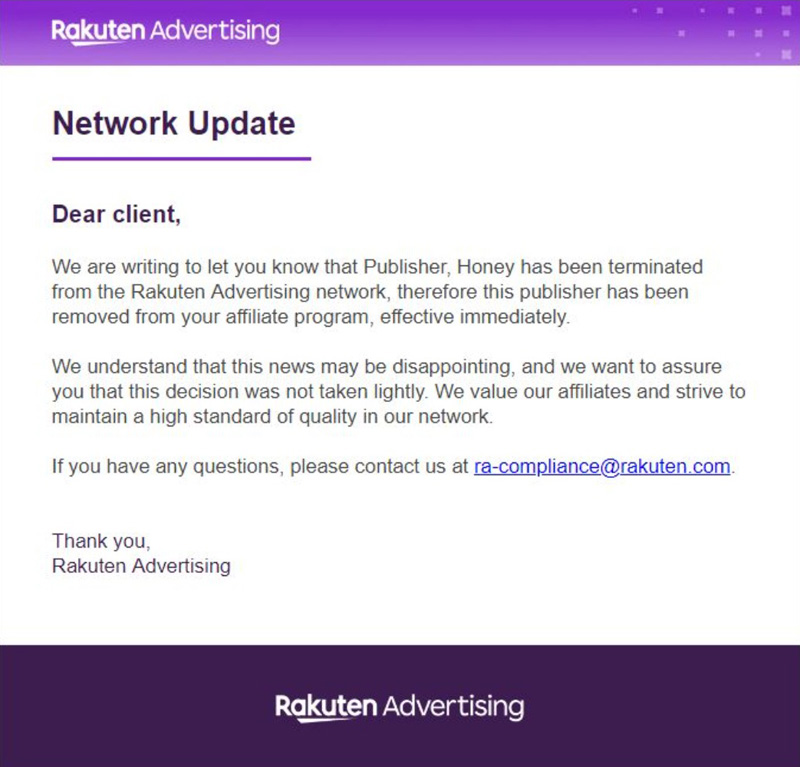
The industry was caught off guard when Rakuten Advertising, one of the primary pillars of the U.S. affiliate space, announced that PayPal Honey had been "terminated from the network." In a brief but pointed statement, Rakuten framed the decision as a necessary measure to "maintain a high standard of quality" within their ecosystem.
January 16, 2026:
Just four days later, impact.com followed suit. After an investigation into Honey’s activities, the network determined that the publisher was "out of compliance" with platform policies. Unlike Rakuten’s permanent termination, impact.com characterized the move as a suspension, specifically citing "attribution manipulation" as the core catalyst for the decision.
The timing of these events was particularly striking, as the initial termination coincided with the opening day of Affiliate Summit West, the industry’s largest annual gathering. For the thousands of professionals in attendance, "Rakuten" and "Honey" became the inescapable subjects of every conversation, turning the event into an impromptu forum on the state of affiliate ethics.
Understanding the "Stand-Down" Violation
At the heart of this controversy lies the technical concept of the "stand-down" rule. In the current affiliate ecosystem, most programs operate on a "last-touch-wins" attribution model. This means the affiliate whose link is clicked or whose cookie is placed last receives the full commission for the transaction.

Browser extensions like Honey often operate by injecting themselves into the user’s shopping journey. To ensure fairness, networks implement "stand-down" rules—mandates that require browser extensions to yield to other affiliates if a referring link or cookie is already present in the user’s browser. The violation occurs when an extension intentionally bypasses these rules to "overwrite" an existing cookie, effectively hijacking credit for a sale that another affiliate—such as a content creator or niche blogger—had already facilitated.
When Honey was found to be engaging in these concealed violations, it was not merely breaking a technical rule; it was undermining the trust that serves as the foundation of the entire partnership economy.
Industry Implications: Why This Matters
The removal of such a high-profile player carries significant weight for brands, networks, and fellow publishers.
1. The "One Bad Apple" Effect
In affiliate marketing, the presence of a "hijacking" publisher can be catastrophic for a program’s health. Rule-abiding, high-value affiliates—such as reputable content creators and influencers—routinely audit the partners of the brands they promote. If they perceive that a program is populated by "last-click" parasites that will strip them of their commissions, they will refuse to join or will stop promoting the brand entirely. By tolerating a bad actor, a brand risks alienating its most loyal and effective partners.
2. The Myth of Network Policing
A critical lesson from this crisis is the danger of relying solely on affiliate networks to act as the "police." While networks have compliance departments, their primary mandate is often to protect the network as a whole, not necessarily the specific interests of individual brands. History has shown that networks may, at times, overlook infractions to maintain volume. Brands must take ownership of their own compliance, monitoring their traffic and enforcing their own Terms and Conditions rather than waiting for a third-party platform to step in.
3. The Need for Granular Evaluation
There is a temptation to paint all browser extensions with the same brush, but doing so is a tactical error. Just as some search affiliates are perfectly compliant while others engage in prohibited trademark bidding, some browser extensions function ethically. Program managers must move away from broad generalizations—such as banning all loyalty programs or all extensions—and instead evaluate each partner on their specific technical behavior and adherence to attribution standards.
Strategic Recommendations for Affiliate Managers
To survive and thrive in an environment where attribution is constantly being tested, program managers should adopt a more rigorous, proactive stance.
Diversification: The Ultimate Safety Net
If your affiliate program suffered a significant revenue drop after the removal of Honey, you have a structural problem. A healthy program is not reliant on a single type of affiliate, nor a single partner. If 80% of your sales are driven by a handful of players in the same category, you are operating in a state of high risk.
Managers should look to diversify their base across 28 distinct categories, including:
- Content Producers and Influencers: For authentic, top-of-funnel discovery.
- Affinity Groups and Charities: To align with specific demographics.
- Card-Linked Offers: To bridge the gap between online and offline shopping.
- Podcasters and Video Marketers: For deeper, more sustained engagement.
The Power of the Audit
Independent research, such as the audit conducted by The Affiliate & Partner Marketing Association (APMA), highlights the complexity of attribution rules. Brands should leverage such resources to gain a deeper understanding of the "soft click" vs. "stand-down" distinction. Understanding these technical nuances allows managers to spot manipulation long before it impacts the bottom line.
Own Your Program
Ultimately, an affiliate program is a reflection of its manager’s standards. Relying on the network to dictate what is "acceptable" is a passive strategy that leaves your brand vulnerable. By clearly defining, communicating, and enforcing your own policies, you build a program that attracts high-quality partners who feel protected.
As we move deeper into 2026, the expulsion of PayPal Honey serves as a wake-up call. The era of "laissez-faire" affiliate management is over. The future belongs to those who prioritize transparency, demand technical integrity, and cultivate a diverse, healthy ecosystem of partners who add genuine value to the customer journey.
The question remains: will other networks follow suit, and how will PayPal adjust its strategy to regain the trust of the brands it relies on? For now, the message is clear—attribution manipulation is no longer a "cost of doing business." It is a liability that the market is no longer willing to tolerate.