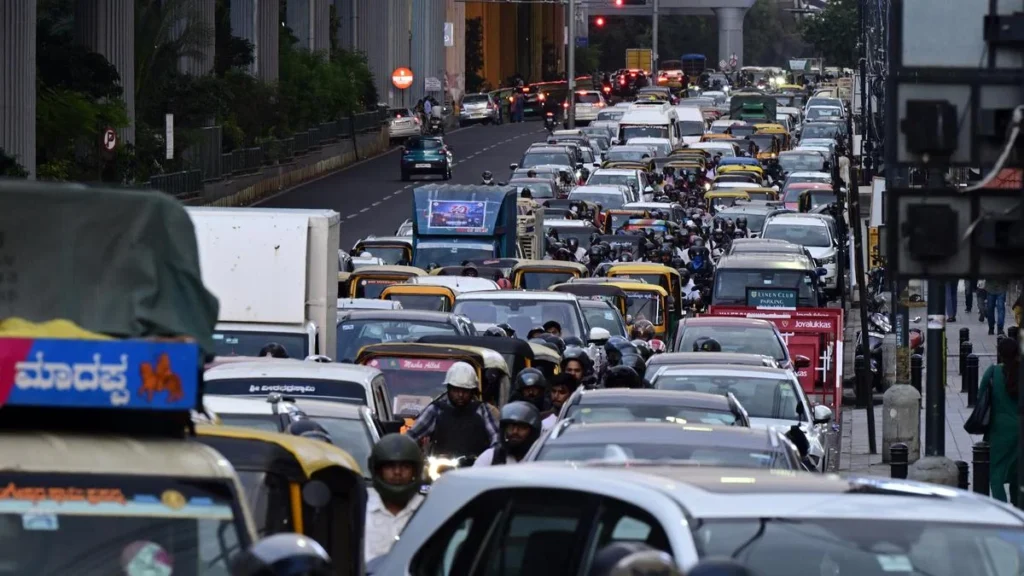
In an era where smart cities lean heavily on artificial intelligence to maintain order, a peculiar incident in Bengaluru has exposed the comical yet concerning vulnerabilities of automated policing. A local motorist found himself slapped with an online traffic violation fine, commonly known as an e-challan, for carrying a "pillion rider without a helmet." The catch? His scooter had no passenger.
Upon checking the Bengaluru Traffic Police (BTP) e-challan portal, the bewildered commuter realized the root of the error: the BTP’s AI-powered Intelligent Traffic Management System (ITMS) had mistaken the guitar strapped tightly to his back for a human being. A subsequent manual review at the Traffic Management Centre (TMC) failed to catch the glitch, resulting in the wrongful penalty being issued.
While the episode quickly went viral, triggering online debates about the reliability of algorithmic governance, it highlights a much larger narrative. Bengaluru’s ambitious shift toward contactless, tech-driven traffic enforcement—designed to eliminate human corruption, ease congestion, and optimize manpower—is wrestling with the stubborn realities of edge-case anomalies, algorithmic misinterpretations, and the delicate balance between automation and human oversight.
Chronology: The Evolution of Bengaluru’s Contactless Enforcement
December 2022: The Dawn of ITMS
The groundwork for Bengaluru’s current automated enforcement framework was laid in December 2022, when the BTP officially rolled out the ITMS. Spearheaded under the vision of minimizing physical intervention—which historically led to allegations of bribery, harassment, and dangerous on-road pursuits—the system deployed high-resolution AI and machine learning cameras across major junctions. The primary mandate of the ITMS was to automatically flag violations, beam the data directly to the TMC, and free up human officers to focus on traffic flow regulation.
The 2022–2023 Accuracy Struggles
In its nascent stages, the technology faced teething troubles. Internal BTP data and reviews from late 2023 indicated that the system’s true accuracy plummeted to roughly 80% for specific violations, including pillion riders lacking helmets, seatbelt infractions, and signal jumping. Factors such as faded zebra crossings, non-standard number plate fonts, and shadows occasionally triggered false flags.
September 2025: The Guitar Incident
The structural flaws of the system entered public consciousness in mid-September, when the motorist carrying his guitar was penalized. The incident encapsulated the perils of relying on algorithmic pattern recognition without robust secondary checks, prompting a fresh round of introspection within the police department regarding how AI processes unorthodox objects.
Present Day: Adjusting the Hybrid Model
Recognizing that 100% algorithmic perfection remains a distant dream, the BTP has recalibrated its enforcement strategy. Rather than relying entirely on contactless automation, the department has reintroduced targeted physical checks during non-peak hours, ensuring that the deterrent "fear of fines" is maintained without causing peak-hour gridlock.
Supporting Data: Numbers Behind the Automated Grid
A deep dive into the data collected via the Actionable Intelligence for Sustainable Traffic Management (ASTraM)—a comprehensive one-stop platform for commuter needs launched by the BTP—reveals the sheer scale of Bengaluru’s digital policing apparatus:
Daily Output: The BTP issues an average of roughly 26,500 contactless challans every day. Of these, over 19,000 are generated entirely by AI cameras.
Dispute Rates: Out of the 19,000 AI-generated challans daily, approximately 25 cases (roughly 0.13%) are formally challenged by motorists. However, traffic officials caution that this low dispute rate does not equate to absolute algorithmic accuracy, as many citizens choose to pay minor fines rather than navigate the bureaucracy of disputing them.
Monthly Volume: A staggering 7.9 lakh contactless challans are processed every month, constituting roughly 87% of the BTP’s total ticketing volume. In contrast, physical interceptions account for only 1.05 lakh challans monthly out of a total pool of 9 to 9.1 lakh violations.
Violation Breakdown: According to ASTraM data, contactless challans are heavily dominated by riding without a helmet (29%), wrong parking (21%), pillion riding without a helmet (14%), and signal jumping (14%). Conversely, physical interceptions are led by "no entry" (one-way) violations at 38%.
Official Responses: Navigating the Limits of Artificial Intelligence
Law enforcement leadership has adopted a pragmatic, albeit defensive, stance regarding the capabilities and limitations of the city’s smart traffic grid.
Karthik Reddy, Joint Commissioner of Police (Traffic), defended the technology, asserting that the ITMS system operates with nearly 99% accuracy when paired with minimal human oversight, dismissing systemic wrong-flagging as statistically negligible.
However, other senior traffic officials have offered a more nuanced assessment. They concede that after filtering out human intervention and manual rectifications, the raw AI system’s accuracy can dip significantly depending on environmental variables.
"Despite machine learning and the constant feeding of data having improved the system, we need human intervention, at least to verify some aspects. We cannot completely rely on AI," a senior officer noted, pointing out the limitations of pattern-matching software.
For instance, the officer highlighted junctions where civic bodies have failed to repaint faded zebra crossing lines. Even though motorists cannot clearly see the boundary, the AI rigidly flags the vehicle for stopping past the line. "These violations are not actively booked by us, because in many cases civic bodies would be at fault… In such instances, human intervention is necessary," he explained.
Other known blind spots include:
The Seatbelt Paradox: Commuters wearing dark or black shirts—whose color frequency closely matches that of a standard seatbelt—are occasionally flagged for driving unbuckled despite being securely strapped in.
Signal Nuances: Motorists who momentarily lift their helmets while waiting at a prolonged red light, or those who drive straight through an intersection where right turns are restricted, frequently find themselves mistakenly ticketed.
Font Irregularities: Variations in vehicle registration plate fonts regularly trick optical character recognition (OCR) software into issuing erroneous fines.
Implications: The Human Element in Smart Policing
The Bengaluru guitar incident and its broader systemic context carry profound implications for the future of urban governance, data privacy, and citizen-state relations in India’s tech capital.
The Erosion of Deterrence vs. The Threat of Over-Policing
When Bengaluru rolled out its near-total contactless ticketing model in 2022 (where up to 97% of fines were tech-generated), authorities noticed an unintended consequence: citizens stopped fearing traffic rules altogether. Serious offences, such as drunk driving, plummeted from an annual average of 35,000 cases to just 6,000 in 2023, raising serious public safety alarms. The BTP realized that a purely digital, impersonal system lacked the psychological deterrent of physical enforcement. This prompted the department to reintroduce targeted on-ground checks, proving that technology alone cannot completely replace the authoritative presence of an officer.
Empowering the Citizenry
To combat the friction caused by algorithmic errors, the BTP has integrated multiple dispute mechanisms into the ASTraM app and its official web portal. Commuters can view photographic evidence captured by ITMS cameras, file structured disputes with supporting explanations, or approach the Traffic Management Centre (TMC) in person. This feedback loop is vital; without a transparent, accessible grievance redressal mechanism, automated ticketing risks alienating the tax-paying public and eroding trust in municipal technologies.
The Path Forward: Refining the Hybrid Model
Bengaluru’s experiment demonstrates that smart policing cannot function in a vacuum. Artificial intelligence is an exceptional tool for processing high-volume, repetitive visual data, but it lacks contextual awareness. Whether distinguishing a musician’s guitar from a pillion passenger or recognizing that a motorist has pulled down their visor due to health reasons, the human element remains irreplaceable.
As the city continues to scale its digital infrastructure, the ultimate success of Bengaluru’s traffic management will depend not on eliminating human oversight, but on strengthening it. Until algorithms learn to appreciate art—or at least tell the difference between heavy luggage and human anatomy—the burden of common sense will rest squarely on the shoulders of human reviewers behind the screens.