The Pay-Per-Crawl Revolution: How AI Agents, Microtransactions, and Google’s Pilot Are Rewriting the Web’s Economic Model
By Tech & Search Desk
Published September 2026
Main Facts
The fundamental economic contract of the internet—the exchange of free content for human attention and ad impressions—is collapsing under the weight of generative artificial intelligence. For nearly three decades, search engines crawled publisher websites, indexed the text, displayed links, and sent human traffic back to the source. Today, AI engines like Google Gemini, OpenAI’s ChatGPT, and Perplexity parse that same content to formulate direct answers inside conversational interfaces, often bypassing the traditional click-through entirely.
In response to this existential shift, two distinct models are rapidly emerging to compensate publishers:

- Platform-Managed Revenue Sharing: Google’s newly launched AI contribution pilot tracks when publisher content substantially drives generative answers (such as AI Overviews or AI Mode) and pays out a monthly lump sum. However, critics note the calculation remains a opaque "black box."
- Direct, Protocol-Driven Microtransactions: Independent developers and technical publishers are bypassing tech-giant gatekeepers entirely. By resurrecting the long-dormant HTTP
402 Payment Requiredstatus code through the x402 protocol and blockchain-based stablecoins (such as USDC on Layer-2 networks like Base), websites can now charge autonomous AI agents fractions of a cent per page-view in real time before handing over data.
While major media conglomerates leverage bot-blocking and corporate muscle to negotiate lucrative, multi-million-dollar licensing deals, small-to-medium publishers are left searching for automated, scalable solutions to monetize the billions of background requests made by AI crawlers.
Chronology of Events
The transition toward automated machine-to-machine payments and platform compensation programs has accelerated dramatically over the past two years:
- April 2026: SEO expert Barry Schwartz uncovers cryptic Google Search Console help documentation referencing an automated metric for AI contributions, though its precise functionality remains obscure.
- July 1, 2026: Cloudflare announces its Monetization Gateway, introducing the concept of virtual wallets and pay-per-use architecture for web resources.
- August 4, 2026: During Cloudflare’s "Agents Week," the company opens public reservations for wallet handles, laying the groundwork for agent-to-site identification and financial transactions.
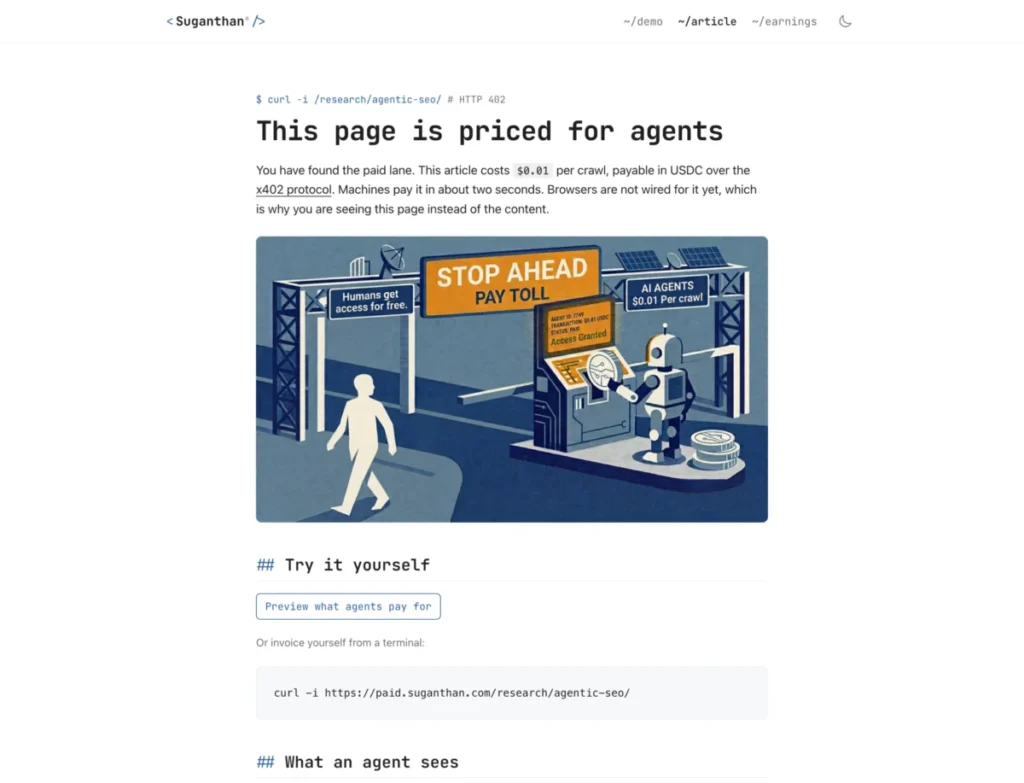
- August 8, 2026: Digital strategist and publisher Suganthan Mohanadasan deploys a live experimental paywall on a Cloudflare Worker using the open x402 protocol (
paid.suganthan.com), charging autonomous agents one cent (testnet USDC) per requested article. - August 18, 2026: Amazon Web Services (AWS) announces general availability for AgentCore payments, enabling autonomous AI agents to transact safely at scale.
- September 4, 2026: Press Gazette reports that aggressive bot-blocking via Cloudflare has successfully forced AI companies to the negotiating table with mid-sized publishers like People Inc.
- September 13, 2026: TRM Labs publishes an analysis examining nearly 199 million x402 protocol settlements, questioning how much actual autonomous agent activity versus automated testing volume drives current blockchain transaction counts.
- September 14, 2026: Following a Digiday report earlier that morning, Barry Schwartz covers the official rollout of Google’s AI contribution pilot via Search Console, confirming that Google is actively paying selected publishers for deep contributions to AI Overviews and the Gemini app.
- September 15, 2026: Mohanadasan successfully executes automated microtransactions using live AI tooling—specifically Claude Code via a WebFetch hook—where an agent autonomously encounters a
402payment gate, checks its internal budget constraints, pays a fraction of a cent, receives the data, and logs a public transaction hash on the Base Sepolia blockchain.
Supporting Data & Technical Architecture
To understand how automated microtransactions function in practice, it is necessary to examine the technical mechanics of the open x402 protocol. Standardized under the Linux Foundation’s x402 Foundation (which boasts over 40 corporate members, including Visa, Mastercard, Google, AWS, Stripe, and Cloudflare), the system breathes life into a status code that sat idle for nearly three decades.

The Four-Step x402 Handshake
When an autonomous AI agent or crawler requests a protected resource on an x402-enabled server, the exchange unfolds in four automated steps:
- The Request: An AI agent sends a standard HTTP GET request to access a specific article, dataset, or API endpoint.
- The Payment Challenge: The web server intercepts the request and responds with an HTTP
402 Payment Requiredstatus code, attaching a machine-readable payload specifying the exact payment parameters:"x402Version": 2, "accepts": [ "scheme": "exact", "network": "eip155:84532", "amount": "10000", "asset": "0x036CbD53842c5426634e7929541eC2318f3dCF7e", "payTo": "0xEdF2444D0259BBB8aC5094216D0148938F8308ff", "maxTimeoutSeconds": 300, "extra": "name": "USDC", "version": "2" ] - The Budget Check & Settlement: A client-side script or AI agent hook reads the demand (e.g.,
10000units, representing 0.01 USDC with six decimal places on the Base Sepolia network), evaluates the price against internal spending caps and daily allowances, signs the transaction, and routes it through a payment facilitator. - Content Delivery: Once the blockchain transaction settles, the server releases the full text or payload to the agent, providing a cryptographically verifiable transaction hash.
Guardrails and Spending Limits
A critical vulnerability in delegating financial autonomy to artificial intelligence is the risk of a run-away script draining a wallet. Practical implementations incorporate strict guardrails:
- Per-Call Caps: Setting a maximum expenditure threshold per individual request (e.g., rejecting any page costing more than $0.001 unless manually overridden).
- Daily Allowance Limits: Capping cumulative daily spending to prevent infinite crawler loops from depleting funds.
- Cryptographic Identity: Utilizing emerging standards like Web Bot Auth to verify that incoming requests genuinely originate from authorized AI operators rather than malicious actors.
Official Responses & Industry Perspectives
The rapid commercialization of AI scraping has fractured the publishing ecosystem into distinct factions based on enterprise scale and technical capability.

Large Publishers and Collective Bargaining
Media giants such as News Corp, the Financial Times, and Reddit have bypassed technical paywalls altogether, opting instead for multi-million-dollar, direct enterprise licensing agreements. For these corporations, legal threats and centralized contract negotiations remain the primary defense.
Mid-sized publishers have found leverage through defensive infrastructure. As noted by the chief executive of People Inc. in early September reports, aggressive bot-blocking configurations via Cloudflare effectively choked off unauthorized data ingestion, directly compelling AI platforms to negotiate structured compensation frameworks.
The Platform Perspective: Google’s Black Box
Google’s AI contribution pilot represents the tech giant’s effort to institutionalize revenue sharing without breaking the user experience of AI Overviews. Under this program, Google compensates publishers only when an algorithm determines their content played a foundational role in generating an answer prior to synthesis. Content that merely receives a citation link after the text has been compiled is excluded from payouts.

However, industry executives have heavily criticized the initiative’s lack of transparency. Publishers receive a lump-sum monthly earnings report inside Search Console without visibility into the underlying mathematical models or attribution metrics. One media executive warned that accepting these opaque terms early could weaken a publisher’s legal and economic standing in future industry-wide negotiations.
The Independent Developer View
Independent publishers and technologists argue that centralized platform programs inevitably favor massive content networks while shutting out niche researchers, open-source documentation sites, and independent journalism. By implementing decentralized protocols like x402, creators maintain absolute sovereignty over pricing, bypassing corporate intermediaries entirely.
Implications for the Future of the Web
The maturation of pay-per-crawl protocols and platform-managed compensation models signals structural changes across several key areas:

1. The Redefinition of Web Accessibility
For decades, the default ethos of the web has been open indexation via robots.txt and unrestricted HTTP GET requests. As AI agents evolve from passive indexers into active, transactional participants that extract commercial value, unmonetized open access is becoming financially unsustainable for high-value content creators.
However, overzealous paywalls carry a heavy penalty. Smaller sites that completely block AI crawlers risk disappearing entirely from the training sets and conversational retrieval engines that modern users rely on for discovery, choking off human referral traffic alongside machine traffic.
2. Microtransactions Moving to Mainstream Infrastructure
While early experiments rely on testnet tokens and custom developer hooks, institutional backing from the Linux Foundation, AWS, and Cloudflare points toward mass consumer readiness. As Cloudflare’s Monetization Gateway and virtual wallet products transition out of closed beta, setting a per-page access fee for automated agents will likely become as trivial as toggling a dashboard setting.

3. A Shift in Content Valuation
Not every page on the internet commands an economic price. General explainers, basic news summaries, and community forums will likely remain free to preserve human discoverability and SEO visibility. Conversely, proprietary datasets, technical research papers, specialized financial feeds, and deep investigative journalism will transition toward micro-priced APIs. Autonomous agents will seamlessly evaluate these costs in real time, purchasing precisely the data chunks required to complete complex multi-step tasks on behalf of human users.
Ultimately, the web is transitioning from a human-centric browsing paradigm to a hybrid economy where machines negotiate, transact, and consume content autonomously. Whether publishers choose to trust the black-box accounting of platform giants or take control of their own digital tollbooths via cryptographic protocols, the era of free, unrestricted AI scraping is drawing to a close.