India’s Defense Sector Hits Milestone: Rajnath Singh Highlights ‘Operation Sindoor’ and Self-Reliance
By Staff Reporter
New Delhi | July 4, 2026
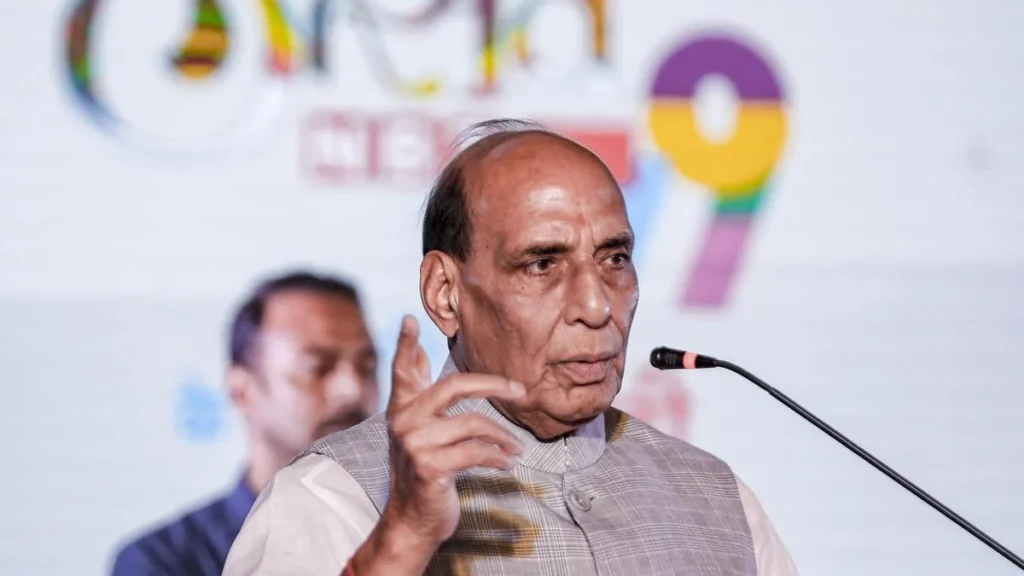
In a keynote address at the Navbharat Times (NBT) Utsav in New Delhi on Saturday, Union Defence Minister Rajnath Singh painted a compelling picture of India’s transformation into a global defence powerhouse. Marking the 80th anniversary of the national Hindi daily, the Minister took the opportunity to reflect on a decade of rapid industrial growth, the operational validation of indigenous technology, and the evolving ethics of journalism in an era dominated by Artificial Intelligence.
The Operational Validation: ‘Operation Sindoor’
At the heart of the Minister’s address was a resounding endorsement of India’s domestic defence manufacturing capabilities. Mr. Singh specifically cited "Operation Sindoor"—the decisive military action launched by India in May 2025 in response to the tragic Pahalgam terror attack—as a watershed moment for the "Make in India" initiative.
"After Operation Sindoor, the trust in ‘made-in-India’ defence platforms has received a significant boost," the Minister stated. He noted that the operation served as a "field trial" of sorts for a variety of indigenous platforms, ranging from advanced surveillance drones to precision-guided munitions and tactical communication suites. According to military observers, the success of these platforms in a high-stakes, real-world counter-terror operation has effectively silenced skeptics who once doubted the quality of home-grown defence hardware.

The Minister emphasized that the integration of indigenous technology into frontline operations is no longer just a policy goal but a strategic reality that bolsters India’s operational autonomy.
Chronology of Transformation: From Shortages to Self-Reliance
Mr. Singh framed India’s trajectory over the last 12 years as a deliberate, three-stage evolution: from systemic shortages to self-reliance, transitioning into a period of national self-confidence, and ultimately moving toward the goal of a Viksit Bharat (Developed India).
- The Baseline (2014): A decade ago, the Indian defence sector was characterized by heavy import dependency, bureaucratic inertia, and a lack of private-sector participation.
- The Reform Period (2015-2022): The introduction of the Defence Acquisition Procedure (DAP), the corporatization of the Ordnance Factory Board (OFB), and the establishment of two Defence Industrial Corridors in Uttar Pradesh and Tamil Nadu laid the groundwork for industrial expansion.
- The Maturation Phase (2023-Present): The current era is defined by the export of high-value systems, the successful integration of AI in military logistics, and the widespread adoption of indigenous platforms in active duty, as evidenced by the 2025 operations.
Supporting Data: The Economic Metrics of Defence
The Minister provided striking statistics to illustrate the sheer scale of the turnaround in the domestic defence economy.
Production Growth
"Today, our defence production has reached over ₹1.78 lakh crore," Mr. Singh revealed. To provide perspective, he compared this to the figures from approximately 8–9 years ago, when the total production stood at a modest ₹46,000 crore. This growth trajectory reflects a more than threefold increase in domestic output, driven by the participation of both Public Sector Undertakings (PSUs) and an increasingly vibrant private sector.

The Export Revolution
Perhaps the most significant metric cited was the growth in defence exports. In the fiscal year 2013-14, India’s defence exports were valued at a negligible ₹686 crore. By 2026, those figures have reached a record-breaking ₹38,000 crore—a staggering 57-fold increase. Mr. Singh added that preliminary estimates suggest the current figures are already trending toward the ₹40,000 crore mark, signaling that India is rapidly transitioning from a net importer to a reliable global arms supplier.
The Nexus of Tradition and Technology
Addressing the audience at the NBT Utsav, Mr. Singh argued that India’s unique strength in the 21st century lies in its ability to synthesize tradition with cutting-edge technology. "India lays emphasis on both technological development and celebrating its traditions," he said.
This balance, he argued, is essential as the nation navigates the complexities of the digital age. He posited that while technological advancements are necessary for national security, the core values of the nation—humanity, empathy, and ethical governance—must continue to guide the deployment of these tools.
AI and the Future of Journalism: An Official Perspective
A significant portion of the Minister’s speech was dedicated to the intersection of Artificial Intelligence and journalism. While acknowledging the inevitability of AI integration in media workflows, Mr. Singh offered a cautionary perspective.

The Human Pulse
"AI can read and analyze data, but it cannot feel the pulse of the people," the Minister observed. He warned that while AI can enhance the speed and precision of news reporting, it lacks the human empathy required to understand the social and emotional context of events. He urged journalists to strike a balance: using AI for efficiency while maintaining human intellect to ensure credibility and empathy.
The Challenge of Misinformation
Mr. Singh addressed the growing threat of "communicative abundance," where the problem is not a lack of information, but a surplus of unreliable data. He specifically warned against the proliferation of misinformation, noting its corrosive impact on society and, more critically, on the morale of the armed forces.
"Especially when the subject concerns the defence forces, national security, or the honour of those who make the supreme sacrifice, every word becomes a matter of national responsibility," the Minister asserted. He called upon the media to uphold the values of accuracy, objectivity, and impartiality, noting that in the age of instant reporting, the race to be first must never supersede the duty to be correct.
Implications for the Future
The Minister’s address serves as a blueprint for the coming years. For the defence sector, the focus will remain on scaling up indigenous R&D to meet the requirements of modern, technology-intensive warfare. The success of platforms used during Operation Sindoor suggests that the government will continue to prioritize indigenization, potentially leading to even stricter curbs on non-essential imports.

For the media landscape, the Minister’s message is a call to professional vigilance. As India continues its journey toward a Viksit Bharat, the role of the Fourth Estate in maintaining the integrity of the national discourse is viewed by the government as a matter of national security itself.
In conclusion, the event highlighted a government that is confident in its industrial capabilities and increasingly concerned about the quality of the information ecosystem that surrounds it. Whether the rapid growth in defence production continues at the current pace will depend on sustained investment in R&D and the continued success of the private sector in overcoming the final barriers to high-tech manufacturing. As India stands on the cusp of becoming a global defence hub, the synergy between technology, tradition, and responsible journalism will likely define the next decade of national development.