The Silent Cost: Navigating the Complex Landscape of E-Commerce Returns in Europe
The digital marketplace has evolved into a global ecosystem where the transaction does not conclude at the virtual checkout. For the modern European e-commerce merchant, the true test of operational efficiency lies in what happens after the package arrives. Returns, once considered a marginal post-purchase activity, have matured into a fundamental pillar of the online shopping experience. As consumer expectations for "frictionless" shopping reach an all-time high, merchants are finding themselves caught in a delicate tug-of-war between maintaining customer loyalty and safeguarding bottom-line profitability.
1. The Anatomy of Returns: A Continental Overview
In the European theatre, the returns phenomenon is not a monolith. It is a highly fragmented landscape where cultural shopping habits, legal frameworks, and logistical maturity vary wildly from one border to the next.
Statistical Realities
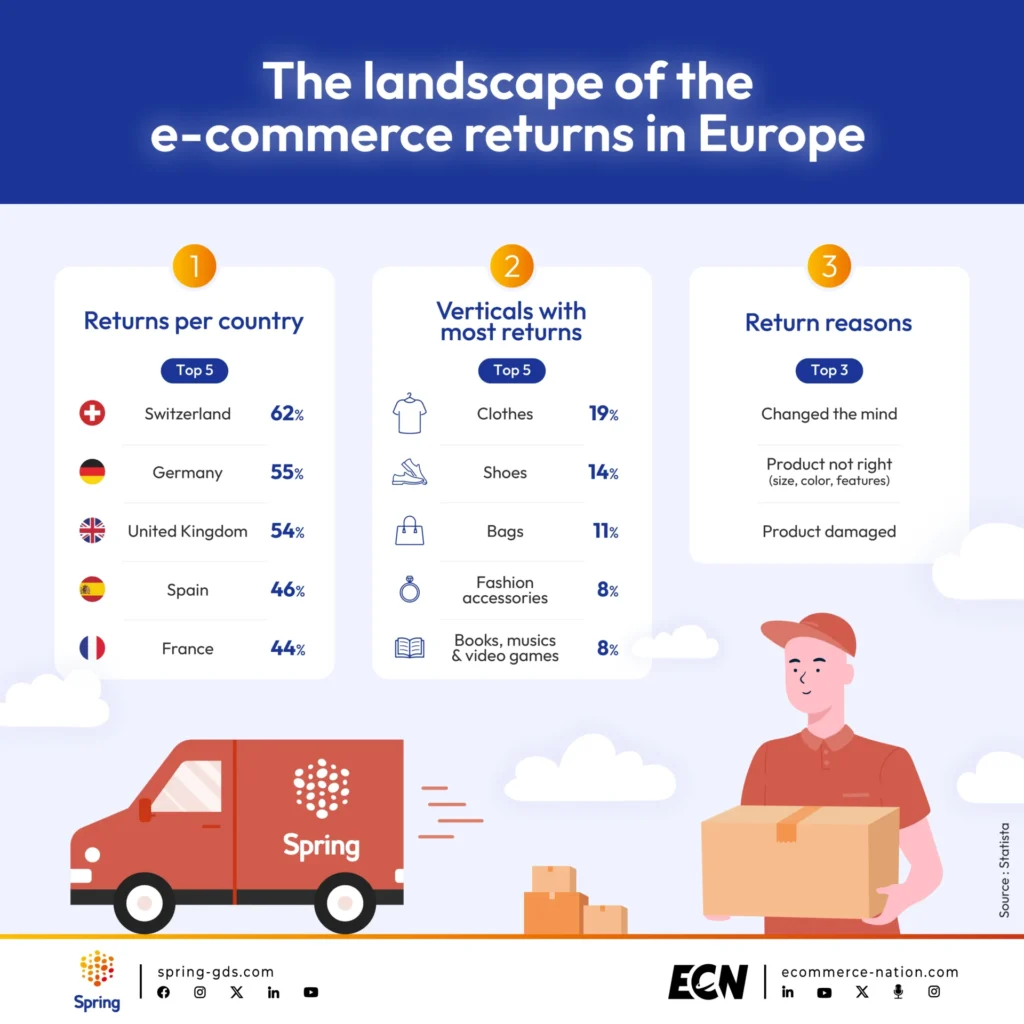
Current data paints a stark picture: the average return rate for European online purchases fluctuates between 30% and 40%. However, this average masks the extreme volatility seen in mature markets. Switzerland leads the continent with a staggering 62% return rate per online buyer, followed closely by Germany (55%) and the United Kingdom (54%). These figures suggest that in Northern and Western Europe, the "try-before-you-buy" culture has become deeply ingrained in the consumer psyche.
The Rise of "Bracketing"
A significant driver behind these numbers is the burgeoning trend of bracketing. This practice involves consumers intentionally purchasing multiple versions of the same product—different sizes, colors, or variations—with the full intent of returning the majority of them. While this behavior is a boon for the customer, providing them with a "fitting room" experience at home, it creates a logistical and financial nightmare for the retailer, who must process, inspect, and restock items that have effectively been "rented" for free.
2. Chronology of a Return: From Consumer Impulse to Operational Impact
To understand the scale of the challenge, it is helpful to visualize the lifecycle of a return:
- The Intent (T-minus 0): The customer decides to return an item. This stage is dictated by the merchant’s policy. If the process is opaque or requires a paid shipping label, the customer’s satisfaction drops immediately.
- The Transit (Days 1–5): The item enters the reverse logistics chain. For cross-border sales, this is where complexity peaks, as the parcel crosses jurisdictions, potentially incurring customs fees or VAT reconciliation issues.
- The Processing (Days 5–10): The item reaches the warehouse. It must be inspected for damage, cleaned, re-packaged, and returned to inventory.
- The Re-entry (Day 10+): The product is finally available for resale. If this cycle takes too long, the product may become seasonal dead stock, losing its retail value.
3. Supporting Data: The Sectors Under Pressure
Not all retail categories are affected equally. The fashion and apparel industry remains the epicenter of the return crisis. Because apparel is inherently subjective, sizing discrepancies and "style misfits" lead to return rates that can exceed 50% in the fashion sector alone.
Conversely, consumer electronics and household goods face a different challenge. While their return rates hover around 6% to 10%, the cost per return is significantly higher due to the fragility of the goods, the need for technical inspection to ensure functionality, and the risk of depreciation. A returned television set cannot simply be re-sold as new if the box has been opened, forcing retailers to liquidate stock at deep discounts through secondary channels.
4. Official Responses and Industry Shifts
In response to the mounting costs of "free returns," a quiet revolution is taking place. Major European retailers—including giants like Zara, H&M, and various luxury fashion houses—have begun to pivot.
The End of "Free"
Many merchants are now implementing "return fees" to curb abusive behavior and mitigate the high cost of reverse logistics. The industry consensus is shifting: by charging a nominal fee for returns, companies are not necessarily looking to profit, but rather to influence consumer behavior, encouraging shoppers to be more intentional with their initial purchases.
Strategic Localization
Official industry reports suggest that retailers are increasingly opting for "local return hubs." By establishing regional return centers rather than forcing all products back to a central warehouse, companies are significantly reducing both the carbon footprint and the cost of the return journey.
5. Navigating the Challenges: Logistical, Financial, and Ethical
The Logistical Labyrinth
The most daunting hurdle is the lack of a unified logistical standard across Europe. A parcel moving from Italy to Germany faces different carrier requirements, labeling standards, and tracking expectations than one moving within domestic borders. For small and medium-sized enterprises (SMEs), these cross-border complexities can be prohibitive.
The Financial Drain
The true cost of a return is often hidden. It is not merely the price of a return label; it is the cost of labor to inspect the item, the depreciation of the product, and the lost opportunity cost of the item sitting in a warehouse instead of being sold. Merchants must master the art of the "re-commerce" economy to ensure that returned goods are given a second life.
The Ecological Mandate
Perhaps the most pressing concern for the modern consumer is the environmental impact of returns. The "reverse supply chain" is carbon-intensive. Consumers are increasingly scrutinizing brands for their "return footprint." Companies that discard returned goods rather than refurbishing them face significant reputational risk in a market that prioritizes ESG (Environmental, Social, and Governance) criteria.
6. Strategic Recommendations: Optimizing for the Future
To survive and thrive, e-commerce merchants must stop viewing returns as an inevitable evil and start managing them as a strategic asset.
I. Data-Driven Insights
Merchants must leverage data to identify the "why" behind returns. If a specific dress size is returned 80% of the time, the solution is not better logistics—it is a better size guide. Predictive analytics can help identify high-risk shoppers and provide them with personalized sizing advice before they click "buy."
II. Technology as an Enabler
Investing in automated return management platforms can reduce manual labor by up to 40%. These platforms provide customers with a self-service portal, real-time tracking, and automated refund triggers, which significantly bolsters customer trust without requiring a massive customer support overhead.
III. Radical Transparency
The most effective way to reduce returns is to provide as much information as possible at the point of sale. High-definition videos, 360-degree views, augmented reality (AR) fitting tools, and detailed customer reviews act as a filter, ensuring that the item the customer receives matches their expectations.
IV. Sustainable Re-commerce
For items that cannot be returned to the primary inventory, merchants should build partnerships with third-party platforms that specialize in the resale of "open-box" or "refurbished" goods. This ensures that the product maintains some value and reduces the volume of goods ending up in landfills.
Conclusion: The Path Forward
The European e-commerce market is at an inflection point. The era of "unlimited, free, and instant" returns is being replaced by a more sustainable, calculated model. By investing in better sizing technology, localized logistical infrastructure, and transparent return policies, merchants can transform this operational burden into a competitive advantage.
The future of retail is not just about selling a product; it is about managing the entire relationship between the brand and the consumer. In this new landscape, the way a company handles a return is often the strongest indicator of its commitment to quality, sustainability, and long-term customer success. The winners in the European market will be those who can make the return process as seamless as the sale, while ensuring that every returned item finds its way back to a customer who truly values it.