The Token Tax: How Data Formatting is Reshaping AI Agent Efficiency
In the rapidly evolving landscape of Large Language Model (LLM) integration, developers are encountering an unexpected fiscal hurdle: the "Token Tax." As AI agents move from simple chatbot interfaces to complex autonomous workflows, they are increasingly tasked with retrieving and processing vast amounts of external data. However, the standard method for transmitting this data—JavaScript Object Notation (JSON)—has become a significant bottleneck.
For developers building search-augmented agents, the cost of "reading" a search result is often higher than the cost of the query itself. As models consume thousands of tokens to parse nested metadata, tracking links, and redundant syntax, the economic viability of autonomous agents is being tested. A new solution is emerging: transitioning from data-heavy JSON payloads to streamlined Markdown outputs. This shift promises to cut token consumption by as much as 75%, fundamentally changing the unit economics of AI-driven search.
The Problem: Why JSON is Bloating Your Context Window
Modern AI agents are designed to "think" by iterating. They conduct searches, scrape web pages, and pull in documentation. In a typical stack, this data is returned as JSON—the industry standard for machine-to-machine communication. While JSON is perfect for programmatic processing where data types and schema integrity are paramount, it is notoriously verbose for LLMs.
When an agent searches for something as simple as "local coffee shops," the JSON response often includes a payload riddled with nested objects, tracking metadata, and repetitive structural markers like brackets and quotation marks. An LLM must "read" every character of this structure, consuming tokens for every redundant field.
If an agent runs a recursive loop—a common occurrence in complex reasoning tasks—the token cost scales exponentially. Suddenly, a simple search query that costs pennies to run can result in a significant expenditure simply to parse the "noise" surrounding the signal. This is the core of the token bloat crisis: the model is paying to process formatting that it never actually uses to derive an answer.
Chronology of a Data Paradigm Shift
The realization that JSON might be suboptimal for AI agents did not happen overnight. It is the result of a multi-year maturation in the AI agent space:
- 2022–2023: The Era of Naïve Integration. As LLMs became accessible via API, developers treated them like traditional databases. Data was fed in as raw JSON because that was the format provided by existing scrapers and search engines. Token costs were high, but the novelty of agentic workflows masked the inefficiency.
- Early 2024: The Context Window Crunch. As agentic loops became more complex, developers began hitting the limits of context windows. Engineers noticed that "context bloat"—the accumulation of unnecessary metadata—was forcing models to "forget" earlier parts of a conversation.
- Late 2024: The Rise of Optimized Data Formatting. Providers like SerpApi began identifying the disconnect between machine-readable data (JSON) and LLM-readable data (Markdown). By stripping away structural noise, these providers realized they could offer a significant value proposition: cheaper, faster, and more context-efficient AI agents.
Supporting Data: The Case for Markdown
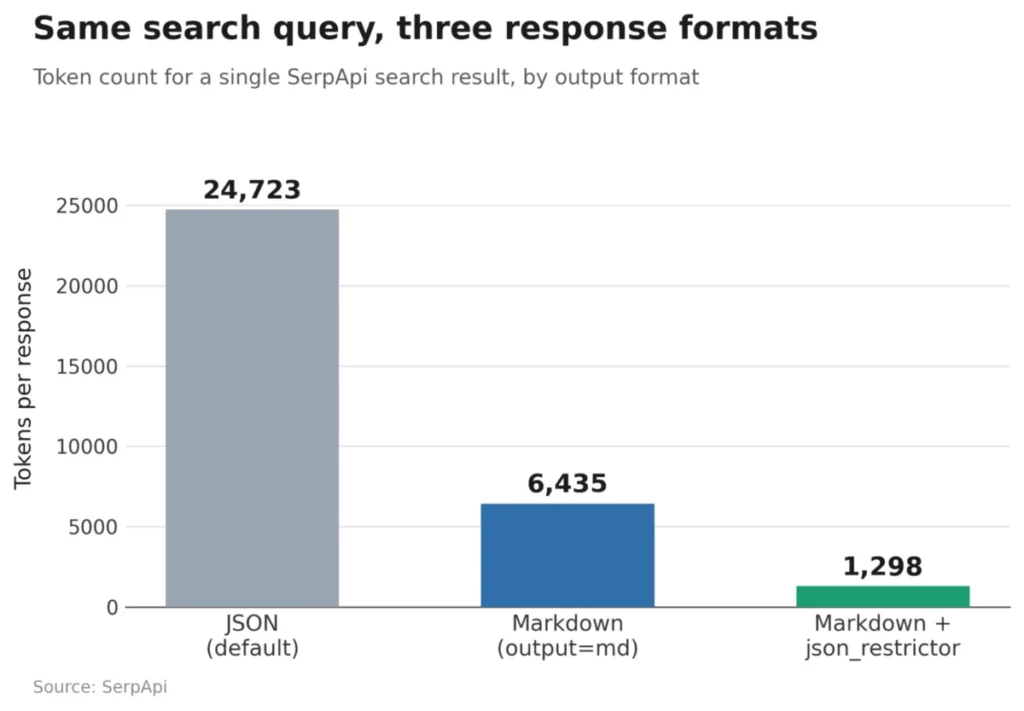
The performance metrics provided by early adopters of Markdown-based retrieval are compelling. In a controlled test comparing JSON against Markdown for a standard search query ("coffee"), the difference in resource utilization was stark:
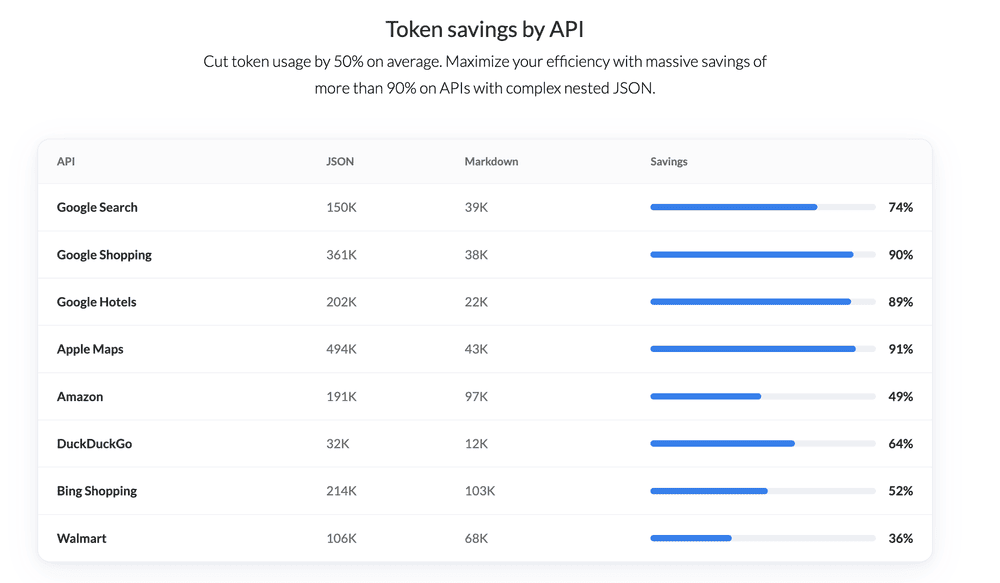
- JSON Payload: 24,723 tokens.
- Markdown Payload: 6,435 tokens.
- Efficiency Gain: A 74% reduction in token usage.
Further optimization, using restricted field sets, brought the Markdown payload down to just 1,298 tokens. This represents a nearly 20x improvement in efficiency over the raw JSON baseline.
This data suggests that the "token tax" is not a technical necessity, but a formatting artifact. By utilizing Markdown—a format designed for human readability—developers are actually aligning the data structure with the training objectives of LLMs, which are optimized to digest natural language patterns rather than rigid, syntax-heavy code blocks.
Official Perspectives and Technical Implementation
The move toward Markdown is being spearheaded by data infrastructure providers who recognize that the future of the internet is not just "people reading web pages," but "AI agents reading web pages."
SerpApi, for instance, has integrated Markdown support directly into their API architecture. The philosophy behind this is simple: provide the data in a shape that suits the consumer. If the consumer is a pricing algorithm, send JSON. If the consumer is a reasoning agent (GPT-4o, Claude 3.5, etc.), send Markdown.
How to Implement the Shift
For developers, the transition is largely a matter of configuration. Through query parameters or header adjustments, developers can request the "Markdown output" mode.
- Header Configuration: By passing a specific flag in the API request, the server-side logic strips away tracking pixels, redundant arrays, and structural boilerplate that the AI doesn’t need to reason effectively.
- Field Restriction: Beyond just changing the format, developers are encouraged to use "json_restrictor" patterns. This acts as a surgical tool, selecting only the specific fields—such as the snippet, the title, and the URL—that are strictly necessary for the agent’s task.
This approach treats the API response as a "just-in-time" delivery system, where only the required information is transmitted, minimizing both network latency and token expenditure.
Implications for the AI Agent Ecosystem
The shift from JSON to Markdown has profound implications for the future of autonomous systems.
1. The Economics of Scale
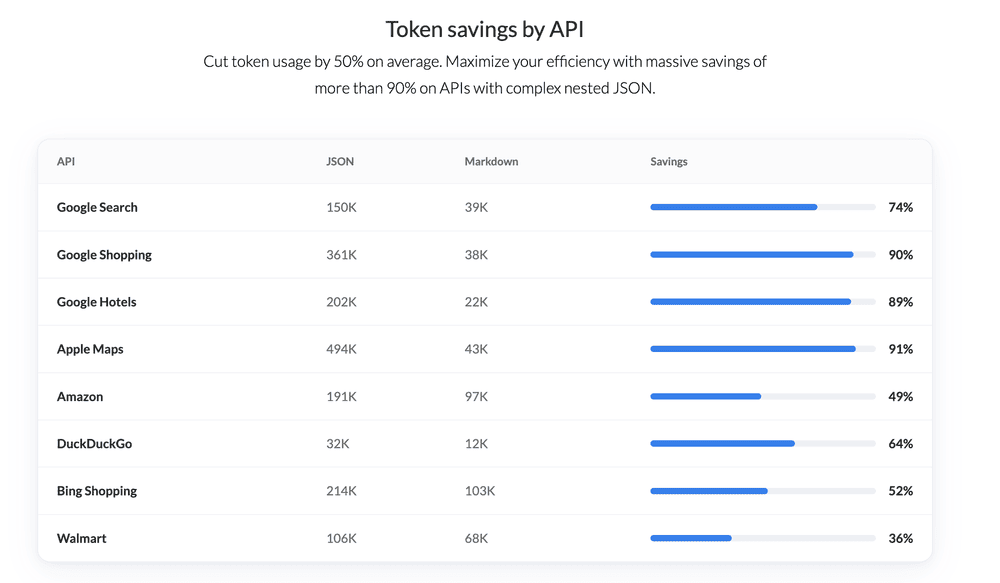
For startups and enterprises scaling AI agents to thousands of queries per day, a 74% reduction in token usage is not merely an optimization; it is a fundamental shift in unit economics. It allows for higher-frequency queries, more complex reasoning chains, and ultimately, a more robust agentic experience without a linear increase in cloud infrastructure costs.
2. Context Window Optimization
By reducing the size of retrieved data, developers can fit more "world knowledge" into the context window. Instead of truncating search results to save tokens, agents can now include more detailed context, leading to higher-quality outputs and reduced "hallucination" rates.
3. When JSON Still Reigns Supreme
Despite the benefits of Markdown, it is not a universal replacement. The industry is reaching a consensus: Markdown is for agents; JSON is for engines.
If a pipeline requires strict data types—such as processing float values for stock prices, calculating aggregate averages from arrays, or performing database inserts—JSON remains the superior choice. The goal is not to eliminate JSON, but to use the right tool for the right "reader." Developers must now evaluate their pipelines to identify which nodes require precision and which nodes require summarization.
Conclusion: Shaping the Future of Data Retrieval
The "Token Tax" has served as a wake-up call for the developer community. It has highlighted that the way we format data for computers is not necessarily the way we should format data for the new generation of AI "thinkers."
As we look toward the future, the integration of Markdown into data pipelines marks a maturation of the AI agent stack. It is a transition from "brute force" AI—where we pay for every byte of metadata—to "intelligent" AI, where data is pruned, shaped, and optimized to be as lean as possible. For those building the next generation of agents, the message is clear: if you aren’t measuring the token cost of your data format, you are paying for noise that your model doesn’t need.
In the high-stakes game of AI development, the most efficient architecture will win. By rethinking the shape of the data we feed our agents, we aren’t just saving money; we are making our AI smarter, faster, and more capable of handling the complexities of the modern web.