The "Undo" Button for Infrastructure: AWS Unveils Kubernetes Version Rollbacks for Amazon EKS
For years, the phrase "Kubernetes upgrade" has struck a chord of anxiety in the hearts of platform engineers and DevOps teams worldwide. In the realm of open-source Kubernetes, a control plane upgrade has traditionally been a "one-way door"—an irreversible operation that, if met with unexpected compatibility issues, left administrators scrambling to rebuild clusters or perform high-stakes emergency troubleshooting.
Today, Amazon Web Services (AWS) has fundamentally altered that narrative. With the announcement of native version rollbacks for Amazon Elastic Kubernetes Service (Amazon EKS), AWS is providing a critical safety net that promises to accelerate innovation by removing the existential fear of cluster upgrades.
The Core Transformation: Moving Beyond the "One-Way Door"
In the standard Kubernetes ecosystem, the lack of a native rollback mechanism has forced organizations to adopt defensive, often cumbersome, operational patterns. To mitigate risk, teams have historically relied on elaborate "compensating mechanisms." These include multi-stage bake periods, complex stagger groups, manual sign-offs, and protracted upgrade cycles that can span months.
Given that the Kubernetes community releases three minor versions per year, these long cycles create a "version debt" trap. Teams managing hundreds of clusters—particularly those in highly regulated industries like finance or healthcare—often delay upgrades entirely to avoid the risk of a catastrophic failure. This leads to clusters languishing on aging versions, missing vital security patches, and eventually colliding with the hard deadlines of the Kubernetes extended support lifecycle.
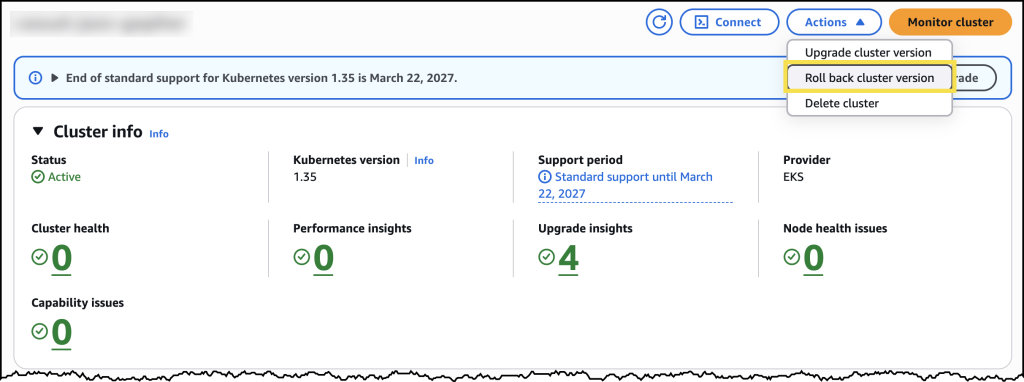
By introducing version rollbacks, AWS is effectively providing an "undo button." This feature allows cluster administrators to revert a Kubernetes version upgrade within a seven-day window, returning the cluster to its previous, fully validated, and known-good production state.
Chronology: A New Standard for Operational Resilience
The journey to this announcement has been marked by a broader industry push toward better lifecycle management. While the open-source community has made progress with initiatives like KEP-4330—which introduces emulated versions—these solutions often keep a cluster in a "transitional holding state."
AWS’s approach is distinct. Instead of relying on emulation, the EKS rollback feature reverts the cluster to the exact, fully functional version that was previously running in production. The implementation timeline and operational flow are as follows:
- The Trigger: A user upgrades their EKS cluster (e.g., from version 1.34 to 1.35).
- The Observation Window: Upon detecting a compatibility issue or performance degradation, the administrator has up to seven days to initiate a rollback.
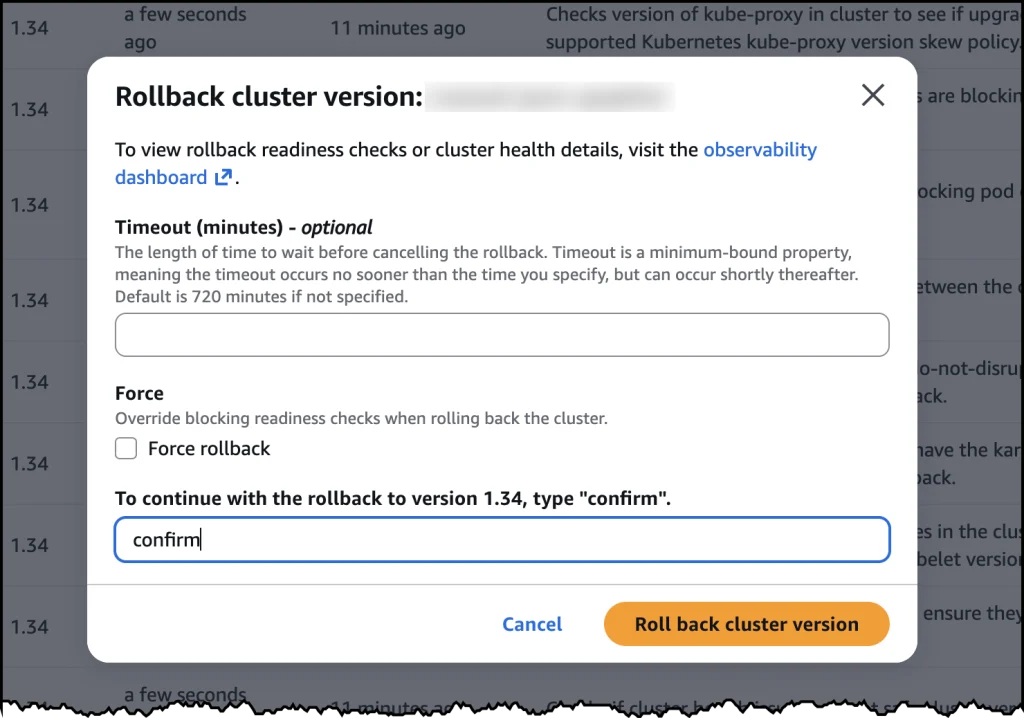
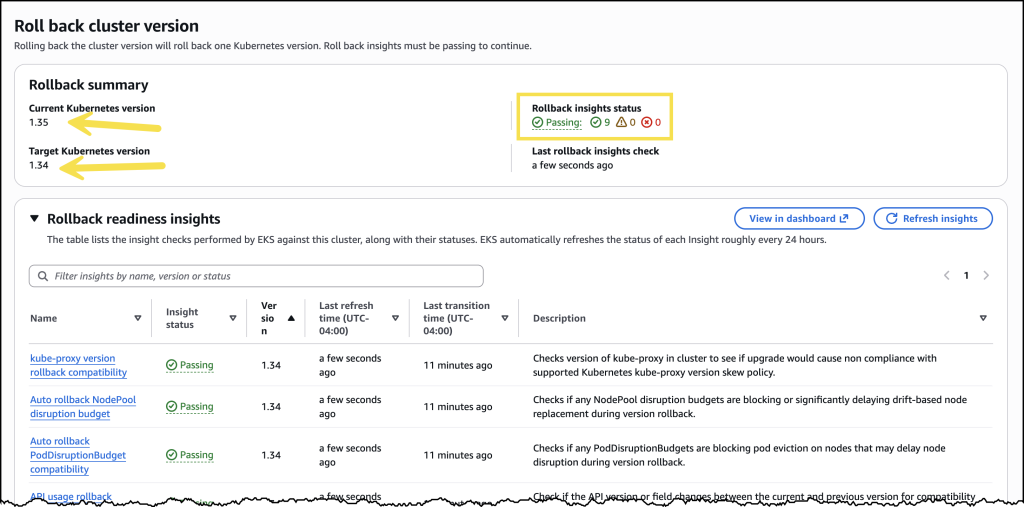
- The Validation Phase: Before the rollback begins, EKS utilizes its "Cluster Insights" tool to evaluate readiness. This automated check flags potential blockers, such as node version compatibility or specific add-on dependencies.
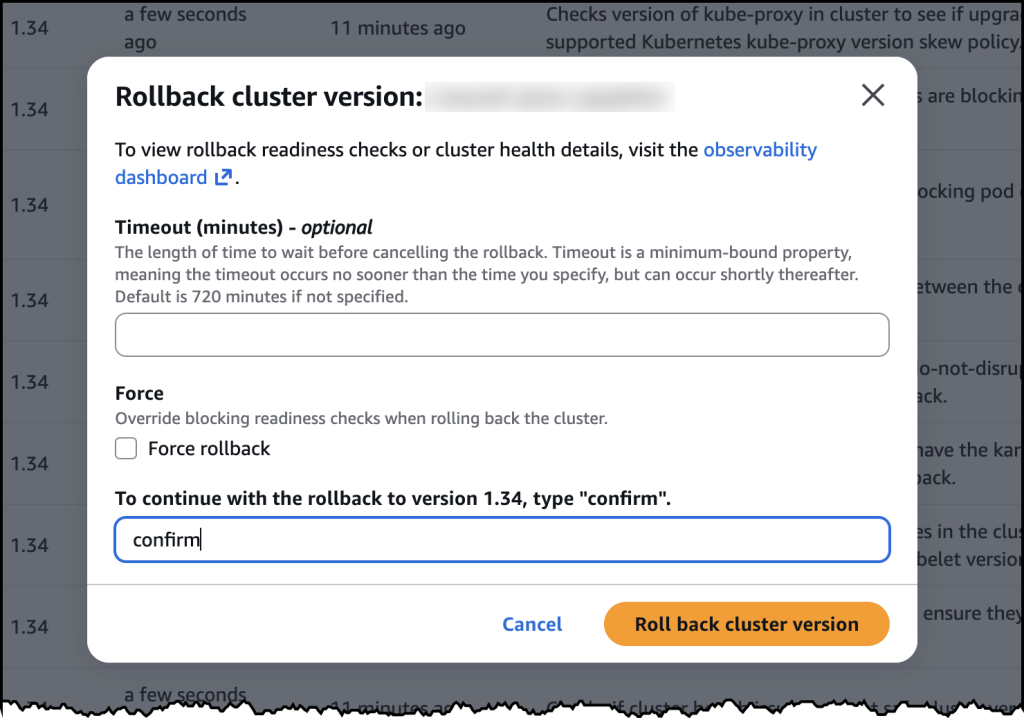
- The Execution: If the user proceeds—either by clearing the flagged items or using the
--forceflag—the control plane reverts. This process typically takes approximately 20 minutes, mirroring the duration of a standard upgrade. - The Verification: Once the control plane rollback is complete, the cluster returns to its prior stable state, with the infrastructure state fully restored to the previous minor version.
Supporting Data and Technical Nuance
The technical architecture of this feature is designed to respect the complexities of modern, distributed applications.

The EKS Auto Mode Integration
For customers utilizing EKS Auto Mode—the recently introduced, highly opinionated deployment model that manages compute, networking, and storage—the rollback process is even more comprehensive. Because EKS Auto Mode manages both the control plane and the underlying managed nodes, a rollback must synchronize both layers.
Recognizing that rolling back nodes can be time-intensive due to the need to honor Pod Disruption Budgets (PDBs), AWS has introduced a Cancel API. This provides administrators with granular control: if a rollback is progressing too slowly or if an administrator decides to pivot strategies, they can stop the process mid-stream, adjust their PDB settings, and proceed with a more optimized configuration.
Safety First
AWS has reinforced the importance of stability by ensuring that, by default, EKS will never bypass user-defined Pod Disruption Budgets during a rollback. This prioritizes the availability of mission-critical workloads. While users can choose to override these settings to accelerate the process, the default behavior ensures that the rollback is as non-disruptive as possible.
Official Perspective: Simplifying the Lifecycle
The official stance from the AWS EKS engineering team is that this feature is not merely a tool, but a cultural enabler. By lowering the risk of upgrades, AWS aims to encourage teams to stay current with Kubernetes versions, thereby inherently improving the security posture of the entire cloud ecosystem.
"We want to move teams away from the fear of upgrading," noted a spokesperson during the launch. "By providing a verified path back to a previous state, we are giving teams the confidence to test new features, adopt the latest Kubernetes enhancements, and keep their infrastructure secure without the looming threat of an irreversible breaking change."
Implications: The Future of Cluster Management
The introduction of native version rollbacks is poised to have profound implications for the DevOps and SRE communities.
1. Accelerated Adoption of Kubernetes Versions
The most immediate impact will be the reduction in "upgrade fatigue." When the cost of failure is reduced to a simple rollback procedure, the psychological barrier to upgrading disappears. Organizations can adopt a more aggressive, iterative approach to cluster maintenance, ensuring they are always running on supported versions and benefiting from the latest performance improvements in the Kubernetes core.
2. Standardized Compliance
For organizations in regulated sectors, this feature provides a clear, documented, and repeatable path for disaster recovery during maintenance windows. The ability to demonstrate a formal rollback procedure can simplify audits and compliance reporting, as it provides a tangible safety mechanism that was previously absent.
3. Shift in Operational Focus
As EKS continues to automate the "heavy lifting" of cluster management—through features like Auto Mode and now native rollbacks—the role of the platform engineer is shifting. The focus moves away from "keeping the lights on" (troubleshooting failed upgrades) toward optimizing application architecture and enhancing developer experience.
4. Financial Efficiency
While there is no extra charge for the rollback feature itself, the indirect financial savings are significant. By reducing the number of man-hours spent on pre-upgrade "bake periods" and post-upgrade emergency firefighting, organizations can reallocate engineering talent toward high-value initiatives.
Getting Started: A Step-by-Step Approach
For teams looking to integrate this into their current workflows, the path is straightforward:
- Audit Current Clusters: Use the EKS console to review which clusters are eligible for the rollback feature.
- Leverage Insights: Familiarize the team with the "Cluster Insights" dashboard. Treat these readiness reports as a standard part of the pre-upgrade checklist.
- Test in Non-Production: Before applying to mission-critical workloads, simulate an upgrade and subsequent rollback in a staging or development environment. This builds muscle memory and validates that current PDB configurations will behave as expected during a reversion.
- Update Documentation: Ensure internal playbooks reflect the new seven-day rollback window.
Conclusion
The release of version rollbacks for Amazon EKS represents a maturation of the Kubernetes ecosystem on AWS. By addressing one of the most persistent "pain points" in container orchestration—the irreversibility of the upgrade process—AWS has provided a much-needed safety net for the cloud-native world.
As organizations continue to scale their containerized footprints, the ability to iterate safely is the ultimate competitive advantage. With this update, AWS is not just managing clusters; they are providing the confidence required to operate at the velocity the modern digital landscape demands. For the platform engineer, the "undo button" has finally arrived, and the days of dreading the upgrade command are, thankfully, coming to an end.