Two Decades and Nine Years Later: The Uphaar Tragedy and the Unending Fight for Accountability
By Editorial Staff
New Delhi | June 13, 2026
Twenty-nine years ago, a mundane Friday afternoon at the Uphaar Cinema in Green Park, New Delhi, transformed into a scene of unimaginable horror. As the audience watched the blockbuster Border, a transformer fire in the parking lot sent toxic, black smoke billowing into the auditorium, ultimately claiming the lives of 59 people—many of them children—and leaving over 100 others with life-altering injuries.
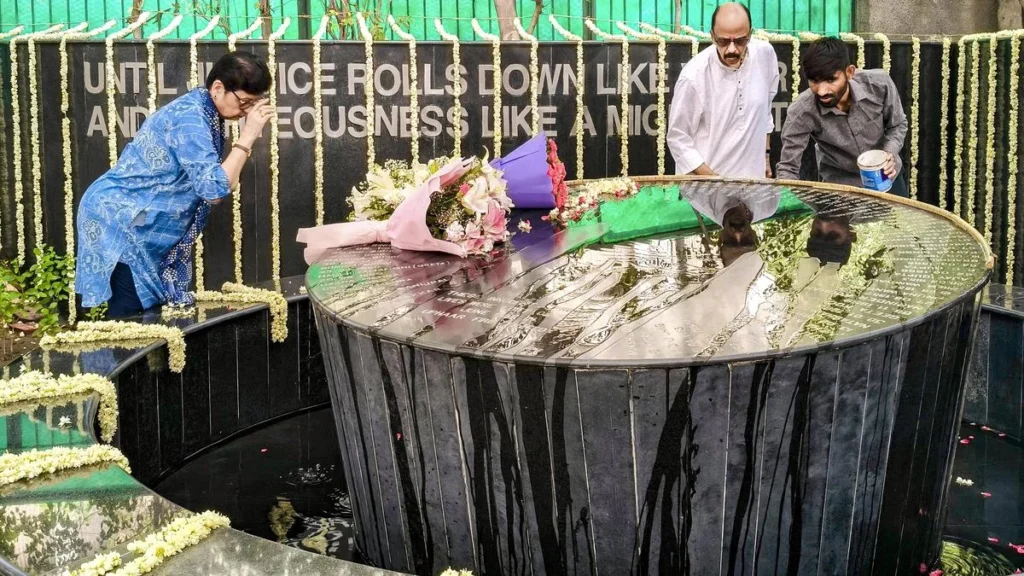
On June 13, 2026, the Association of Victims of Uphaar Tragedy (AVUT) gathered once more at the site of the former cinema hall to hold their annual havan and shanti paath. While the prayers were meant to provide solace to the grieving families, the mood was one of defiance and exhaustion. Nearly three decades after the catastrophe, the association has declared that the systemic failures that led to the 1997 disaster remain largely unaddressed, fueling a cycle of preventable fire tragedies across the national capital.
The Weight of Memory: A Chronology of the Tragedy and the Legal War
The Uphaar fire remains etched in the Indian collective consciousness as a watershed moment for urban safety standards.
- June 13, 1997: A fire breaks out in the basement parking of Uphaar Cinema. Due to faulty wiring and blocked emergency exits, the auditorium turned into a gas chamber. 59 patrons suffocated to death.
- The Immediate Aftermath: The tragedy sparked public outrage, leading to the formation of AVUT, spearheaded by Neelam and Shekhar Krishnamoorthy, who lost their two teenage children in the fire.
- The Judicial Marathon: The legal battle was long and arduous. In 2015, the Supreme Court of India delivered a landmark verdict, allowing the Ansal brothers—owners of the cinema—to walk free in exchange for a fine, a decision that drew intense criticism from the victims’ families who felt justice had been compromised by wealth and influence.
- 2017-2021: Subsequent rulings and petitions focused on the tampering of court evidence, leading to further convictions for the owners, though the families maintained that the punishment did not match the scale of the negligence.
- 2026: On the 29th anniversary, the narrative has shifted from mere remembrance to an urgent demand for a paradigm shift in how India handles "man-made" disasters.
Recurring Nightmares: Why Lessons Remain Unlearned
The AVUT’s frustration stems from a pattern of "deadly déjà vu." Every few years, Delhi witnesses another massive blaze—be it in hospitals, coaching centers, or residential facilities—where the common denominator is always the same: systemic corruption and the apathy of regulatory bodies.
Neelam Krishnamoorthy, the indomitable president of AVUT, spoke poignantly during the memorial. "While we have seen cosmetic improvements in fire safety norms, the reality on the ground is stark. Implementation and enforcement remain weak, and our cities continue to operate like tinderboxes," she stated.

The association highlighted the recent fire at a Malviya Nagar stay facility, which claimed 23 lives, as a grim reminder of the status quo. The investigation into that incident revealed that the building lacked basic fire suppression systems and possessed an "NOC" (No Objection Certificate) that had been issued without a physical inspection—a phenomenon the victims call "the paper-trail of death."
The "NOC" Culture
The reliance on bureaucratic certification rather than ground-level safety verification is a systemic cancer. In many of these disasters, investigative reports later find that the building owners bribed officials to overlook missing fire escapes, blocked ventilation, and faulty electrical circuits. The AVUT argues that as long as an NOC can be purchased, no amount of regulation will save lives.
The Call for a Specialized Legal Framework
The central plank of the AVUT’s 29th-anniversary demand is the enactment of a comprehensive, specialized law dedicated to "man-made disasters." Current laws, which generally fall under the ambit of the Indian Penal Code (IPC) and local municipal bylaws, are often viewed as insufficient to handle the complexities of large-scale negligence.
Key Demands of the AVUT:
- Special Courts: The association advocates for the creation of dedicated tribunals or special courts for fire safety negligence to ensure that cases do not languish for decades.
- Time-Bound Trials: To prevent the "exhaustion strategy" often used by wealthy defendants to wear down victims, the AVUT proposes a mandatory one-year window for the conclusion of trials in cases of mass-casualty negligence.
- Stricter Liability: The current legal framework often treats such incidents as "accidents," allowing owners to pay fines and avoid prison time. The AVUT demands that the law classify these events as "criminal negligence resulting in homicide," with non-bailable offences and severe custodial sentences.
- Institutional Accountability: Beyond the building owners, the association insists that municipal officials, fire department inspectors, and police officers who sign off on unsafe buildings must face immediate criminal charges, not just administrative suspension.
Implications for Public Safety in Urban India
The Uphaar tragedy was supposed to be the "never again" moment for Indian cinema halls and public buildings. Yet, as India urbanizes at a rapid pace, the density of population in cities like Delhi makes the risks exponentially higher.
Economic vs. Human Cost
The AVUT argues that a fundamental conflict exists between profit motives and human safety. Business owners often view fire safety as a "sunk cost" that reduces the bottom line. When the cost of a fine for violating a safety norm is lower than the cost of installing a high-end sprinkler system, the incentive to break the law becomes an economic choice. The proposed legislation seeks to invert this calculus, making the legal and financial cost of non-compliance so high that it becomes a prohibitive risk for any business owner.
The Erosion of Public Trust
Perhaps the most damaging implication of the ongoing struggle is the erosion of public trust in the state. When families see that after 29 years, the same types of violations continue to occur with impunity, it breeds a sense of helplessness. The legal battle for Uphaar has not just been about the 59 victims; it has been a long-running commentary on the failure of the Indian state to protect its citizens from the greed of private enterprises and the corruption of public servants.

A Commitment to Vigilance
As the evening of June 13, 2026, drew to a close, the mood at the Uphaar site was solemn. The 59 lives lost in 1997 have become symbols of a fight that is far larger than the individual tragedy.
"We are not just remembering our loved ones today," Neelam Krishnamoorthy remarked as the final prayers were offered. "We are serving notice to the authorities that we are not going anywhere. We will continue to document, highlight, and challenge every instance of negligence. The fire at Uphaar may have been extinguished decades ago, but the fire for justice is still burning."
The path forward, according to urban planners and legal experts, requires a digital, transparent, and third-party verified system for fire safety. Technology, such as IoT-enabled fire sensors that report directly to a central state monitoring unit, could bypass the human element of corruption. However, until such a system is implemented, the legacy of Uphaar remains a haunting reminder of the high price paid for administrative negligence.
For the families of the victims, the 29th anniversary is not a closure; it is a renewal of a promise. A promise that no other family should have to walk the path they have tread for nearly three decades. As the sun set over Green Park, the memorial stood as a quiet, stubborn testament to the fact that until accountability is absolute, the tragedy of Uphaar will continue to repeat itself in the halls, hospitals, and homes of a city that has yet to learn its most vital lesson.
Data Summary of Fire-Related Disasters in India (Contextual Reference):
- Note: Statistics derived from historical trends and recent reports.
- High-Risk Zones: Public venues, hospitals, and coaching centers remain the top sites for fire-related deaths.
- Common Causes: Electrical short circuits (approx. 60%), lack of emergency exits (approx. 25%), and flammable materials/poor storage (approx. 15%).
- Judicial Status: A high percentage of fire-related negligence cases remain pending for over five years, significantly reducing conviction rates.