The Great IPO Reset: Analyzing the State of India’s New-Age Tech Listings in 2026
Dalal Street witnessed a transformative shift in 2025, cementing its status as a "founder’s paradise." Indian startups collectively raised a staggering INR 41,248 Cr through public offerings, marking a record-breaking year. However, as the calendar turns to 2026, the sentiment has shifted from the exuberance of "growth-at-all-costs" to a more disciplined "profit-first" mandate.
While 2025 was defined by a deluge of liquidity and regulatory easing, 2026 has introduced a recalibration. Investors are no longer dazzled by headline growth alone; instead, they are scrutinizing unit economics, governance, and long-term capital efficiency.
The 2025 Momentum vs. The 2026 Reality
The surge in 2025 was fueled by a perfect storm of macroeconomic tailwinds and SEBI’s proactive reforms. Measures such as the simplification of Draft Red Herring Prospectus (DRHP) filings reduced bureaucratic friction, while flexible Employee Stock Option Plan (ESOP) rules enabled founders to retain meaningful control.
Retail participation hit an all-time high, with demat account registrations crossing the 20 Cr mark. The Offer for Sale (OFS) component dominated these issues, providing a crucial exit route for early-stage venture capital backers. Yet, as we move through the first half of 2026, the market has cooled. Six new-age tech companies have made their debut so far this year, but their performance has been largely lackluster, with many stocks listing flat or at a discount to their issue price.
"Besides the readiness startups showed in their unit economics, we are seeing a shift in founders committing to their businesses for the long haul," notes Ashish Kumar, cofounder and general partner at Fundamentum Partnership. "Public markets are rewarding those who grow through adjacent profit pools rather than just burning cash to scale."
The IPO Pipeline: A Multi-Billion Dollar Opportunity
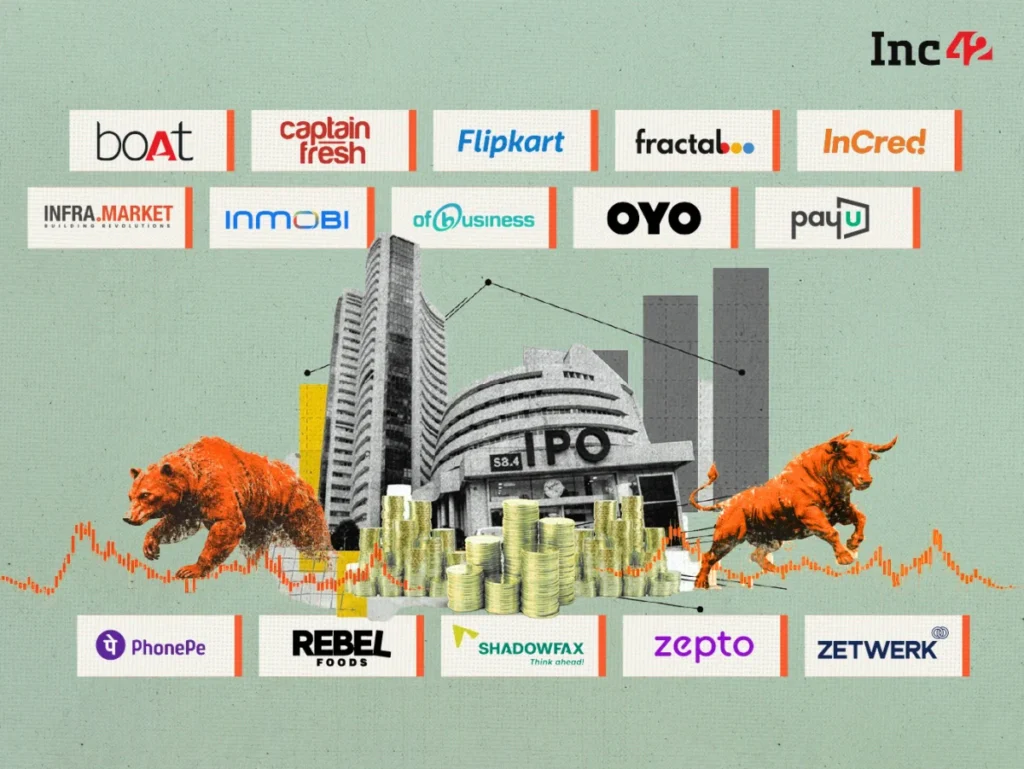
Despite the cooling sentiment, the IPO pipeline remains robust. Twenty-five startups have already filed their DRHPs, with an additional 25 in advanced stages of planning. Giants like Flipkart, Zepto, OYO (rebranded as PRISM), InMobi, and Zetwerk are collectively eyeing a combined raise of over INR 47,000 Cr in 2026. If executed, this would make 2026 the largest year for startup public listings in Indian history.
However, the "IPO-bound" tag is now a badge of scrutiny. "Startups in 2026 will be defined by their ability to demonstrate predictable cash flows," says Rehan Yar Khan, managing partner at Orios Venture Partners. "Investors are favoring companies that balance scale with financial prudence. Governance and capital efficiency are now the primary currency of trust."
Chronology of 2026 Market Debuts
The performance of the companies that braved the markets in early 2026 provides a roadmap for those still in the pipeline.
- Amagi: The SaaS major, after securing SEBI’s nod in late 2025, saw its IPO oversubscribed by 30.2X. However, shares listed at a 12.2% discount, highlighting the market’s sensitivity to valuations.
- Aye Finance: The NBFC faced a challenging environment, with its issue remaining largely undersubscribed and listing flat at the issue price of INR 129.
- Fractal: The AI-analytics unicorn saw a 2.66X subscription rate, but its debut was muted, listing at a 2.7% discount on the NSE, underscoring the volatility in the tech-services sector.
- Kissht: In a rare success story for the year, the lending-tech startup made a robust debut in May 2026, listing at an 11.7% premium, proving that profitability and a clear lending model remain attractive to retail investors.
- SEDEMAC: The deeptech firm saw a stellar listing in March 2026, gaining 13.5% on its debut, signaling that niche, high-tech manufacturing remains a favored sector.
- Shadowfax: The logistics unicorn had a tough debut in January, listing at a 9.19% discount, reflecting the intense competition and thin margins within the logistics space.
Analyzing the Data: A Sectoral Breakdown
A deep dive into the financials of upcoming IPOs reveals a trend of "Right-Sizing." Companies like AceVector (formerly Snapdeal) and Infra.Market are focusing on trimming losses as they prepare for their public debut.
| Company | Sector | Revenue [FY25] | IPO Status |
|---|---|---|---|
| Zepto | Quick Commerce | INR 4,454 Cr | Filed |
| OfBusiness | Ecommerce | INR 22,241 Cr | Yet to File |
| OYO (PRISM) | Travel Tech | INR 6,252 Cr | Filed |
| Zetwerk | Ecommerce | INR 12,798 Cr | Yet to File |
| PhonePe | Fintech | INR 7,115 Cr | Filed |
The data indicates that while revenue growth remains strong across these sectors, the "burn rate" has decreased significantly compared to the 2021-2022 period. Companies like Curefoods and Shadowfax have shown significant progress in narrowing their losses, a key metric for institutional investors who are currently wary of "growth-only" narratives.
Official Responses and Market Sentiment
The mood among institutional investors is one of "cautious optimism." While domestic capital pools have deepened, Foreign Institutional Investors (FIIs) have been pulling back, citing geopolitical tensions in West Asia and a lack of excitement in the secondary markets.
"The moderation in retail subscription levels is a warning sign," says an analyst from a leading domestic brokerage. "Investors are becoming increasingly selective. They want to see a clear path to dividend-paying profitability or at least a defensible moat against global competitors."
The Strategic Pivot: What Defines Success?
The most critical takeaway from the 2026 landscape is that the "startup" label is no longer a pass for poor performance. The market is increasingly treating these entities as traditional corporations.
- Unit Economics: Companies that cannot demonstrate a positive contribution margin are finding it nearly impossible to attract anchor investors.
- Governance: With the heightened regulatory scrutiny, companies with clean, transparent board structures and independent directors are being fast-tracked by SEBI.
- Capital Efficiency: Unicorns that previously relied on high-velocity cash infusions are now pivoting toward internal accruals.
Looking Ahead: The 2027 Pipeline
As the market matures, the definition of a "successful IPO" is changing. Success is no longer measured by the "pop" on day one, but by the ability of the stock to sustain its value over the first four quarters.
The companies in the current pipeline—ranging from Acko in insurtech to Atomberg in D2C—are being forced to internalize these lessons. Those who cannot adapt their business models to this "new normal" of fiscal discipline are likely to defer their listings or face the prospect of a "down-round" IPO.
Ultimately, India’s startup IPO journey has moved past its infancy. The market is signaling that it is ready to support the country’s next generation of giants, provided they prove that they are businesses first and startups second. As we look toward the second half of 2026, the focus will remain squarely on the fundamentals: cash, governance, and the ability to survive in a high-interest-rate environment.
With significant IPOs from companies like Zepto and OYO on the horizon, the coming months will be a litmus test for the resilience of the Indian startup ecosystem. The appetite for risk is there, but the patience for losses has clearly run out.