Telangana Unveils ‘Model’ Education Paradigm: CM Revanth Reddy Launches State-of-the-Art Public Schools
By Our Political Correspondent
Arutla, Rangareddy District | June 17, 2026
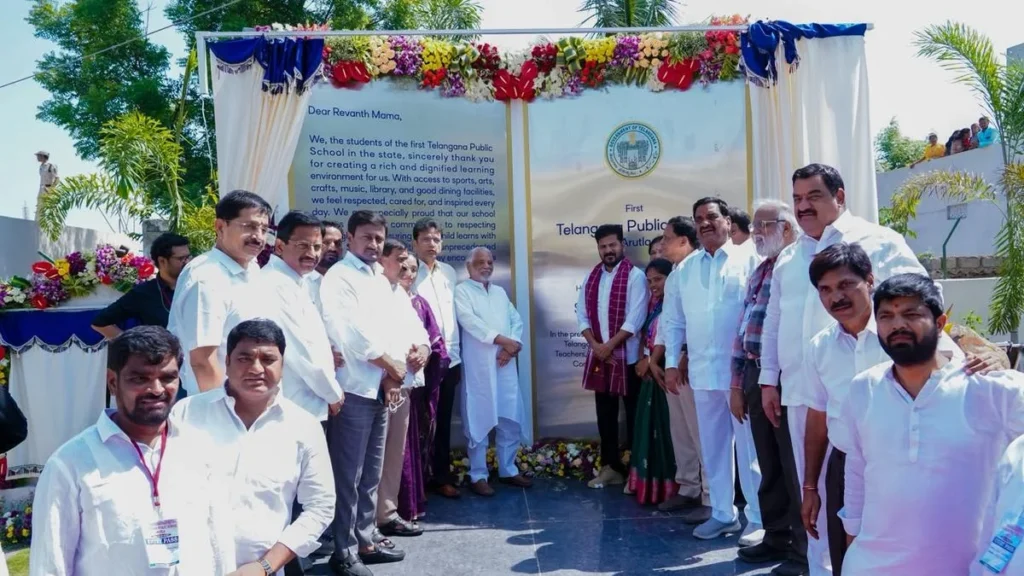
In a significant move aimed at fundamentally restructuring the state’s pedagogical framework, Telangana Chief Minister and Education Minister A. Revanth Reddy inaugurated the first of a series of "Telangana Public Schools" (TPS) in Arutla, Rangareddy district, on Wednesday. The initiative represents a pivotal shift in the state’s approach to public instruction, blending high-end corporate-style infrastructure with an egalitarian social mandate to prepare students for the complexities of a hyper-competitive global landscape.
A New Vision for State-Run Education
The inauguration of the Arutla facility serves as the cornerstone of the government’s ambitious mission to dismantle the stigma often associated with government-run educational institutions. Chief Minister Revanth Reddy, who has personally taken on the portfolio of Education, emphasized that the state is not merely building classrooms but is actively "reconstructing the future of Telangana."

The government’s strategy is rooted in the belief that quality education is the most potent tool for socioeconomic mobility. "We are committed to creating infrastructure that rivals the best private institutions," the Chief Minister stated during the public meeting held at the school premises. "Our goal is to ensure that every child, regardless of their socioeconomic background, is provided with the skills and the environment necessary to succeed in the competitive world."
Chronology of the Initiative
The road to the launch of the Telangana Public Schools has been marked by a series of deliberate policy maneuvers designed to revitalize the state’s education sector:
- Early 2026: The state government constitutes a high-level Education Commission tasked with identifying systemic bottlenecks and recommending a roadmap for holistic improvement.
- Budget 2026-27: The administration allocates a massive ₹27,000 crore for the education sector, representing 8.5% of the total budget outlay of over ₹3 lakh crore.
- June 17, 2026: The formal inauguration of the first Telangana Public School in Arutla, accompanied by the simultaneous opening of three additional schools, including one in the Chief Minister’s home village of Vangur.
- Ongoing Integration: The government begins the rollout of comprehensive student kits—including uniforms, books, and essential stationery—to bridge the resource gap for rural students.
Supporting Data and Infrastructure
The Telangana Public School model is a radical departure from traditional state-run facilities. Each campus has been designed to provide an environment that fosters physical, mental, and social development.

The infrastructure at the Arutla facility and its counterparts includes:
- Sports Facilities: Dedicated spaces for cricket, football, volleyball, tennis, and kabaddi, intended to cultivate a professional sports culture from the primary level.
- Holistic Development: Integration of cultural arts, personality development programs, and vocational training modules alongside the standard academic curriculum.
- Accessibility: Modern, secure buildings equipped with digital learning tools, aiming to replicate the facilities usually reserved for elite private schools.
The financial allocation for the student kits alone, valued at ₹680 crore, underscores the government’s commitment to resource equity. These kits are designed to ensure that the "look and feel" of a student’s daily experience is not a barrier to their academic confidence.
Breaking Caste Barriers through Education
One of the most profound aspects of the new school policy is the ideological push to erode systemic social divisions. CM Revanth Reddy was explicit in his critique of the past practice of segregating schools based on community or caste.

"Historically, we have seen schools established specifically for different communities. This has only served to reinforce the caste barriers that we must, as a progressive society, dismantle," the Chief Minister noted. The "Young India Integrated Residential Schools" and the TPS model are designed to foster an inclusive environment where students from all walks of life study, dine, and play together, thereby actively working to eradicate social evils like untouchability.
Official Responses and Political Friction
The inauguration has predictably triggered a heated political exchange. While the government positions the TPS project as a triumph of governance, the Opposition—specifically the Bharat Rashtra Samithi (BRS)—has raised concerns regarding transparency and expenditure.
The Chief Minister addressed these criticisms directly during his address, dismissing allegations of financial irregularities. "There is a tender for ₹680 crore for these student kits, yet a leader, a former IPS officer, is attempting to create a narrative of a ₹3,000 crore scandal," Mr. Reddy remarked, in an oblique reference to BRS leader R.S. Praveen Kumar. He challenged the Opposition to focus on constructive criticism rather than attempting to derail initiatives that benefit the marginalized.

Furthermore, the Chief Minister slammed the BRS for their criticism regarding the government’s recent outreach to international sports icons. The state’s invitation to football legend Lionel Messi to visit Hyderabad and engage with SC/ST students was framed by the government as an inspirational moment for youth. "He is not a drug lord, nor is he responsible for the structural failures of our barrages," the CM retorted. "Why is the Opposition unable to digest such positive developments for our children?"
The Path to Olympic Glory
A key pillar of the government’s long-term vision is the establishment of a state-funded Sports University. The Chief Minister expressed deep frustration at India’s performance in international sports, particularly the Olympics.
"As a nation of 1.4 billion people, we remain unable to secure a gold medal 75 years after Independence," he lamented. Drawing comparisons to South Korea, where specialized sports universities have produced dozens of Olympic champions, the Chief Minister urged the youth to take advantage of the facilities being provided. The goal is clear: to prepare a generation of athletes capable of bringing home Olympic gold by the 2034 games.

Implications: A Legacy in the Making
The Chief Minister concluded his address by invoking his own journey from a government school student to the state’s highest office, as well as the legacy of former Prime Minister P.V. Narasimha Rao, who was also a product of the public school system.
The implications of the Telangana Public School initiative are far-reaching. If successful, the model could serve as a blueprint for other Indian states struggling to balance the quality of education with the need for social inclusion. By positioning education as the primary tool for governance, the Revanth Reddy administration is betting that the long-term socioeconomic benefits—a more employable workforce and a more integrated society—will far outweigh the current political skirmishes and budgetary pressures.
As the state moves forward with its expansion of these facilities, the eyes of the nation will remain on Telangana to see if this ambitious investment can truly turn the tide in public education, transforming classrooms into the laboratories of the next generation’s leaders.