The Canvas Crisis: Inside the Multi-Month Cyber Siege on Education Infrastructure
In a stark reminder of the fragility of the digital classroom, the education technology giant Instructure—the parent company behind the ubiquitous learning management system Canvas—found itself at the center of a catastrophic data extortion saga in May 2026. What began as a localized security concern rapidly spiraled into a nationwide disruption, leaving millions of students and faculty members across nearly 9,000 educational institutions in a state of academic paralysis during the height of final exam season.
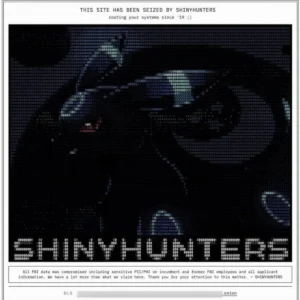
The perpetrator of this sophisticated assault was the notorious cybercrime syndicate ShinyHunters, a group known for its fluid tactics, audacious data theft, and a growing list of high-profile victims including ADT, Medtronic, and Rockstar Games. The incident has not only exposed critical vulnerabilities in the software that powers modern education but has also sparked a heated debate regarding transparency, incident response, and the efficacy of "containment" strategies in the face of persistent, advanced threat actors.
Chronology of a Digital Siege
The breach was not an isolated event, but rather the culmination of an eight-month campaign of escalation by ShinyHunters.
The Foundation: The September 2025 "Proof of Concept"
While the public focus remained on the May 2026 disruptions, security analysts now view the September 2025 compromise of the University of Pennsylvania as the true beginning of the saga. During that incident, ShinyHunters leaked thousands of sensitive files—including donor records and internal memos. While initial reports framed the breach as a localized Penn issue, investigators later determined that the attackers had leveraged an access path through Instructure’s infrastructure. At the time, the incident was handled quietly, missing the warning signs of a broader, systemic vulnerability.
The Escalation: May 1–May 6, 2026
On May 1, 2026, the threat group formally breached Instructure’s environment. By May 6, Instructure issued a statement acknowledging that "certain identifying information" of users—including names, email addresses, and student ID numbers—had been accessed. Despite the admission, the company insisted the incident was contained and that the platform remained fully operational.
The Climax: The May 7 Defacement
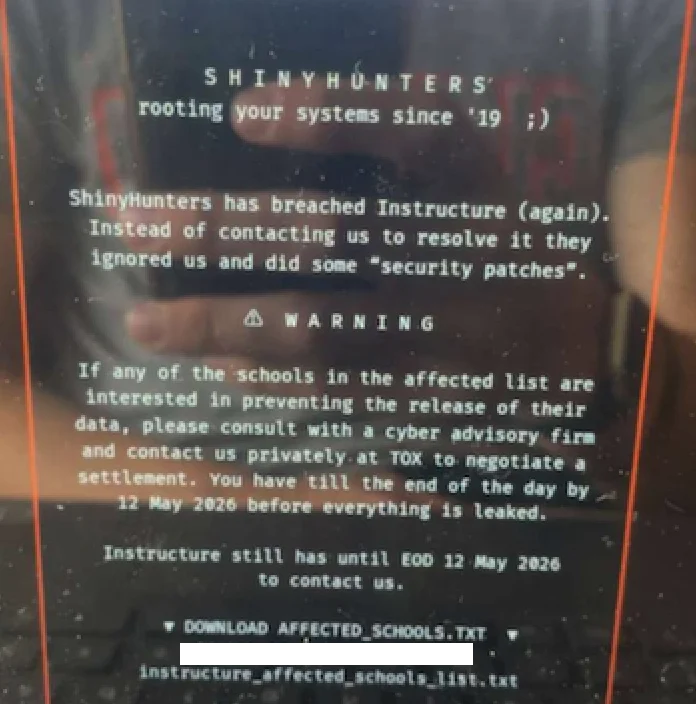
The narrative of "containment" collapsed on May 7. By midday, thousands of students and educators attempting to log into their coursework were met not with their assignment portals, but with a brazen ransom demand from ShinyHunters. The message mocked Instructure’s previous security efforts, claiming that their attempts at "security patches" were insufficient. Faced with the public defacement of their primary product, Instructure was forced to pull the platform offline, replacing the login page with a generic "scheduled maintenance" notice—a decision that drew sharp criticism from cybersecurity professionals.
The Resolution: May 11 Payment
Following days of instability and mounting pressure from affected institutions, Instructure confirmed on May 11 that it had entered into negotiations with the extortionists. In a move that highlights the ongoing dilemma of ransom payments, the company revealed it had paid the hackers in exchange for a promise to destroy the stolen data, claiming they received "digital confirmation" of the data’s deletion.
The Anatomy of the Attack: A Persistent Threat
ShinyHunters is characterized by its reliance on social engineering and human-centric exploits rather than brute-force technical vulnerabilities. The group’s signature, as seen in their recent breach of ADT, often involves voice phishing (vishing) attacks against employees, effectively bypassing multi-factor authentication by compromising SSO (Single Sign-On) credentials.
In the case of Canvas, the exploit centered on "Free-for-Teacher" accounts. These accounts, designed to lower the barrier for entry into digital learning, became the weak link in the chain. As Instructure later admitted in its incident updates, the attackers repeatedly exploited this specific vector, demonstrating a deep familiarity with the company’s internal architecture.
Dipan Mann, CEO of the security firm Cloudskope, provided a damning assessment of the company’s response. "The September 2025 Penn breach was the proof of concept," Mann wrote in a widely cited analysis. "The May 1, 2026 incident was the production run. The May 7 re-compromise was ShinyHunters demonstrating publicly that the May 2 ‘containment’ did not happen."
Official Responses and Corporate Transparency
The communication strategy employed by Instructure during the crisis has become a focal point of industry scrutiny. By labeling a forced, reactive shutdown as "scheduled maintenance" on their status page, the company inadvertently eroded the trust of the very institutions that rely on their services for mission-critical operations.
Instructure’s later updates were more candid. Following the May 7 outage, the company acknowledged the specific vulnerability within the "Free-for-Teacher" program and announced its temporary suspension. Furthermore, their May 11 statement regarding the payment of the ransom represents a controversial but increasingly common reality in modern cybersecurity: the prioritization of data recovery and the cessation of extortion over the long-term goal of denying criminals their payday.
"If your organization is affected, Instructure will contact your organization’s primary contacts directly," the company stated, urging schools to ignore third-party lists circulating on social media. This directive underscores the chaotic nature of the event, where misinformation often spread faster than official guidance.
Implications for the Education Sector
The Canvas breach serves as a watershed moment for the EdTech industry, raising three primary concerns that will shape the sector for years to come.
1. The Vulnerability of Aggregated Data
Educational institutions are increasingly reliant on centralized platforms to handle sensitive, granular data. When a single vendor acts as a "hub" for thousands of schools, it creates a massive target for threat actors. The Canvas incident demonstrates that a single security oversight at the vendor level can ripple across the entire country, affecting everyone from elementary schools to elite universities.
2. The Limits of "Containment"
The failure of Instructure to fully remediate the vulnerability after the May 1 breach suggests that traditional incident response frameworks are struggling to keep pace with agile, persistent groups like ShinyHunters. For IT departments at universities, this highlights the need for a "zero-trust" approach to third-party vendors. Institutions can no longer assume that a platform is secure simply because a vendor provides a clean audit or a status page with green checkmarks.
3. The Ethical and Financial Cost of Ransom
The revelation that Instructure paid the ransom to secure the deletion of student data brings the industry back to the "ransomware dilemma." While the payment may have prevented a public leak of billions of private messages and personal identifiers, it also validates the business model of cybercrime. Experts like Charles Carmakal of Mandiant Consulting note that such extortion campaigns are currently occurring at an unprecedented scale, and paying only ensures that these groups remain well-funded for their next series of attacks.
A Future of Heightened Scrutiny
As the dust settles, the long-term impact on Instructure remains to be seen. While the immediate threat of data exposure has been mitigated through payment, the reputational damage and the loss of consumer confidence are substantial. For the educational institutions that were caught in the middle, the event has prompted a broader audit of their software supply chains.
The ShinyHunters saga is a stark warning: in an era where education is digitized, the security of the classroom is inextricably linked to the security of the cloud. The question now facing boards of directors and university IT leaders is not whether another breach will occur, but whether they have the resilience to withstand it when it does. As the industry moves forward, the demand for transparency, robust multi-factor authentication, and a departure from the "path of least resistance" will become the new standard for survival in the digital age.